
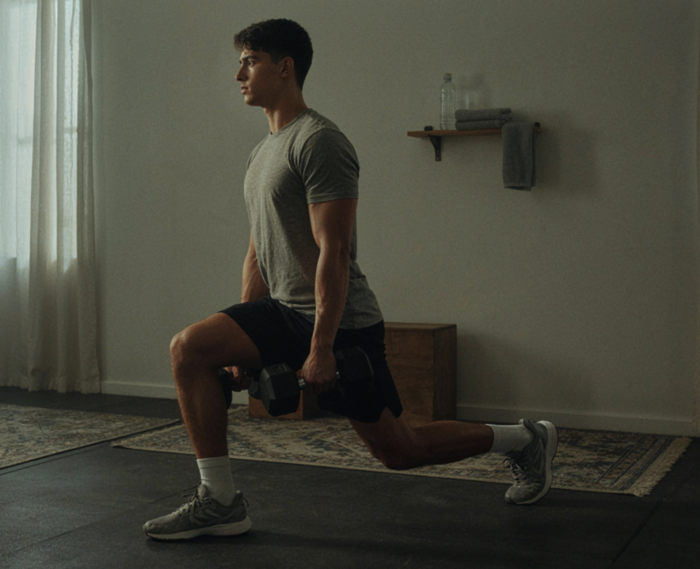
At a glance:
- The Bulgarian split squat is a single-leg exercise with your rear foot supported on a bench – it works your quadriceps and glutes while challenging your balance.
- As a beginner, start with your own body weight and learn to keep your back straight and your knee over your toes.
- Research shows that unilateral squat exercises produce strength gains comparable to bilateral squats while improving symmetry between the legs.
- Do 2–3 sets per leg, with 8–12 repetitions per set, 2 times a week.
The Bulgarian split squat can seem intimidating at first if you are a beginner – your balance feels unsteady and your muscles are working at unfamiliar angles. Yet it is one of the most effective lower-body exercises you can perform with minimal equipment. In this guide, you will learn how to master proper technique, avoid common mistakes and incorporate the exercise sensibly into your training plan.
Bulgarian split squat for beginners: what is it and why does it work?
The Bulgarian split squat – also known as the rear-foot elevated split squat – is a unilateral strength exercise in which your rear foot rests on a bench or raised surface while your front leg performs the squat. Unlike a conventional bilateral squat, it works one leg at a time, forcing your body to recruit more stabilizing muscles. The exercise strongly activates four muscle groups: the quadriceps (quadriceps femoris), the gluteus maximus (gluteus maximus), the biceps femoris (biceps femoris), and the calf and forefoot muscles to maintain balance.
Speirs et al. (2016) showed that unilateral squats produce strength gains comparable to bilateral squats while improving symmetry between the legs – an important benefit for beginners, as most people have one leg that is stronger than the other. To understand how squat variations differ and when to choose each one, read Squat, squat, squat, squat, squat, which offers a comprehensive overview of the squat family.
How do you learn the Bulgarian split squat step by step?
The best way to master the technique is in three stages. Do not rush to add weights – controlled movement with your own body weight matters more than a heavy training load.
Stage 1 – setting up your stance
Stand about one stride away from the bench, facing away from it. Place your rear foot on the bench so that the top of your foot (the instep) is supported, rather than your heel. Your front foot should be far enough forward that your knee does not move past your toes as you lower into the squat. To find the right distance, try a few repetitions without added weight and adjust your stride length as needed.
Stage 2 – lowering with control
Inhale and lower your body weight down and forward, keeping your back straight and your chest up. Let your front knee bend towards an angle of about 90 degrees – your thigh should become parallel to the ground. Your rear knee moves towards the floor at the same time but does not need to touch it. Keep 70–80% of your body weight on your front heel, rather than the ball of your foot.
Stage 3 – rising and breathing
Squeeze your glutes and drive through your front heel to stand up. Exhale as you rise. Keep the movement controlled – do not use a jumping motion or bend your back forward. One complete repetition takes approximately 2–3 seconds to lower and 1–2 seconds to rise.
It is worth comparing the technique with other unilateral variations: the Jefferson squat, for example, is an interesting alternative that develops coordination between the hip and back muscles in a completely different body position and can add variety for more experienced lifters.
McCurdy et al. (2005) found that participants achieved significant strength gains after 6–8 weeks of unilateral exercises, even without bilateral exercises – this proves that the Bulgarian split squat is entirely sufficient as a standalone training exercise.
What are the most common beginner mistakes in the Bulgarian split squat?
A stance that is too short – if your front foot is too close to the bench, your knee moves past your toes and compressive force on the knee joint increases sharply. The solution: lengthen your stance and check your knee position in a mirror or on camera.
Leaning your torso forward – this often results from limited ankle mobility or weak core muscles. Focus on keeping your chest up; if necessary, do dynamic calf stretches and warm-up exercises before your workout.
Slipping off the bench – socks on a smooth surface cause your rear foot to slip. Always wear athletic shoes and, if necessary, support your foot on a bench with a soft rubber covering.
Too much training load too soon – many beginners pick up dumbbells before they can perform the movement steadily with their own body weight. Practice with your own body weight for at least 2–3 weeks before adding weight for the first time.
Actively pushing off with your rear leg – in the Bulgarian split squat, your front leg should do all the work. If you feel the leg on the bench actively pushing, move farther away from the bench.
According to the Estonian Health Board’s physical activity recommendations, proper exercise technique and adequate recovery are paramount in strength training for managing cardiovascular strain and preventing injuries.
To better understand what different lower-body exercises actually train and how to combine them, read The upper-body squat – it explains how squat variations differ in their involvement of the core and upper body. Also worth reading is The deadlift is not a squat, which explains why you cannot lump all leg exercises together.
How often should beginners do Bulgarian split squats, and how much should they do?
The NSCA’s Essentials of Strength Training and Conditioning (Baechle & Earle, 2008) recommends that beginners train the same muscle group 2–3 times a week, allowing at least 48 hours for recovery. For the Bulgarian split squat, this means:
- Frequency: 2 times a week
- Sets: 2–3 sets per leg
- Repetitions: 8–12 repetitions per set (using your own body weight as a beginner)
- Rest between sets: 60–90 seconds
Once you have been doing the exercise for a few weeks and feel confident, you can add some light weights – 2–5 kg dumbbells in each hand are a good starting point. Progress slowly: increase the weight only when you can complete all sets with good technique.
References
- Speirs DE, Bennett MA, Finn CV, Turner AP. (2016). Unilateral vs. Bilateral Squat Training for Strength, Sprints, and Agility in Academy Rugby Players. J Strength Cond Res. 30(2):386–392. PMID: 26694507
- McCurdy KW, Langford GA, Doscher MW, Wiley LP, Mallard KG. (2005). The effects of short-term unilateral and bilateral lower-body resistance training on measures of strength and power. J Strength Cond Res. 19(1):9–15. PMID: 15705003
- Baechle TR, Earle RW, eds. (2008). Essentials of Strength Training and Conditioning. 3rd edition. Human Kinetics/NSCA.
Frequently asked questions
Is the Bulgarian split squat suitable for a complete beginner?
Yes, but start with just your body weight. First, master a stable stance and the correct movement pattern – spending 2–3 weeks without added weight is a perfectly normal way to start.
How high should the bench be for a Bulgarian split squat?
The ideal height is 30–50 cm, which is the height of a standard weight bench. A support that is too high puts excessive stress on the hip joint, while one that is too low makes the exercise less effective.
Do Bulgarian split squats damage your knees?
Not when performed correctly. The most common mistake is letting your knee move too far forward – keep your knee over your toes and your weight on your heels to keep the pressure on the joint within a safe range.
How deep should you go in a Bulgarian split squat?
Aim to bring your thigh parallel to the ground (with your knee bent at about 90 degrees). This may feel deep as a beginner – start at half that depth and increase your range of motion as your flexibility improves.
Can you do Bulgarian split squats at home without a bench?
Yes. Any stable raised surface will work – a sofa, a sturdy chair or the edge of a stair tread. The surface should not slide; place some rubber material underneath if needed.
Come and train! ArtGym




