
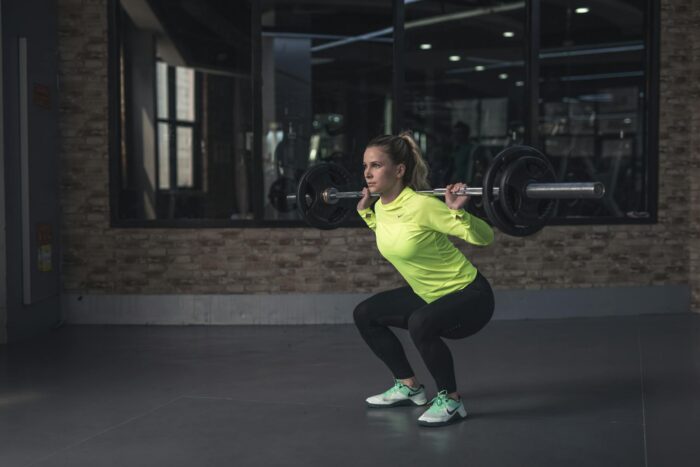
You burn calories when you move—burning calories at the gym
One thing that really makes me angry is when you keep explaining something to people and giving them the reasons behind it, yet the message still doesn’t get through. It’s like banging your head against a wall. No matter how hard you bang, you’re the only one who gets hurt, and the wall barely changes. Today’s topic is training at the gym to burn calories—if you move, you burn calories.
Let me say right away that if your goal is to maximize energy expenditure, conventional strength training is far from the best option. Of course, everything depends on exactly how you approach it, but the average hour-long strength training session most people have in mind doesn’t burn a particularly large number of calories. Beginners are particularly slow to grasp this, and often it’s women who are new to the gym.
People quite often come to me wanting to start going to the gym because they’ve accumulated a lot of fat on their thighs, developed a belly or gained inches around their waist. Once I’ve finished explaining the importance of nutrition and the need to significantly increase their daily calorie expenditure, most still insist on going to the gym. Unfortunately, what they then do there is anything but burn calories, even though I keep pointing out where they’re falling short.
Some seem to spend more time filling in their training logs than doing exercises. Others literally just come to hang around, fitting in the occasional set when they remember. Others do at least try, but their rest periods still tend to stretch to 4 – 5 minutes. This may sound harsh, but behaving like this and approaching your so-called goals this way is an absolute waste of time.
If, despite all this, you still want to use strength training specifically to burn calories, keep three key factors in mind: exercise selection, the length of your rest periods between sets and the duration of your sets.
Choose exercises that engage your whole body, working many muscles at once. If your goal is to reduce your body weight and you’re coming to work out with that goal in mind, you need to expend energy. If energy expenditure is the priority, there is absolutely no reason to do exercises such as standing side bends, sit-ups, barbell biceps curls or hyperextensions on a bench. It doesn’t work as simply as thinking, “I want visible abs, so I’ll do abdominal exercises,” or “I want smaller love handles, so I’ll do side bends,” and so on. Do what burns calories, what works and what gets results.
In some ways, losing weight is like a sculptor’s work. When a sculptor starts carving a figure out of stone, it’s as though the figure is already there inside the block. All they have to do is remove the excess, and the finished sculpture emerges. Weight loss is similar in a way. In many cases, a shapely physique—even those much-coveted abs—is already there, but to reveal a slim body, attractive contours and all that beauty, you need to remove the excess covering it. To remove it, you need to expend energy.
The best exercises for burning calories:
Thruster
Click here…
Squat and all its variations
Click here…
Deadlift and all its variations
Click here…
Lunges
Click here…
Burpees
Click here…
Tire flips…outdoors in summer
Click here…
Sled drags…outdoors in summer
Click here…
Kettlebell swings
Click here…
Pull-ups
Click here…
Jumping rope
Click here…
…and of course, there are more!
The fact is that the activities I’ve listed are hard, and most people find them very unpleasant. But remember: when it comes to exercises, the harder they are, the more effective they are. If something is easy, it puts no strain on your body and presents no challenge; you don’t have to make an effort or expend energy.
How many calories you burn depends on how long you rest between sets. So here’s a message for everyone looking to reduce their body fat percentage through gym training specifically. Unfortunately, people typically fail to grasp the importance of rest periods at all. The facts are that if your goal is to burn calories, even a 30 – 40 second delay or extension of a rest period significantly reduces calorie expenditure. Rest periods should be 45 – 60 seconds if your goal is to burn calories and strength training is the only physical training you do during the week. If you also do cardio in addition to your gym workouts, things are, of course, somewhat different.
A woman weighing 45 – 50 kg burns an average of around 250 – 510 kcal in an hour at the gym
250 kcal (90 seconds between sets)
380 kcal (60 seconds between sets)
510 kcal (40 seconds between sets)
A man weighing 95 – 100 kg burns an average of around 550 – 1120 kcal in an hour at the gym
550 kcal (90 seconds between sets)
836 kcal (60 seconds between sets)
1120 kcal (40 seconds between sets)
So, as you can see, if you are a woman weighing 50 kg, you can easily structure your strength training so that you burn very little in an hour. In the worst case, you will burn off only the equivalent of one 250 gram tub of vanilla quark in that hour. With the right rest periods, however, you could burn twice as many calories. Obviously, with rest periods of 40 – 50 seconds, you will not be lifting particularly heavy weights, but try doing two sets of 15 – 20 repetitions of squats, even with an empty barbell, with just 45 – 50 seconds of rest between sets. It is no walk in the park. The truth is, though, that this is one of the few approaches that work in the gym for someone looking to lose weight and burn calories.
Many people see the gym as a way to reduce their body weight. I have always said that if weight loss is the priority, the gym alone is not the best solution for the average person. You can certainly get your body fat percentage under control through strength training and nutrition alone, but that takes consistency, a solid understanding of what you are doing and the relevant knowledge. The average person, however, usually lacks these qualities. With images of elite bodybuilders from magazines or the internet in mind, people think, “If they got that firm and lean by going to the gym, perhaps I should be doing that kind of training too, given my protruding belly and all?” When people come to me wanting to get into shape specifically at the gym, what I usually read between the lines is that they think strength training does not require “that much” effort and that they can get fit “fairly easily”.
Of course, I could be wrong, but I think many people trying to lose weight gravitate towards the gym because they subconsciously feel that strength training is not as hard as it initially seemed, or as hard as, say, rowing continuously on a rowing machine for half an hour or running for 45 minutes. And it is true: strength training is not hard the way most novices and beginners tend to do it on their own. The weights are barely worth mentioning, they lack the ability to push themselves, and without reminders, their rest periods tend to stretch to 5 – 6 minutes, without exaggeration. Stand beside them for a couple of workouts in a row and have them do just two or three sets of 25 – 30 bodyweight squats with 45 – 60 seconds of rest, and they soon become less enthusiastic about burning calories at the gym. Unfortunately, that is precisely what works when the goal is to burn calories.
Sets should be relatively long. Aim mostly for sets of 20 – 50 repetitions, but at times, do not be afraid to take your sets up to even 100 repetitions for certain exercises. This does not apply in every situation, far from it. Any professional reading this will know that it would be foolish to state categorically that sets must be long. But I am talking about an ordinary person who comes to the gym intending to lose weight. Someone whose only goals are weight loss and energy expenditure, and for whom these strength training sessions two/three times a week are their only substantial physical activity.
Why does running burn so much energy? Because much of your body is working at once, often continuously. You can think of a run as one very long set. The longer your sets and the shorter your rest periods, the more your strength training starts to resemble running in some respects (or any other form of endurance training). If you approached running the way you approach the gym, taking 12 – 15 running strides followed by 1 – 2 minutes of rest, you would not burn even half as much energy as you do when running continuously (and running burns a lot). That is why, if your goal is to burn calories at the gym, you need to make your strength training as similar as possible to continuous, steady-state endurance training. The only difference is that you are doing it using weights, which means you still need some minimal rest between sets. Otherwise, the total training load on your body and the duration of your workout would be too low and too short, respectively, preventing you from achieving the desired training effect.
Finally, of course, the ultimate result of your efforts also depends on what you eat. What you eat, how much you eat and when you eat. Without monitoring and adjusting your diet, all the work and effort you put in at the gym will very likely fail to deliver results!
Author: Janar Rückenberg
Come and work out! ArtGym




