
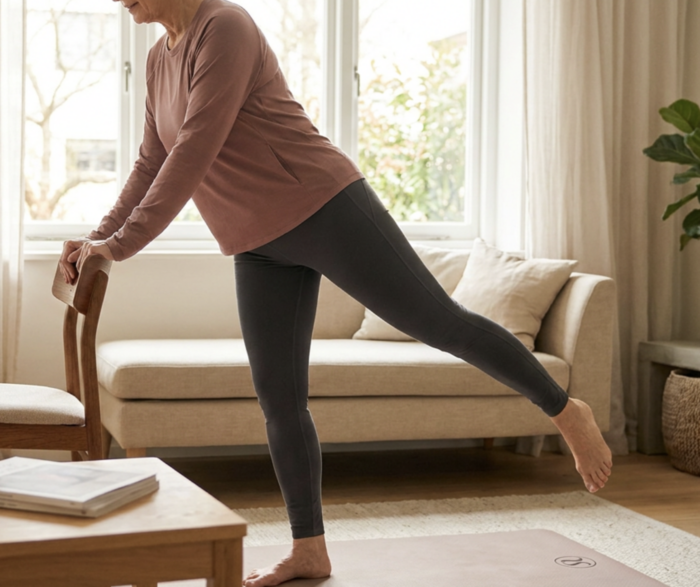
In brief:
- Exercises for seniors at home should combine leg strength, balance and everyday movement patterns.
- The best way to start is simple: standing up from a chair, heel-to-toe walking, wall-supported calf raises and controlled steps.
- The training load should be noticeable but not painful; if your balance is unsteady, or after a fall or new pain, it is worth involving your family doctor or a physiotherapist.
Exercises for seniors are not just gentle gymnastics but purposeful work to maintain muscle strength, balance and independent living. In older age it becomes especially important to train the movements you use every day: standing up, walking, turning, stepping as you would on stairs, and lifting objects. This guide offers an evidence-based framework for training at home that suits getting started and can be adapted to how you feel and your health status.
How do exercises for seniors at home build balance and strength?
Strength and balance training work best when they are tied to real-life movements. Standing up from a chair trains the thigh and glute muscles, calf raises support ankle control, a side step helps stabilize the hip, and heel-to-toe walking tests how well you transfer your body weight.
With sarcopenia, it is not only a question of muscle mass. EWGSOP2 emphasizes that low muscle strength is the central feature in the approach to sarcopenia, and that physical performance helps assess how severe the condition is (Cruz-Jentoft, 2019). That is why a home program should include both strength exercises and tasks that challenge balance.
The WHO approach to healthy ageing links physical activity to functional ability, not just athletic shape. You can find practical background on the WHO page Healthy ageing and functional ability. The same idea runs through the Fitness.ee article Why strength training is vitally important for seniors, which looks at strength training from the perspective of independence and coping with daily life.
Which balance exercises are suitable for seniors at home?
Start with exercises that have a firm support next to you: a kitchen counter, a heavy table or a wall. A good home option is the semi-tandem stance, where one foot is slightly in front of the other; from there you can progress to the heel-to-toe stance and to slow heel-to-toe walking. If your balance wobbles, keep your fingertips on the support rather than forcing yourself to let go.
In fall-prevention studies, the effects have been better in programs that genuinely challenge balance and include enough training volume; among older people living in the community, an exercise program reduced the rate of falls by roughly a fifth, and greater benefit was seen in balance-challenging programs whose volume exceeded three hours a week (Sherrington, 2017). That does not mean a beginner has to do that much right away. It means balance improves with consistent, sufficiently challenging practice.
A home mini-block could look like this: stand next to a support with your feet together, do slow side steps, rise onto your heels, step forward and back, and finish with a calm walk. At first, each exercise could last just a short set, and you should increase repetitions and duration only once the movement stays under control (Chodzko-Zajko, 2009).
Which strength exercises for seniors are the most practical?
The most useful home strength exercises are those that improve standing up, walking and carrying objects. Standing up from a chair is the first choice: sit on the front edge of the chair, keep your feet firmly on the floor, lean your torso slightly forward and stand up in a controlled way. If you need to, use your hands, but the goal is to reduce the help from your arms over time.
The second core exercise is a half squat done with the support of a wall or a chair. The range of motion does not need to be large; what matters more is that your knees move in the direction of your toes and your heels stay on the floor. The third exercise is the calf raise, which helps walking and balance because the ankle is involved in every step. The fourth is the hip thrust or glute squeeze lying down, which suits those who find squats uncomfortable at first.
The ACSM position statement stresses that older adults gain adaptations from strength and endurance training, and that the choice of training must take into account health status, functional level and a gradual increase in training load (Chodzko-Zajko, 2009). In practice, this means you can start with one to two strength sets per exercise and perform the movements to moderate effort, not to pain or breathless exhaustion (Chodzko-Zajko, 2009).
If you need a broader guide to setting up a home training environment, it is worth reading Why and how to work out at home and How to work out smartly at home alongside this article. They help you think about space, routine and habit, which are just as important in training for seniors as the list of exercises.
How often should a senior train balance and strength at home?
A good goal is to do strength and balance work on several days of the week, leaving room for recovery between the harder strength days. ACSM describes combining endurance, strength, mobility and balance in training for older adults and stresses individual adaptation (Chodzko-Zajko, 2009). WHO recommendations for older adults likewise support multicomponent physical activity, in which balance and strength play a central role in reducing the risk of falls.
A home week could look like this: strength exercises on one day, lighter walking and balance work the next, then strength again, and finally a longer stretch of calm movement. If you have no previous training experience, it is better to do less but do it consistently. Someone who is already active can add a slower tempo, a deeper range of motion or a small amount of extra weight, such as a water bottle.
It is important to tell the difference between muscle work and warning pain. Fatigue in the thigh or glute muscles after standing up from a chair is to be expected. Sharp joint pain, dizziness, chest pain or new shortness of breath are not a normal part of training. In that case, stop the exercise and, if necessary, seek medical advice.
How can you make home exercises for seniors safe and consistent?
Safety starts with your surroundings. Remove loose rugs, leave enough space in the training area, use a sturdy chair and avoid slippery socks. It is a good idea to keep your phone close by, and for the first few sessions it makes sense to practice when someone else is at home.
To increase the training load, change one variable at a time: add a few repetitions, lower yourself more slowly, hold the balance position longer, or reduce the support from your hands. Don’t change everything in the same week. Studies on strength training in older adults show that resistance exercises can improve strength and physical performance even in people with sarcopenia or frailty, but the interventions vary, and the outcome depends on consistency, training load and the person’s baseline capacity (Lopez, 2021; Chen, 2021).
It helps to stay motivated if you tie your exercises to your daily rhythm: standing up from a chair after your morning coffee, calf raises in the kitchen while the water boils, a balance exercise before a walk. For an inspiring story about moving at home, you can also read Bronze Age woman back home, but your training plan should always be based on your own capacity.
In short, home training for seniors should be simple, repeatable and measurably progressive. The best program isn’t the most complicated one, but the one that is done regularly, safely and with enough effort.
References
- Chodzko-Zajko WJ, Proctor DN, Fiatarone Singh MA, Minson CT, Nigg CR, Salem GJ, Skinner JS (2009). American College of Sports Medicine position stand. Exercise and physical activity for older adults. Medicine & Science in Sports & Exercise. PMID: 19516148. DOI: 10.1249/MSS.0b013e3181a0c95c
- Cruz-Jentoft AJ, Bahat G, Bauer J, Boirie Y, Bruyere O, Cederholm T, Cooper C, Landi F, Rolland Y, Sayer AA, Schneider SM, Sieber CC, Topinkova E, Vandewoude M, Visser M, Zamboni M (2019). Sarcopenia: revised European consensus on definition and diagnosis. Age and Ageing. PMID: 30312372. DOI: 10.1093/ageing/afy169
- Sherrington C, Michaleff ZA, Fairhall N, Paul SS, Tiedemann A, Whitney J, Cumming RG, Herbert RD, Close JCT, Lord SR (2017). Exercise to prevent falls in older adults: an updated systematic review and meta-analysis. British Journal of Sports Medicine. PMID: 27707740. DOI: 10.1136/bjsports-2016-096547
- Lopez P, Pinto RS, Radaelli R, Rech A, Grazioli R, Izquierdo M, Cadore EL (2021). Benefits of resistance training in physically frail elderly: a systematic review. Sports Medicine. PMID: 33921356. DOI: 10.1007/s40279-021-01437-0
- Chen N, He X, Feng Y, Ainsworth BE, Liu Y (2021). Effects of resistance training in healthy older people with sarcopenia: a systematic review and meta-analysis of randomized controlled trials. European Review of Aging and Physical Activity. PMID: 34763651. DOI: 10.1186/s11556-021-00277-7
Frequently asked questions
Are exercises for seniors suitable even if I haven’t trained before?
Yes, as long as you start with simple, supported movements and increase the training load slowly. If you have medical conditions, a history of falls or unsteady balance, it’s worth asking your family doctor or physiotherapist for advice first.
Should I do balance exercises every day?
Short, safe balance exercises can be done often, but if you feel tired or unsteady, reduce the volume. Good control matters more than long duration.
Which home strength exercise is the most important?
Standing up from a chair is highly practical, because it’s directly linked to everyday independence. You can make it easier by using your hands for help, or harder by lowering yourself more slowly.
When should I stop a workout?
Stop the workout if you have sharp pain, dizziness, chest pain, new shortness of breath or a sudden worsening of your balance. These are not normal sensations during training.
Come and train! ArtGym




