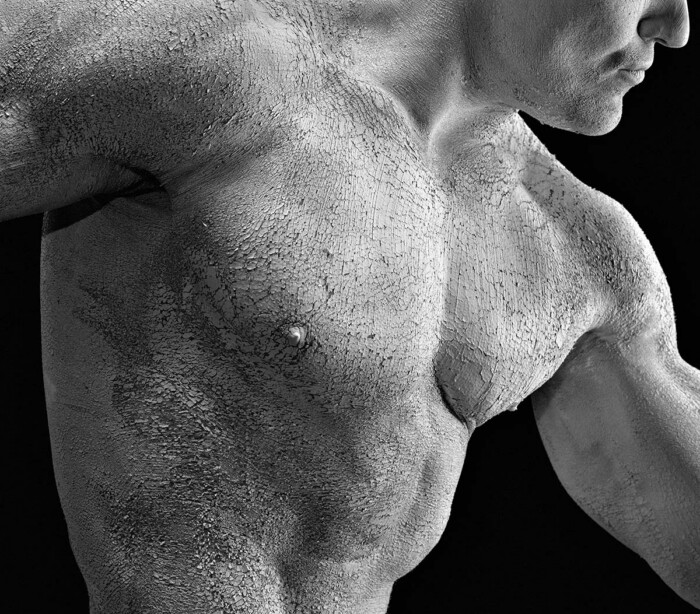
Fitness = philosophy
Why real training begins before the first rep
For some people, fitness simply means getting into better shape. A smaller waist. More defined abs. Bigger biceps. More steps on their watch. Fewer calories on their plate.
Then there are those who eventually realize that fitness is not really a project to transform your body.
It is a way of seeing the world.
Fitness is more than an activity. Fitness is a philosophy.
It is about more than going to the gym. It is about how you relate to yourself, time, pain, discipline, aging, comfort, goals and even death.
Because ultimately, training shapes more than your muscles.
It shapes who you are.
The body as your first home
The modern world teaches you to live mainly in your head. Think faster. Consume more information. React faster. Stay connected at all times.
But you are not built just to think.
You are built to move.
The ancient world already understood this. The ancient Greeks did not separate physical and mental development. A strong body and a strong mind were two halves of one whole. The Greek ideal was not simply an educated person, but a balanced one.
Eastern philosophies have also spoken of the same principle for centuries: body and mind are not opposites. They are one system.
When the body deteriorates, thinking begins to deteriorate too.
When you lose touch with your physical self, you often lose your inner stability as well.
It is no coincidence that regular training improves not only physical health, but also confidence, stress tolerance, concentration and emotional resilience.
Movement is not a luxury for human beings.
It is a biological need.
Discipline as the highest form of freedom
Paradoxically, many people believe that discipline limits freedom. In reality, the opposite is usually true.
If you cannot control your habits, impulses or body, you are not truly free. You are constantly reacting to your environment. To fatigue. To cravings. To comfort. To fear.
Fitness teaches you something much deeper than exercise technique.
It teaches you how to manage yourself.
Every workout involves a small philosophical conflict:
- whether to choose comfort or growth,
- whether to give up or keep going,
- whether to look for excuses or take responsibility.
The struggle beneath the barbell is not just physical.
It often brings you face to face with yourself.
Status, money and your social media image are no help there.
The barbell does not care about your ego.
That is precisely why training has such a cleansing effect. It strips away illusions. It shows you where you really stand — both physically and mentally.
The role of pain in personal growth
Modern society teaches you to avoid discomfort at all costs. Fast transport. Fast food. Instant entertainment. Instant dopamine.
But human nature does not develop through comfort.
All meaningful growth involves some form of effort.
Training is one of the few activities in modern life in which you deliberately choose difficulty.
It is an interesting paradox:
you pay money to experience controlled suffering.
Why?
Because deep down, you sense that effort gives life meaning.
That the ability to endure hardship builds an inner strength you cannot buy.
Training teaches you:
- delayed gratification,
- patience,
- consistency,
- humility,
- endurance.
These qualities eventually carry over into every area of life.
Often, fitness changes your life not because you become more physically attractive, but because you begin to respect yourself more.
Fitness as resistance to the modern world
The modern world is built around maximizing convenience and fragmenting our attention.
Fitness runs almost entirely counter to that logic.
Training demands:
- focus,
- consistency,
- patience,
- routine,
- being present.
These qualities are becoming rarer with every passing year.
That is why fitness is more than a hobby.
In some ways, it is an act of cultural resistance.
When you take care of your body, you are implicitly saying:
- I do not want to live purely on impulse,
- I do not want to become passive,
- I do not want to give up responsibility for myself.
A strong body is about more than aesthetics.
It means the capacity to work. Vitality. Independence. The ability to enjoy a good quality of life as you grow older.
In an aging society, this matters more and more.
Muscles as a byproduct
Interestingly, many people who have trained for years eventually reach the same conclusion:
the best thing about fitness is not how you look.
It is how you feel within yourself.
A calmer mind.
Clearer thinking.
Greater energy reserves.
A better ability to cope with stress.
Greater self-control.
Muscles may be the visible result, but the real change happens somewhere you cannot see — in your identity.
Training becomes a ritual.
Something that helps you stay true to yourself, even in a chaotic world.
True fitness does not end at the gym
At its most mature, fitness culture is not about extremes.
Nor obsession. Nor feeding the ego.
True fitness means balance:
- strength without arrogance,
- discipline without fanaticism,
- ambition without self-destruction.
It means understanding that your body is more than just your “appearance”: it is what carries you through life.
And perhaps the deepest purpose of fitness is very simple:
to keep you strong enough to live your life to the fullest.
Because, ultimately, it is not just about how much you lift.
It is about how you live.
Idea: ArtGym
Illustrative photo: Kaupo Kikkas
Come work out! ArtGym