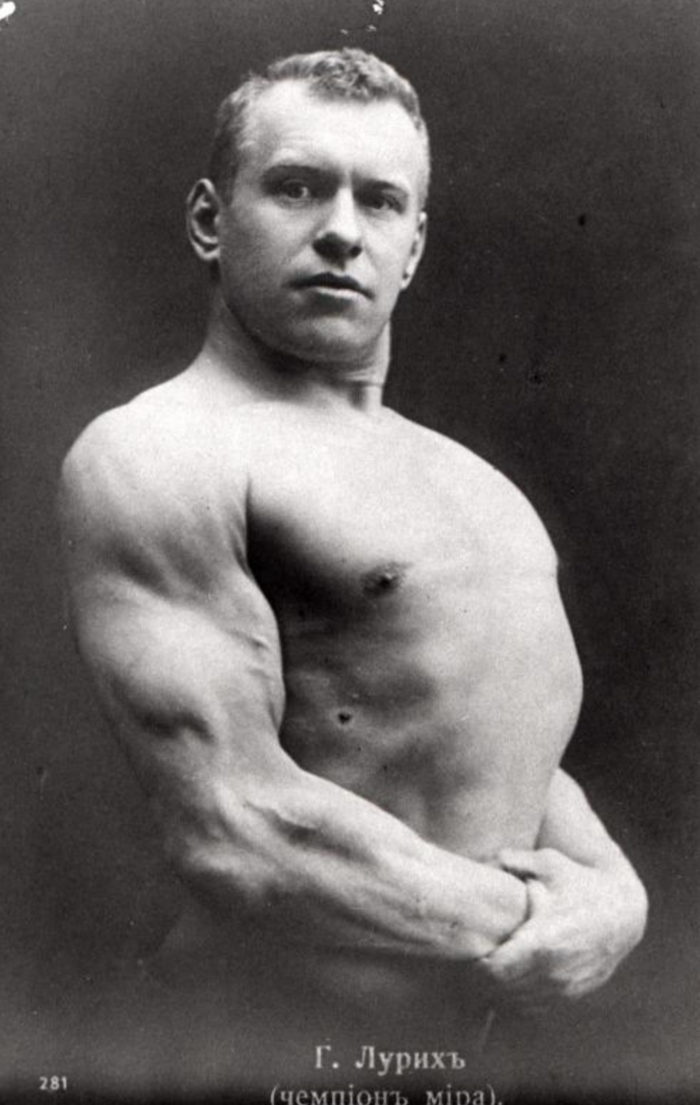
Lurich: the story of Estonian strength and wrestling
Georg Lurich was born on 22 April 1876 in Väike-Maarja, in Virumaa. This is the story of how a sickly schoolboy grew into a man whose name became a symbol of strength, wrestling and self-belief in Estonia.
Georg Lurich was far more than a strong man on a stage. He traveled from town to town, lifted heavy weights, wrestled the best opponents and convinced people that the body can be trained as consistently as the mind.
Why Lurich matters in Estonian sports history
As a child, Georg was a strong boy, but a severe illness left him frail. When he started at the Tallinn Realschool at the age of ten, he was excused from gymnastics because his teachers thought he looked too weak. That is exactly what makes his story so telling: the future strongman did not start out as a legend, but from quite ordinary weakness.
Toward the end of the century before last, heavy athletics began to grow rapidly in Europe. Professional strongmen moved from town to town, showing audiences weightlifting, wrestling and feats of skill. These performances made a strong impression on the young Lurich. He decided to become strong, very strong.
The beginning was simple. He wrestled boys who were stronger than he was, lifted stones and weights, and tried everything that built strength. By the age of fifteen he was already training systematically. In Tallinn he joined the first Estonian heavy athletics circle, founded in 1888 by Gustav Boesberg.
By the end of his school years, the frail boy had become a strong young man. In Tallinn and around Väike-Maarja he was already known as a strongman. When Dr. Wladyslaw Krajewski, known as the father of Russian heavy athletics, invited Lurich to show what he could do, his real rise began.
How Lurich grew into a strongman
On his very first evening at Dr. Krajewski’s heavy athletics club, Georg Lurich set a couple of world records in weightlifting. He then defeated the club’s best wrestlers in French wrestling, which we now know as classical wrestling. Krajewski advised him to go home for a while longer and practice Swiss belt wrestling.
In the autumn of 1895, Georg Lurich came once more to the capital of Tsarist Russia. He beat the best amateur wrestlers in both classical wrestling and Swiss belt wrestling. After studying under Wladyslaw Pytlasinski, he joined the ranks of professional athletes in the summer of 1896. At the time, that was the path that led to the best opponents and the greatest results.
In 1896–1898 he performed mainly in St. Petersburg and Tallinn. He beat every opponent in wrestling and set Russian and world records in weightlifting. He was given the titles of Russia’s top wrestler and Russian champion athlete. Because he was especially strong when lifting with one hand, he was also called world champion in one-handed lifting.
In January 1896 he performed a lift that shows well the measure of strength in his era. He jerked a 112 kg barbell overhead with two hands, shifted it onto his right hand, picked up a further 37 kg kettlebell from the floor and pressed that overhead as well. In total, 149 kg was above his head. At the time, it was the third-best result in the world.
In the summer of 1897, Lurich performed in towns in southern Russia. He beat opponents in wrestling and amazed audiences with his strength acts. For example, he lifted a horse together with its rider on his back. In the port towns of the Black Sea he also beat Ivan Poddubny, in whom he immediately saw a wrestler of great promise.
In May 1898, newspapers wrote that Georg Lurich had founded a school of strength shows and wrestling in Sevastopol. What became of that school is not known. But the report alone shows that he did not want to be only a performer. He wanted to teach and to spread heavy athletics.
Lurich and the self-belief of the Estonian people
Until the summer of 1899, Georg Lurich performed in Tartu, Valga, Viljandi, Pärnu, Narva, Rakvere, Väike-Maarja, Tallinn, Kuressaare, Haapsalu, Vana-Vändra and elsewhere in Estonia. He also visited Riga and northern Latvia. The reception was fiery everywhere.
Folk strength contests had long been known in Estonia, but this was not yet sport in the modern sense. Lurich’s influence was different. He presented training as a deliberate pursuit. He invited the strongest local men to compete, had them test themselves against him and rewarded the winners with silver coins.
In Valga, the man from Sangaste, Jaak Karu, won Lurich’s silver coin. The shoemaker Gustav Järv also did well in lifting. In Viljandi, Jüri Laan, Aleksander Laur, Joosep Sprinkovski and others competed for his prize. In Narva the enthusiasm was especially great: instead of the planned five shows, there were nine.
In Narva, the blacksmith Kaalep, the locksmith Neelus from the Kalev factory and others competed against him. Mihkel Neelus won a silver coin inscribed: To the first strongman of the city of Narva, in memory, from G. Lurich, 4 XII 1898.
In Narva, Lurich also stepped forward as a speaker for the first time. He spoke vividly and plainly. He promoted heavy athletics, a sober way of life, training, wrestling techniques and tactics. Frankly, it was more than sport. It was a call to build yourself up.
Lurich’s name became a symbol of strength among Estonians. Amid the pressure from the Baltic estate owners and the nationalities policy of the tsarist government, he was seen as a national hero. He was called Kalev and Kalevipoeg. He embodied the idea that an Estonian, too, can do great things.
When Georg Lurich began training systematically in 1891, he stood 150 cm tall and weighed about 50 kg. Abroad, this later aroused suspicion: how could such a slight man beat the stout, world-famous athletes of the day? The answer was technique, consistency and the ability to use his body well.
Competition tours, records and the death of Georg Lurich
A new chapter began in the autumn of 1899. Georg Lurich set out on a longer competition tour of Western Europe. Austria-Hungary, Germany, Belgium, Denmark, Sweden, Norway, Holland and Germany again made up his first big tour. Everywhere he went, he captivated audiences with his strength, wrestling and lifting technique.
In almost every major city he set world records in lifting and beat the local champions. The only one he could not defeat was the Turkish giant Nurlah, who stood over two meters tall and weighed nearly 170 kg. Lurich took him down to the mat, but could not pin him.
In Magdeburg he set a record of a kind: in 38 minutes he pinned the 18 best wrestlers from Magdeburg and the surrounding area, one after another. His tally of world records rose to about twenty. At the Hercules heavy athletics club in Rotterdam he was given the title of Strongest Athlete of Our Time.
In January 1901, the world championships in classical wrestling were held in Hamburg. There were several dozen participants. Georg Lurich took first place and the world champion’s title. Among those he beat were Constant le Boucher, Gabriel Lassartesse-Bordeaux, Paul Pons, Aimable de la Calmette, Heinrich Weber and others.
From 1901 onward, it is hard to give an exact account of his competition tours. He travelled across Europe and Tsarist Russia. Around 1903, Georg Lurich focused mainly on wrestling, although in training he carried on lifting weights. By then his lifting records were said to number three dozen, or 36.
In the autumn of 1912, Lurich travelled to the United States with his best pupil, Aleksander Aberg, to try freestyle wrestling. After a few weeks of getting to know American freestyle wrestling, also called catch as catch can, he beat a number of the local wrestling celebrities. The only one he lost to was Frank Gotch.
In 1917, Lurich and Aberg made their way back to Russia via China. They first competed in Petrograd, then in Tallinn. In 1918 they performed in Petrograd again and then in southern Russia. Georg Lurich’s death came on 22 January 1920 in the city of Armavir in the Caucasus, when he died of typhus. Aleksander Aberg followed him on 15 February.
Lurich in numbers: famous lifts
At the age of 21, Georg Lurich performed the following lifts. These numbers are worth singling out, because they show just how great his strength was for his time.
- Right-arm snatch without dropping under the weight, 65.5 kg.
- Right-arm jerk 112.5 kg, 1 rep.
- Right-arm jerk 104.25 kg, 2 reps.
- Right-arm jerk 100 kg, 3 reps.
- Two-arm lift lying on his back, 156 kg, which he then took onto his right arm.
- Two-arm push lying on his back, 164 kg, 1 rep.
- Two-arm push lying on his back, 160.75 kg, 2 reps.
- Two-arm push lying on his back, 133.75 kg, 8 reps.
- Standing, he jerked 115 kg with both arms, took it onto his right arm and pressed another 39 kg overhead with his left, 154 kg in total.
- Holding 82 kg overhead with his right arm, he lowered himself to the floor and stood up again.
- Sitting on the floor, he grabbed an 82 kg kettlebell from behind his back and stood up.
At the same time, Lurich could jerk about 70 kg overhead with his right arm 20 times in a row. Some of Lurich’s lifting results from 1903 are also known.
- Right-arm press 96 kg.
- Two-arm press 85 kg, 24 reps.
- Right-arm snatch without dropping under the weight, 78 kg kettlebell.
- Right-arm snatch 70 kg, 12 reps.
- He snatched a 50 kg kettlebell overhead with his right arm and, holding it there, snatched a second kettlebell of the same weight overhead with his left.
- Right-arm jerk 121 kg, 1 rep.
- Right-arm jerk 100 kg, 6 reps.
- Right-arm jerk 90 kg, 10 reps.
- Right-arm jerk 81.5 kg, 15 reps.
- He jerked 112 kg with his right arm and tossed it overhead from one hand to the other.
- With his right arm, he slowly curled a 70 kg kettlebell from the floor to his chest using biceps strength.
- Left-arm jerk 109 kg.
- Two-arm jerk 165 kg.
- He jerked 140 kg with both arms, then took it onto his right arm overhead.
- He jerked 128 kg with both arms, then took it onto his right arm overhead and pressed another 37 kg kettlebell with his left, lifting 165 kg overhead in total.
- Two-arm press lying on his back, 164 kg.
- Two-arm push lying on his back, 201 kg.
- Lying on his back, he pushed 150 kg up with both arms, took it onto his right arm and pressed another 36 kg kettlebell with his left, 186 kg in total.
- Lying on his back, he pushed 187 kg up with both arms and then held it on his right arm.
- Lying on his back, he leg-pressed a 164.5 kg bar 30 times.
- Lying on his back, he leg-pressed a 115 kg bar 100 times.
- Holding 50 kg kettlebells in his outstretched arms overhead, he did a deep squat.
- Holding an 85 kg bar in his outstretched right arm overhead, he lowered himself to the floor and stood up.
Lurich also excelled at pressing in the wrestler’s bridge. His famous bridge held a 50-pood weight. He also performed lifts with live weights, for example raising seven grown men with his right hand. Around 1910, he still held nearly 20 records.
An article in the 1907 newspaper Sõna described how, on Wednesday, July 7, in St. Petersburg, a contest was held in front of spectators between the best American strongman, Louis Cyr, and Lurich. Lurich lifted 10 poods 10 pounds with his legs 25 times, while Cyr pushed up 9 poods 15 pounds 17 times. Lurich then stood in the bridge and held the weight of four men, 21 poods, on his chest. He also threw a 7-pood iron bar into the air and let it fall onto his neck.
Later, Lurich invited journalists to Lebedev’s heavy athletics club after rumors spread that he no longer had the strength people talked about. One attendee wrote that there was no bar heavier than 7 poods 30 pounds at hand. Lurich pushed it up like a walking stick and then demonstrated the strength of his bridge once more. The pood was an old Russian unit of mass: 1 pood = 40 pounds = 16.381.
FAQ: Lurich in brief
Who was Georg Lurich?
Georg Lurich was an Estonian strongman, wrestler and great popularizer of heavy athletics. His performances helped raise interest in Estonia in wrestling, lifting and deliberate training.
When and where did Georg Lurich die?
Georg Lurich died of typhus on January 22, 1920, in the city of Armavir in the Caucasus. His student Aleksander Aberg also died, on February 15.
Was Jüri Lurich his relative?
Jüri Lurich is not mentioned in this original story. What is mentioned is Jüri Laan, a farmhand who competed for the Lurich prize in Viljandi. The names can get mixed up in searches, but here we are talking about Georg Lurich.
Author: Marek Morozov
Source: WHO – physical activity.
Come and train! ArtGym