
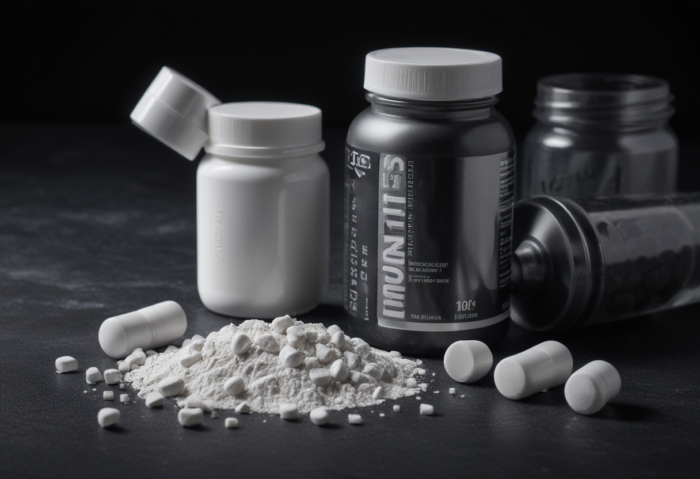
The supplement bodybuilders probably revere most is an amino acid called glutamine. Lately, though, there has been talk that casts doubt on its effects. Let’s see how things really stand.
Glutamine supplements were supposed to speed up recovery, strengthen immunity, protect against overtraining and preserve muscle mass during a diet. No wonder bodybuilders treat it as a given in their supplement arsenal. But do these promises hold up?
What glutamine is and why the body needs it
Glutamine is a nonessential amino acid — the body produces it on its own. But when stress levels are high (injury, inflammation, hard training), demand can grow so large that the body can no longer produce enough. At that point it becomes conditionally essential, and the shortfall has to be made up through food.
Glutamine is the most abundant amino acid in muscle and in the bloodstream, but it gets used up very quickly. The reason is simple: many metabolic processes depend on it directly or indirectly. Intestinal cells alone absorb about 40% of the body’s total supply. It is the main fuel of the immune system, a building block of the antioxidant glutathione and a regulator of acid-base balance. It is also needed for the synthesis of other amino acids and of muscle protein.
Does glutamine build muscle mass?
Several studies have shown that glutamine supplementation protects muscle tissue in severe catabolic situations — burns, major surgery. In healthy athletes, the story is different.
In one trial, experienced strength athletes were given either glutamine (0.3 g per kg of body weight), glycine or a placebo. An hour later they performed two sets of leg press with a load of twice their body weight and two sets of bench press with a load equal to their body weight. The rep count was the same in every condition — glutamine did not add any strength.
In another study, healthy participants took 0.9 g of glutamine per kg of lean body weight daily for six weeks alongside strength training. The training itself added both muscle mass and strength, but there was no difference between the glutamine group and the placebo group. In short: glutamine protects muscle tissue under extraordinary stress, not during ordinary hard training.
There are also hints that glutamine increases growth hormone secretion. This has been demonstrated in only one study, where the effect was small and lasted just 90 minutes. If the effect were genuinely meaningful, it should show up in the muscle mass and strength numbers too — and it doesn’t.
Glutamine and the immune system
The effect of training on the immune system follows a J-shaped curve. Light and moderate activity protects against viruses better than a sedentary lifestyle. Seriously intense training, on the other hand, weakens the body’s defenses and makes you more susceptible to illness. Because glutamine levels in the bloodstream drop precisely after this kind of training load, the so-called glutamine hypothesis was born: if you add glutamine, immunity should improve.
The reality is more modest. Studies confirm that supplementation stops the drop in blood glutamine levels (although intestinal cells absorb about 50% of what is taken orally). But there is no measurable effect on the immune system. In a test tube, glutamine feeds individual immune cells well, but at the level of a whole healthy person the effect gets lost among other factors.
Glutamine and overtraining
Overtrained athletes often have low glutamine levels in their blood. From this comes the logic: if you refill the stores, the body should recover. That is not how it actually works. Supplementation does keep glutamine levels up, but it does not slow the decline in performance as volume or training load increases. In overtraining, several systems are damaged at once, and a single amino acid will not put them right.
A noteworthy nuance: persistently low glutamine levels have mainly been seen in athletes who overtrained through aerobic training load. In strength sports, the blood picture of overtraining looks quite different.
Where glutamine could actually help
One area where glutamine supplementation does have a measurable effect is refilling glycogen stores. Just 8 g of glutamine (34 kcal) raises muscle glycogen as much as 61 g of glucose (260 kcal). On a low-carbohydrate diet, it helps keep your muscles “charged.” When carbohydrates and glutamine are consumed together, liver glycogen stores also increase — useful before a marathon, but undesirable when the goal is fat loss, because full liver stores promote fat storage.
Another speculation concerns acid-base balance. Glutamine may raise bicarbonate levels in the blood and help acids be excreted in urine. This matters because acidification of the body promotes muscle protein breakdown, lowers protein synthesis, raises cortisol and lowers IGF and thyroid hormone levels. Glutamine supplementation could theoretically soften these effects — but so far there is no firm clinical evidence in athletes.
FAQ: glutamine in practice
Does a healthy gym-goer benefit from glutamine supplements?
In terms of muscle mass, strength or immunity, studies show no benefit. The only concrete benefit is refilling glycogen stores on a low-carbohydrate diet.
Does glutamine cure overtraining?
No. Glutamine levels recover, but performance does not. Overtraining is a multi-system disorder and needs rest, not a single amino acid.
When does glutamine actually help?
In cases of major injuries, burns and recovery after surgery — in a medical context, not in the gym.
You can find glutamine here: Glutamine + vitamin C!
Translated from Body magazine
Author: Monika Mollica
Author: Greta
Come and train! ArtGym




