
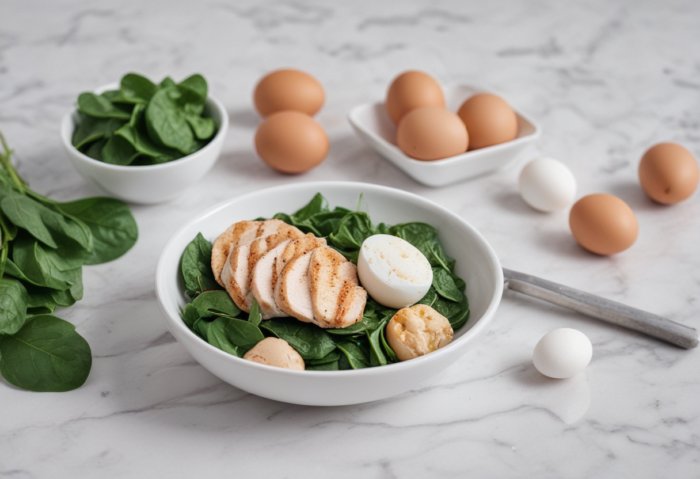
Glutamine in food matters more for athletes than many people think. This amino acid helps muscles recover faster, keeps the immune system up and running, and protects muscle tissue from breakdown. Below I look at where you can get it, how much is left after cooking, and when it’s worth considering a supplement.
Glutamine in food and in the body: where we get it
The body makes glutamine itself from the branched-chain amino acids valine, L-leucine and isoleucine. Under normal circumstances that is entirely enough. But when training load rises — a hard workout, injury, infection — demand grows so large that the body’s own production falls short.
In skeletal muscle, glutamine is the most abundant amino acid, making up as much as 60% of the free amino acids. That is exactly why muscle reacts quickly to a glutamine shortage — water leaves the cells and catabolic processes gain the upper hand.
Glutamine in food, however, is surprisingly modest. From protein-rich food the body gets only 4-8% of the glutamine it contains. If you eat, say, 200g of protein a day, only 8-16% of that amount reaches the bloodstream as glutamine. On top of that, heat destroys glutamine in food — in boiled or fried meat its content is minimal. Raw fish, fresh dairy products and raw vegetables provide a little more, but not much is left there either.
Why training raises glutamine demand
Every stress situation — a hard workout, mental strain, injury, illness — triggers the release of cortisol and, along with it, an outflow of glutamine from the muscles. Glutamine is the first amino acid the body starts to break down from muscle under stress. Only then do the others follow. So glutamine in food works like a protective shield for the remaining amino acids.
The same goes for energy sources under intense training load: BCAA use can rise by up to 15% during training. In practice, this means a BCAA product taken 30min before a workout helps preserve muscle tissue. Taking glutamine itself, meanwhile, helps keep the muscle cell in an anabolic state — studies show that the cell’s water content stays more stable and protein synthesis continues.
Besides muscle, glutamine supports the immune system. One of the body’s most important antioxidants — glutathione — is synthesized from glutamine. The gut lining and white blood cells use this amino acid as fuel, which is why a longer season without enough glutamine often means seasonal fatigue and frequent colds.
What glutamine does in the body
- strengthens the immune system
- raises glycogen content in skeletal muscles
- increases the buffering capacity of the blood
- stimulates protein synthesis
- prevents the breakdown of muscle tissue
- stimulates growth hormone production
- speeds up gut motility
Glutamine in food vs supplement: how to use it
If you train seriously and want to speed up recovery, glutamine in food no longer covers your needs. The usual dose is 4-6 times a day, 2-4g each time. Depending on your goal, it can be split up differently:
- Right after waking up and before falling asleep — supports the production of growth hormone (somatotropin).
- Before and after training, 5-10g at a time — to speed up recovery.
- To strengthen the immune system — 5g a day, in the morning or evening.
- To raise growth hormone — 2-5g on as empty a stomach as possible.
- To replenish muscle glycogen stores — 10-30g a day in portions, including 10-15g right after training.
Powder is more effective and cheaper than tablets. Drink it right after dissolving it in water — glutamine dissolves rather poorly in water and loses its effect when left to stand. Peptide-form products are absorbed better, but they contain only about 60% pure glutamine, which means paying for a larger dose to get the same amount.
Side effects are practically absent in healthy athletes. Sometimes a slight body weight gain may appear at first, which comes from water returning to the muscles and passes on its own. Before long-term use, it is definitely worth consulting a sports physician and a coach.
FAQ: glutamine in food and as a supplement
Can you get enough glutamine from ordinary food?
For someone who isn’t very active, yes. For a hard-training athlete, no. The 4-8% obtained from food does not cover the demand under stress load, and cooking reduces it even further.
When does adding glutamine make the most sense?
During periods of high-volume strength training, ahead of the competition season, when recovering from injury, and when you notice frequent colds. A dose of 5-10g before and after a workout is a good starting point for most people.
Powder or capsule?
Powder. It is cheaper per gram, makes it easier to adjust the dose, and is absorbed faster if you drink it right after dissolving it.
Find more glutamine HERE
Author: pumpiniron
Source: WHO – physical activity.
Come and work out! ArtGym




