
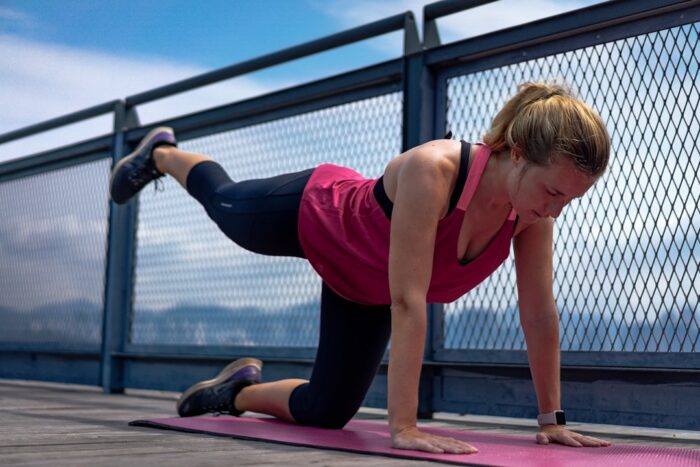
The fix for a flat butt: how to get your glutes working
Key points…
1. Strong, well-trained, visibly toned glutes are a hot topic right now. But for many women, thorough, serious leg training doesn’t automatically translate into well-developed glutes.
2. If your thighs are big and well-developed but your butt still seems almost nonexistent, you should dedicate one day a week to training your glutes.
3 A dedicated “butt day” does more than improve your glute development. Progress in this area changes the appearance of your entire physique and helps you improve your performance in compound exercises.
The era of the strong, powerful female physique
It has begun. Women today are pushing back hard against the trends imposed by fashion magazines. Looking bony, skinny and unhealthily thin is no longer the goal. Bony legs with no muscle tone and nonexistent butts? No thanks!
Today’s active woman who trains in the gym wants a shapely, toned butt and strong, well-trained legs. To hell with those fashion magazine trends…
One problem
A solid leg workout alone is far from a guarantee of the glute development you want. For many women, those much-loved lower-body compound exercises—squats, deadlifts and lunges—build substantial leg muscle and work the lower back and hamstrings, yet don’t place enough training load on the glutes.
Many women have disproportionately developed legs and glutes for this very reason: their quads and the rest of their legs take on the lion’s share of the training load during lower-body compound exercises.
Well-developed, muscular legs aren’t the problem. Underdeveloped glutes are.
We already learned this from Bret Contreras. You can squat, deadlift and lunge with good technique, substantial weight and plenty of volume, yet in many cases the training load on your glutes still isn’t enough to adequately stimulate growth. Even the most disciplined woman in the gym can do impressive things in the power rack while directly engaging her glutes very little. It’s entirely possible, and actually fairly common. The result is well-developed legs but a soft, flat, very small butt. How does this happen?
When squats don’t engage your glutes
Those familiar motivational sayings about the butt you’ll get from squatting can often be misleading. Why? Because everyone’s anatomy and biomechanics are different. Those differences mean that, during complex movements involving multiple muscles, the contribution of each muscle group varies from person to person. Even when they’re doing the same exercise with good technique
Some women simply can’t achieve good glute development through squats alone. They squat, but their thighs grow instead. You’re one of them if:
1. Squatting tends to make your thighs grow more than your glutes.
2. You struggle to feel your glutes working during squats and their variations.
3. You occasionally find yourself wondering why your glutes are still flat and small despite doing plenty of squats and deadlifts.
This combination of underdeveloped glutes and overdeveloped thigh muscles is quite common among women who train.
Your butt-to-leg proportions: what not to do
I’m quad-dominant too. That used to bother me a lot. My legs were “huge,” I thought at the time, and I didn’t find that attractive at all. I learned an interesting lesson from this.
To slim down my bulky legs, I replaced lower-body strength training with long-distance running. After about a year, the running took its toll. I lost a substantial amount of muscle mass and suffered some fairly serious injuries. All of that brought me back to the gym. I learned to appreciate full, muscular thighs, but my glutes were still lagging behind.
At one point, I decided to try competing in a fitness physique competition, and my coaches stopped my lower-body training altogether because my legs were still too big.
So my legs have gone from big to small and back to big again. Although my butt didn’t change much, that experience taught me that thin or small legs don’t necessarily mean firmer legs. Thin legs can still look very soft and lack muscle tone.
After going back and forth like this, I finally found what worked for me, and it wasn’t wasting away metabolically valuable muscle mass in my legs. The solution was to give my glutes dedicated attention and bring their development into proportion with my thighs. With a toned, well-developed butt, my legs no longer looked too muscular.
Avoiding a “pancake butt”
So if your legs respond well to lower-body compound strength exercises, the solution isn’t to stop training them or to squat with pink 2 kg dumbbells. The answer is to prioritize glute training and bring this area up to speed.
A glute day is about choosing exercises that place relatively little training load on the quads and hamstrings while targeting the glutes more specifically. Your glutes are the priority that day. You’ll see them start to grow, improving the appearance of your whole body, not just the part below your waist.
A dedicated glute training day
People who train for aesthetics often use splits that focus each workout on one or two body parts, so why can’t the glutes be one of them? Well-developed glutes are very important for athletes competing in women’s fitness categories, and a toned butt doesn’t go unnoticed on women who don’t compete, either.
Could the reason we neglect the glutes be that we find it difficult to think of them as a separate body part? Here’s how I’d approach it: think about your shoulders. Your front delts get plenty of training load on chest day, just as your glutes do on leg day. Your rear delts get worked on back day. Yet almost every bodybuilder still has a dedicated shoulder day in their program. And the last time I checked, the glutes were considerably bigger than the delts.
Reasons to consider dedicating a day to glute training:
Three reasons:
1.If you train 5-6 days a week, a dedicated glute day is worth the investment. It gives you a chance to learn glute isolation exercises alongside the big compound lifts and develop a better feel for how these muscles work.
2.The larger the muscle group you train, the greater the training load it needs to grow. Your butt is a large area of your body, and your glutes are a large muscle group in their own right. If the familiar compound exercises do little to engage your glutes, you are simply wasting a lot of time trying to develop them with traditional compound lifts.
3.Your glutes make a big difference to your physique, and if they are lagging behind, you need to address that. A dedicated glute day is necessary to do so.
If you compete in physique competitions, remember that bikini and other fitness categories are very often won or lost on the strength or weakness of your glute development. Judges immediately notice a flat, untoned butt—it is like a fatty, sagging double chin.
Warnings
A dedicated glute day is not for everyone. If you are a beginner training three times a week, there is no need to start worrying about a separate glute day straight away. To begin with, full-body workouts several times a week are enough to develop your physique.
If you are a competitive Olympic weightlifter or powerlifter, you may not need a dedicated glute day either. Still, even male powerlifters do specific glute exercises when their glutes are the weak link in the movement chain that determines performance.
Seven tips to keep in mind when developing your glutes
1. Keep your glute-day training intuitive and guided by feel.
The goal that day is to train your glutes, not your entire lower body. Focus on feeling the muscle work, and aim to build such a strong pump over your sets that you eventually begin to lose that sensation. You can finish with HIIT and ab work.
2. Feeling the muscle work is key
Start your glute day with several sets of either glute bridges (with your back on the floor) or hip thrusts (with your back on a bench). Pause at the top, in the peak contraction position, and feel the contraction. Experiment with the tempo of your sets. Negatives help you feel the muscle work.
Foot position matters too. Find the position that lets you feel your glutes working best.
Do not waste a single rep. The goal is to pump plenty of blood into your glutes so they feel full, toned, and hard. If you feel more of a pump in your hamstrings, you need to adjust your position during the exercise.
3. Pretend the numbers mean nothing
Glute day should not be about chasing huge new personal records. Approach glute training from a bodybuilding perspective, rather than a powerlifting one. Remember that training for hypertrophy is about feeling the muscle work, not moving a certain weight from point A to point B.
Control the weight. Try to feel every second you spend under the bar performing the exercise. The weight on the bar is simply there to make you work harder.
4. Do not get fixated on training volume either
Women tend to think that unless they do 15 exercises in a row, the workout is pointless. Let go of that belief. You do not need a “pile” of exercises to work through while gasping for breath.
When it comes to glute training, simple workouts work very well. You will likely get all the work done with 1-2 exercises that suit you.
If your glutes do not yet feel firm and tight after the first exercise, and you can still contract them with a good sense of the muscles working, you should definitely add another couple of exercises.
But if you can work your glutes so hard with the first exercise that you cannot feel them contracting during subsequent exercises, that may be enough. An effective glute workout can last just 15-20 minutes and may only require one good exercise.
5. Start leg day with an exercise that lets you really feel your glutes working too
On leg day, also try starting your workout with an exercise that trains the whole leg while allowing you to feel and challenge your glutes. Bodybuilders often use this approach to bring up a lagging muscle. Whatever you want to focus on gets trained first.
Do not completely “destroy” your glutes during this first exercise; simply try to feel that area working through a lower-body compound exercise.
6. Check the crease under your butt
You will be amazed at how quickly you can shape your butt when you put your mind to it. By feeling the muscle work and focusing specifically on it, you activate muscle fibers, blood flow, and metabolism in that area. All of this will quickly begin to show in your appearance.
7. Forget about body weight
If you are trying to shape your body and add fullness to a particular area, photos, the mirror, and coaches provide much better or more relevant feedback than the scale. You will gain some weight as you try to add muscle to a lagging area.
Glute-day essentials
Hip thrusts and/or glute bridges
Do one or both of these variations on your glute day, for a total of 4-8 sets. Stay roughly within a range of 6-20 reps. Start easy with a light weight, then add weight and include lower-rep sets. “Put your mind in your butt.”
Devote time and energy to these two exercises. Do not even think about the exercises you have planned for afterward. The first exercise may have such an effect that you cannot do much more afterward.
Experiment with different numbers of sets and reps per set. Find what works best for your glutes.
You can start with a light weight and a rep count of 15-20, then increase the weight and reduce the reps. Or you can try the conventional approach of 3-4 x 8-10 reps per set. Feel the pump and the burn.
Bodyweight sets and exercises are not a waste of time either. You can use them as part of your warm-up before moving on to weights.
Options for glute day
Of course, these are optional, and you can leave them out if the key exercise or exercises at the start already give your glutes a substantial training load, a good sense of the muscles working, and a strong pump.
• Glute machine.
• A deadlift variation that particularly targets the glutes.
• Hyperextensions.
• Cable pull-throughs (pictured).
HIIT options for glute day
• Kettlebell swings (or swings with a weight plate)
• Stepmill machine
• Prowler pushes or sled intervals
• Sprint intervals
Choose from these based on what suits you and your specific goals
Plan your training week
Aim to leave 2-3 upper-body training days between glute day and leg day.
Here is an example of my own weekly training split:
Monday: HIIT
Tuesday: Glute day
Wednesday: Chest, shoulders (light)
Thursday: Back, HIIT
Friday: Legs
Saturday: Shoulders (heavy)
Sunday: Back
If I need a day off, I simply stay active or walk instead of sticking rigidly to the plan. I do not schedule days off, but when you need them, you have to take them!
Translated by Janar Rückenberg
Come train! ArtGym




