Principles of hamstring training
There are nine principles to keep in mind when training your hamstrings effectively.
Hamstring kinesiology
The muscles at the back of the thigh are often collectively, but somewhat inaccurately, referred to as the biceps femoris. This is actually just one of the three main muscles in this area. The hamstrings comprise three separate muscles: the semimembranosus, the semitendinosus and the biceps femoris, which is further divided into a long head and a short head (biceps femoris caput longum and biceps femoris caput breve, respectively). Understanding the hamstring muscles and their functions is the first step toward developing them fully and comprehensively.
Semimembranosus and semitendinosus: these muscles form the inner part of the back of the thigh. Both originate on the lower part of the pelvis, cross both the hip and knee joints, and attach to the tibia. Their functions include extending the torso at the hip and bending the leg at the knee, among several others. These two muscles also allow you to rotate your leg inward (medial rotation).
Biceps femoris: this muscle is also known as the “leg biceps.” Like its “cousin,” the biceps brachii (the biceps in the upper arm), it consists, as its name suggests, of two heads: a long head and a short head. The long head crosses both the hip and knee joints and also extends the body at the hip and bends the leg at the knee. The short head crosses only the knee joint and is involved primarily in knee flexion. The entire muscle, meaning both heads, also rotates the leg outward (lateral rotation).
Hamstring synergists
In addition to the main knee flexors at the back of the thigh, the sartorius, gracilis and gastrocnemius also help bend the leg at the knee.
The gluteal muscles (gluteus) and spinal erectors (erector spinae) assist with hip extension.
You can find a useful overview of the hamstring muscles on page 8 of this master’s thesis:
http://dspace.utlib.ee/dspace/bitstream/10062/6189/1/joeloo_anneli.pdf
I Treat the hamstrings as both knee flexors and hip extensors
Among their various functions, the hamstrings have two main roles:
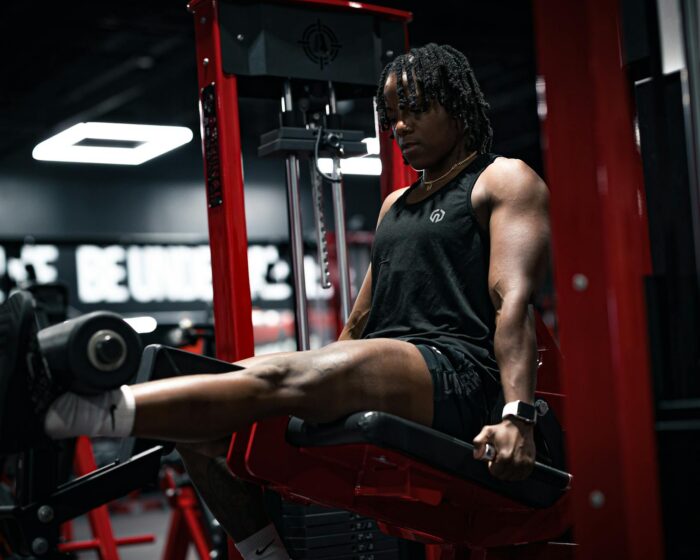
a: Knee flexion (for example, when you lie on your stomach and bend your knees, bringing your lower legs toward the backs of your thighs). Gyms have several types of machines that train this function. You can perform this exercise standing, seated or lying on your stomach.
b: Hip extension (this can also be described as moving your thigh backward while standing. You perform this movement when walking and running, as well as when skiing, for example). Exercises that train this function include stiff-legged deadlifts (also with the knees slightly bent), good mornings (various versions), back hyperextensions and reverse hyperextensions, in which you raise your lower body (legs) while keeping your upper body fixed.
Clearly, then, hamstring training should include exercises that require both knee flexion and hip extension. Most people are only now coming to understand this, but athletics coaches have known it for a long time: the biceps femoris, gluteal muscles and spinal erectors form a muscular chain whose main function is to straighten the body. Translator’s note: this is a function you need when walking, running, jumping, sprinting and so on.
II Train each leg separately during leg curls, too
Various tests conducted with professional athletes have shown that hamstring strength can differ considerably between a person’s two legs. The results show that athletes’ hamstrings are quite often as much as 20% stronger in the dominant leg than in the nondominant leg. Athletes with this kind of imbalance are certainly among those who should also train each thigh separately to prevent injuries.
You should also know that your dominant leg is not necessarily on the same side as your dominant hand. In other words, being right-handed does not mean your right leg is also dominant. Training your hamstrings separately also makes the transmission of nerve impulses through the nerves supplying these muscles considerably more efficient.
III Fully stretch the hamstrings in the starting position
Allowing your hamstrings to reach a full stretch across both the hip and knee joints in the starting position for leg curls promotes more effective recruitment of the hamstring muscle fibers.
This means that when performing leg curls, you should start with your legs straight and your torso bent slightly forward at the hips. This applies to lying, seated and standing leg curls alike. Translator’s note: this is also why some leg curl machines are designed to keep your hips elevated, with your upper body bending slightly forward over the raised section. In fact, all these machines should be designed this way…unfortunately, the one I use is not!!!
NB!!! Although I understand the article well myself, the text is quite difficult to translate, with Latin and English mixed together :))). Still, the article is very informative, which is why I decided to translate it anyway. To help you understand the subject, I have tried to find additional illustrative material. There will also be a second part, with more interesting tips on hamstring training. Stay tuned…
To be continued…
Translated by: Janar Rückenberg
Come and train! ArtGym