In short:
- Home workouts with body weight and a couple of resistance bands deliver results if you follow the principle of progressive overload.
- A mat and a set of resistance bands are enough for the basic equipment.
- The core exercises are the squat, lunge, push-up and plank — bands add resistance.
- Train 3–4 times a week and get enough sleep for recovery.
A gym membership is not a prerequisite for summer shape. A well-planned home workout using body weight and a couple of cheap accessories gives beginners and intermediates entirely realistic results. In this guide we look at what equipment you actually need for home training and how to keep progressing on a small budget.
How does a home workout deliver results on a small budget?
Home training works on exactly the same principles as gym training: your body needs a stimulus that grows gradually from week to week. This is called progressive overload — a few more repetitions each week, a slower tempo or greater resistance. You can start with no weights at all, using your own body weight, and add equipment only once the exercises become too easy. Consistency matters more than expensive equipment: four focused home workouts a week deliver better results than sporadic gym visits. A more in-depth introduction is in the article how to make your home workout truly effective.
What equipment do you need for home training?
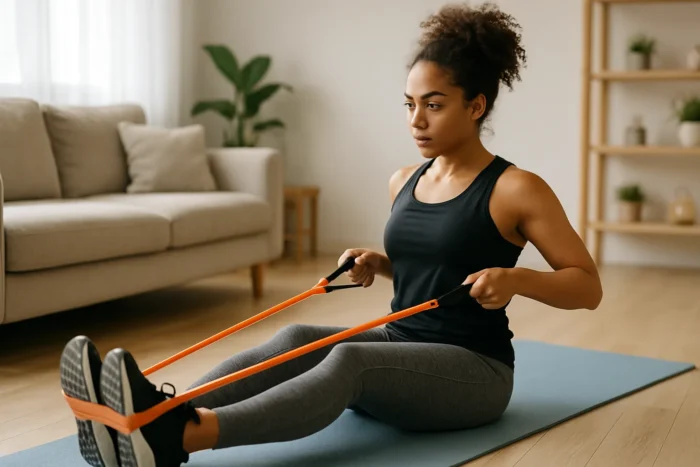
The minimum kit is surprisingly small. First, an exercise mat, which makes floor exercises comfortable and protects your back. Second, resistance bands — a light, cheap and compact tool that adds adjustable resistance to both pushing and pulling exercises. A set of bands of different strengths essentially replaces a whole range of dumbbells: when an exercise gets easy, you switch to a stronger band or shorten your grip on the band. This adjustability is exactly what makes bands the ideal tool for keeping up progressive overload at home without spending a lot on equipment. Bands are also easy on the joints, because resistance is highest in the strongest phase of the movement. In summer, the mat and bands are easy to take outdoors, to a summer cottage or on a trip. The logic of functional, equipment-light training is covered in more detail in what is functional training.
Which exercises are suitable for home training?
You can work your whole body with four movement patterns. For legs and glutes, do squats and lunges — adding a resistance band around your thighs increases the load on the glute muscles and keeps your knees better aligned. For upper-body pushing, the push-up works well; if the classic version is hard, start with push-ups on an elevated surface or from your knees, and when that gets easy, add a band across your back. For pulling, secure a resistance band behind a door and pull it toward your chest, mimicking gym rows and squeezing your shoulder blades together at the end. For the core, hold a plank (the prone support position), which trains the entire core muscle group with no equipment at all. These movements cover the push/pull/legs logic on which programs with heavier equipment are also built. Perform each exercise with control, without jerking, and pay particular attention to the slow return phase. How training supports fat burning is explained in fat burning and training.
How do you ensure progress in home training?
Train 3–4 times a week, leaving recovery days for muscle groups — just like in a gym program. Write down your exercises, repetitions and the band strength you used, because without a record it is impossible to track progress. When you reach the upper end of the repetition range in an exercise, increase the training load: do a slower negative phase, add repetitions, shorten rest between sets or switch to a stronger band. After every three to four harder weeks, it’s worth taking an easier week so your joints and nervous system can recover — that’s not weakness but strategy. Don’t forget recovery: muscles grow not during training but during sleep and rest, so aim for 7–9 hours of sleep a night. On rest days, light movement, such as 6000–10,000 steps of walking, can actually speed up recovery. The World Health Organization recommends that adults, in addition to aerobic activity, do muscle-strengthening exercises on at least two days a week (WHO physical activity recommendation). If you have injuries or chronic conditions, consult a doctor before starting the program.
How do you plan a weekly home workout?
For beginners, two to three full-body workouts a week work best, where each time you do one squat exercise, one pushing exercise and one pulling exercise, plus a plank. If you feel you’re recovering well and want more, split your workouts across four days following the push/pull/legs logic, leaving at least one rest day. At the start of each workout, do a light warm-up of five to ten minutes — a couple of light sets with a resistance band and movements that prepare the joints. Do two to four sets of each exercise, choosing the band strength so that the last repetitions are hard but can still be performed with clean technique. When a whole set becomes easy, it’s time to raise the resistance. A simple framework like this keeps home training structured and leaves room for gradual progress without buying new equipment.
References
- Fitness.ee. Getting ready for summer: 8-week plan (2026).
- World Health Organization (WHO, 2024). Physical activity.
- ACSM. Resistance training guidelines for healthy adults.
- Estonian Health Board. Physical activity recommendations for adults.
Frequently asked questions
Does a home workout deliver results as good as the gym?
For beginners and intermediates, yes. If you follow progressive overload and train regularly, body weight and resistance bands deliver real strength and muscle results.
What is the cheapest equipment for home training?
An exercise mat and a set of resistance bands of different strengths. They are compact, affordable and replace much of what dumbbells do.
How do you keep progressing without weights?
Add repetitions, slow down the tempo, shorten rest between sets, or switch to a stronger resistance band. Write down your results so you can raise the training load systematically.
How many times a week should you train at home?
3–4 times a week is optimal for a working person. Leave recovery days for muscle groups and sleep 7–9 hours a night.
Come and train! ArtGym