
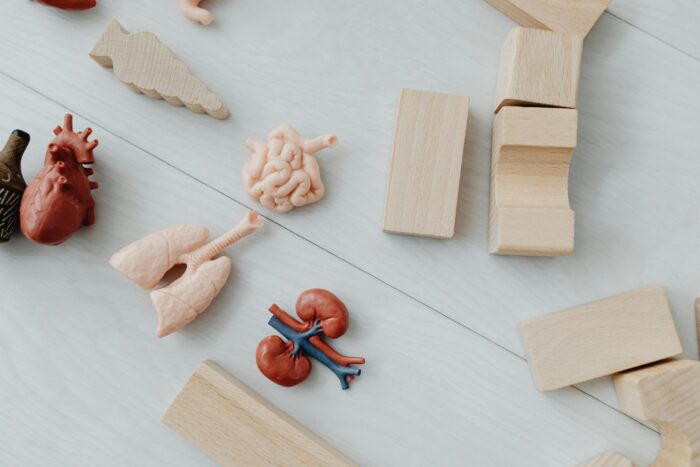
How the excretory system and kidneys work
Excretory function is how your body removes metabolic waste and keeps its internal environment in balance. The kidneys do most of the work, but the lungs, sweat glands and digestive tract also play a part.
Why does the excretory system matter?
Every day, your body produces substances it no longer needs. Excretion is the removal of waste products generated by metabolism. Gaseous substances, such as CO2, are expelled through the lungs when you breathe. Water and substances dissolved in it leave the body mainly through the kidneys and sweat glands. Unabsorbed food and the remnants of digestive juices pass out through the digestive tract.
Put simply, if waste is not removed in time, your body’s internal environment falls out of balance. That is why the excretory organs are not just “plumbing”: they are part of a system that helps regulate water and mineral balance, acid–base balance and osmotic pressure.
How the excretory system works: the kidneys do the main work
The kidneys are the main excretory organs. Their role is to remove metabolic waste, excess water and mineral salts from your body. The kidneys excrete waste products of protein metabolism, including urea and uric acid, as well as creatine from muscle metabolism. They also help eliminate a range of medications and toxins.
The kidneys are paired organs with a combined weight of ~300g. They are bean-shaped and 10-12 cm long. They lie behind the abdominal cavity, on either side of the spine, at the level of the lowest thoracic vertebra and the upper two lumbar vertebrae. In front of the right kidney are the liver, the right colic flexure and the duodenum (12-finger intestine). In front of the left kidney are the pancreas, stomach, left colic flexure and small intestine. Each kidney is covered by a layer of connective tissue and surrounded by a thick layer of fat.
The functional unit of the kidney is the nephron. Together, the kidneys contain 2-2.5 million nephrons. Each nephron begins with a renal corpuscle, which contains a tuft of blood vessels, or Malpighian corpuscle, surrounded by Bowman’s capsule. Another important component is the renal tubule. It is ~2-6 cm long in total and is lined throughout by a single layer of epithelial cells.
- the proximal convoluted tubule lies near the glomerulus;
- the loop of Henle is a U-shaped section that extends into the renal medulla;
- every 7th loop extends deep into the medulla;
- the ascending section returns to its glomerulus and becomes the distal convoluted tubule.
Urine formed in the nephron flows through the collecting ducts into the renal calyces, then into the renal pelvis and through the ureters to the bladder.
How does the excretory system produce urine?
The kidneys have a very rich blood supply. A large renal artery enters each kidney and branches into smaller blood vessels. These form a network of capillaries in the Malpighian corpuscles. The afferent arteriole, which carries blood into the glomerulus, has a wider lumen than the efferent arteriole, which carries blood away. This creates the high pressure in the glomerular capillaries needed for filtration.
Approximately 1 tonne of blood passes through the kidneys’ blood vessels each day. This means that the blood in your body passes through the kidneys ~200 times. At rest, ~20% of cardiac output flows through the kidneys.
- the kidneys excrete metabolic end products and foreign substances;
- regulate the body’s water content;
- maintain mineral concentrations in the blood and acid–base balance;
- synthesize and excrete certain substances, such as hippuric acid;
- produce compounds that affect vascular tone, such as renin.
The kidneys excrete ~1.5 l of urine each day. It contains 25-30 g of urea, 25-30 g of inorganic salts, uric acid, creatine and other substances. The volume and composition of urine depend on diet, environmental conditions and the intensity of physical work. You sweat more in warm conditions, so urine output is lower and urine is more concentrated than in cold conditions.
Urine formation takes place in two phases. In phase I, filtration from the glomerular capillaries produces primary urine. In phase II, reabsorption and secretion produce the final urine.
During ultrafiltration, almost all components of blood plasma pass through the filter, except proteins. Proteins with a high molecular weight cannot pass through. The resulting ultrafiltrate enters the space within Bowman’s capsule and is called primary urine.
Each day, 1440 l of blood passes through the kidneys. This contains ~790 l of blood plasma, of which about 1/5 passes through the filter. In this example, that produces ~160 l of primary urine per day. The body’s total blood plasma volume of 2.7-2.8 l passes through the glomerular filter more than 50 times in 24 h, or roughly every half hour.
Reabsorption and fluid balance
All the substances your body needs, along with up to 99% of the water, are reabsorbed from primary urine into the blood. From the renal tubules, 159 158 l of fluid returns to the surrounding capillaries, while 1 1.5 l leaves the body each day as final urine. This enormous difference shows how precisely the kidneys work.
Reabsorption is helped by the renal tubules’ great combined length of 70-100 km. The microvilli on the epithelial lining increase the surface area available for substances to be reabsorbed. Transporting some substances requires energy from ATP, while water follows along the concentration gradient.
Most of the water in the glomerular filtrate, about 80%, is reabsorbed in the collecting tubules. The descending limb of the loop of Henle is highly permeable to water but impermeable to Na+. The ascending limb actively reabsorbs Na+. This countercurrent system helps concentrate urine.
Glucose is normally fully reabsorbed from the glomerular filtrate, mostly in the proximal convoluted tubule. Amino acids and a large proportion of the minerals the body needs, such as Na, K and Ca, are also reabsorbed. Some substances, such as hippuric acid, creatine, ammonia and certain medications, pass directly into the urine through the renal tubular epithelium. This is called secretion.
Clearance describes the volume of plasma cleared of a test substance. It is a marker-based measurement method associated with glomerular filtration. Only for insulin is clearance identical to glomerular filtration. Freely filtered substances that are immediately reabsorbed have a lower clearance.
FAQ: how the excretory system works
What happens when you sweat a lot?
When your sweat glands are active, more water leaves your body through your skin. Your urine output may then decrease, and your urine becomes more concentrated.
How does the nervous system affect kidney function?
Increased sympathetic nervous system activity constricts the renal blood vessels, and diuresis falls. Pain can also suppress urine output.
Which hormones regulate urine output?
Vasopressin, or ADH, from the posterior pituitary increases water reabsorption in the renal tubules and reduces urine output. The adrenal cortex hormone aldosterone increases the reabsorption of Na and, consequently, water. Small doses of adrenaline increase urine output.
Author: EKFK
Source: WHO – physical activity.
Come and work out! ArtGym




