
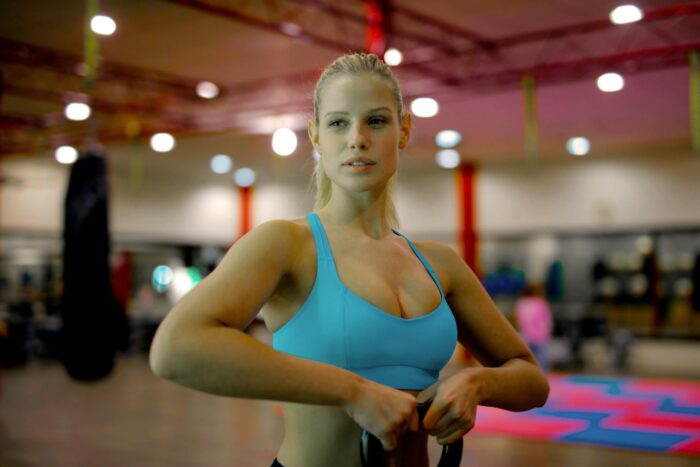
How to choose a sports bra: the complete guide
A good sports bra is as important in your training gear as the right sneakers. The wrong choice means discomfort, poor support and sometimes pain that ruins your workout — but the right bra simply lets you move.
Why is a sports bra so important?
Breasts are made up of fatty and glandular tissue, not muscle fibers — they have no support structure of their own. Regular clothing and a regular bra aren’t designed for jumping, running or lifting weights. Without support, breasts move up and down by as much as 8–15 cm while running, which strains the ligaments and the skin. These changes are mostly irreversible.
A sports bra isn’t a question of comfort — it’s a question of health.
The main parts of a sports bra and what to look for
Shoulder straps
Shoulder straps should fit snugly but not restrict your range of motion. Well-padded straps are especially important for women with larger cup sizes — wide, padded straps distribute the weight more evenly and don’t dig into the shoulder. Adjustable straps are a big plus here: you can set the level of support precisely to your body for different types of training.
A bra with a T-shaped back keeps the straps on your shoulders better and works well if your straps keep slipping off.
Cups and styles
There are two basic options. The first — the cupless, or compression bra — simply presses the breasts against the body. It’s suitable for women with A and B cups and lower-intensity training such as yoga and pilates.
The second option is the encapsulation bra, where each breast has its own separate cup. It offers more support, holds the breasts in place better and is suitable for women with larger cup sizes for training at any intensity — running, aerobics, functional training.
Neckline height
The neckline shows how high the front of the bra reaches from the chest up to the neck. Women with larger cup sizes get the best support from models with a higher neckline — they prevent the breasts from sliding up and down during training. A lower neckline may leave less support during intense movement.
Armholes
Armholes must allow your arms their full range of motion in every direction. In the fitting room, try raising your arms, stretching them out to the side and making circles. If you feel resistance at the bottom edge or notice muscle tissue pressing out over the edge, the bra is either the wrong size or the wrong cut.
Material
A good sports bra fabric is usually a blend of cotton and synthetic fiber: cotton adds softness, while the synthetic fiber wicks moisture away from the body. Pure cotton stays wet and doesn’t dry, which becomes uncomfortable during training.
It’s also worth looking for seamless or flat-seam models — especially in friction-prone spots such as around the nipples, the shoulder straps and the clasps. In longer endurance training (running, cycling), even a small friction point can become very painful after a few kilometers.
Clasps, hooks and construction
All hooks, clasps and wires should be covered with soft fabric — that way they won’t irritate the skin even during longer training. The construction should follow the lines of the body so the bra doesn’t shift or twist as you move.
Women who do endurance training often prefer circular-knit bras, which have no traditional seams where pieces of fabric join. Fewer seams mean less friction.
The right sports bra size — how to find it?
Many women wear bras that are either too big or too small. To find your size, measure your chest circumference across the nipples (bust measurement) and your chest circumference under the bust (band measurement). The difference gives you the cup size.
A sports bra should fit slightly snugger than a regular bra — not suffocating, but supportive. Fastening the clasp on the middle hook leaves room for the band to stretch: as the bra stretches, you can tighten it.
A simple test: slide two fingers under the band wrapped around your chest. If your fingers slip in easily, the bra is too loose. If it’s hard to get your fingers in, it’s too tight.
Sports bra — FAQ
How often should you replace a sports bra?
Most sports bras keep good support for 6–12 months with intensive use. Signs that it’s time to replace yours: the elasticity is gone, the hooks no longer hold snugly, or you get pain you didn’t have before. Washing wears down the elastane — keep the temperature low and don’t use a dryer.
Is one sports bra suitable for every workout?
The level of support should match the intensity of the training. Yoga and stretching — light support is fine. Spinning, running, jumping — you need strong support. It’s not worth using one bra for everything: a lower-support model damages connective tissue during intense training.
Does exercise affect the shape of the breasts in the long term?
A suitable sports bra helps slow the natural rate of breast sagging, because it protects the ligaments from excessive stretching. Exercising without support — especially at high intensity — speeds up this process over time.
Source: WHO – physical activity.
Come and work out! ArtGym




