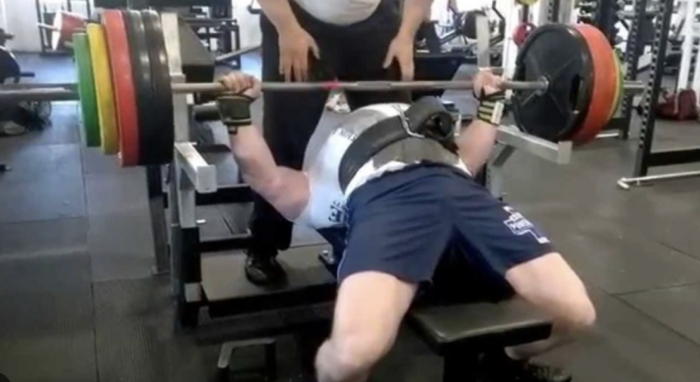
Train your back too
To bench a lot, a strong chest, shoulders and triceps aren’t enough. Your back has to be strong too, so that you can keep your body stable and fixed while pressing. Be sure to include exercises such as bent-over barbell and dumbbell rows, seated rows with different grips, lat pulldowns on the cable machine, and pull-ups with different grips. If you’re a heavy bench presser, your pecs are constantly under a high training load and will most likely develop faster than your back. If you then neglect your back on top of that, the result is disproportionate development. Also, when your back is well developed, your shoulders are better protected from injury while pressing. So don’t forget to train your back!!!
Floor presses
When you train for a bigger bench press or work to improve your result, you probably know your own weak phases and moments. One of the most common “sticking points” in the bench press is a couple of inches off the chest or a couple of inches above it. Floor presses are an effective way to train this difficult point or phase. All you have to do is lie on the floor with the barbell in your hands. Lower the barbell until your elbows touch the floor, then quickly press the barbell back up. This exercise effectively trains exactly the phase mentioned above (a couple of inches off the chest), the point most bench pressers struggle with.
Warm up thoroughly
Many good bench pressers have had to end their careers because of an inadequate warm-up, and quite a few men haven’t reached their potential because of injuries. Some lifters throw themselves into their chest workouts so hard that they constantly suffer from serious shoulder pain. After every serious bench session or chest day, stretch very thoroughly, both chest and shoulders, ice your shoulders and give them proper rest. The biggest mistake people make is going for a bench press record without any warm-up at all. When attempting a record, you need to warm up properly and work your way up in pyramid fashion, but definitely not TOO much. Never tire out your muscles before a record attempt; the aim is to gradually “wake up” both the muscles and the nervous system. It’s important to warm up your ROTATOR CUFF (in the shoulder joint, the group of muscles that form and stabilize the shoulder, and their tendons, which attach to the head of the humerus) with light dynamic stretches, push-ups and standing presses.
Chains
The purpose of chains in the bench press is to develop speed (accelerating the barbell off the chest) and to train fast lockouts. When you use chains for bench pressing, as you lower the weight to your chest, the chains hung on the barbell pile up on the floor in a heap, link by link. So as you lower, the barbell gets lighter with every link that reaches the floor. Now, as you press the weight up, you lift the chain attached to it, link by link, together with the barbell. The higher the barbell travels toward the locked-out position (UP), the heavier it gets, because the chain is being picked up off the floor link by link again. The barbell is heaviest right at the top. Traditional Westside chains weigh 20 kg, and by hanging two chains on at once we get 40 kg of extra weight at the lockout position (from the chains alone).
So if you have 102 kg on the barbell in Westside chains and you press it, that 102 kg is what you’re pressing in the phase where the barbell is down on your chest. When the weight has moved up 25%, you’re actually already pressing something like 113.5 kg, at half range you’re already pressing 125 kg, and by the time you lock out, you have 138.5 kg in your hands. With chains we’re forced to accelerate the weight away from the chest and to lock out fast and hard, because the weight being pressed automatically gets heavier; a regular bench press doesn’t develop these phases in the same way.
Translator’s note: I understand the idea behind the chains and how they work, but going by the translation, I can’t quite see how a 102 kg load with chains can end up as 138.5 kg. The same article did talk about such numbers.
[url=http://www.youtube.com/watch?v=fTUh2Nmd7gw]http://www.youtube.com/watch?v=fTUh2Nmd7gw[/url]
Pressing off boards
Using boards to get past sticking points in the bench press is a very common method. Boards don’t only help you get past sticking points, they also effectively improve your lockout. Boards No. 3, 4, 5 and 6 are usually used. Board No. 3 is a couple of inches off the chest, board No. 4 reaches halfway up the range of the bench press, and board No. 6 trains the lockout. You should use the boards like this: if you know where your sticking point is, you train it, and get past it, by using a board an inch lower. Shawn Lattimer, who has bench pressed 363.5 kg, has written a good article on using boards.
Press the barbell straight up
Pulling your shoulder blades together, lower the barbell to the upper part of your abs or the lower chest. Press the barbell back up vertically, not in an arc, straight to the uprights. This shortens the path of the press and minimizes negative stress on the shoulders. Dave Tate’s recommendation.
Keep a training log
Keeping precise records of your training and nutrition is a science in itself, and at first glance quite a few people don’t feel up to it. Yet all successful powerlifters, bodybuilders and other athletes do it. A training log is an overview of the work you’ve done. In it you can go back years and see what has worked best for you. What’s the point of training if you don’t measure the work done and the results of your training? Without that, no goals arise either, and goals matter, because they create the energy and motivation to keep progressing. Goals are what get you out of bed in the morning and into the gym. So keep track of your workouts; it will motivate you and help you move forward.
Heavy negatives
Here are a few examples from other sports of how the body is trained with increased loads. In basketball, players do jump shots while wearing extra weights on their legs. Swimmers swim laps wearing clothes (T-shirts, shorts). Footballers train in camps on hot summer days under a blazing sun, at high air temperatures. Sprinters run sprints wearing harnesses with extra weights or small parachutes attached by a cord. So powerlifters, too, should let their bodies experience weights that are considerably heavier than what they lift in their 1RM exercise.
Do you see the point?
If you constantly play football in 25-30°C heat, then playing in 15-20°C weather is a piece of cake. If you do jump shots with added weight, then without the weight you practically fly and explode upward. If you constantly train with heavier training loads than your body is used to handling in normal circumstances or in competition conditions, then performance is far more efficient once those loads are gone, because your body has been trained and adapted for much tougher conditions.
Suppose your goal is to press 200 kg. If you have never tried to press that much, just holding 200 kg in your hands may shock you. Now, by pressing and training negatives with, say, 220-240 kg, your muscles have felt a much heavier weight than that 200 kg target. After training negatives like this for a while, or working them into your workouts, the heavier weights make your target weights feel far lighter. To get the maximum out of your muscles, you also have to shock them with maximal weights. Heavy negatives do exactly that.
How to do a negative: a negative repetition actually means an eccentric contraction. That is, you take the weight in your hands and lower it slowly to your chest.
Translator’s note: an effective method, no doubt. With heavy weights you absolutely must use spotters. There is no other way!!!
One way of using negatives: spotters would of course still be recommended!!!
Don’t bounce the barbell
Most injuries occur precisely between the eccentric and concentric phases, that is, at the transition from the yielding phase to the overcoming phase. It is common for a lifter to start bouncing the weight off the chest when fatigue sets in. Sudden loads like this can cause serious injuries to the tendons of the chest, shoulder and triceps. If you press 90 kg slowly, the barbell equals exactly 90 kg. If you do a set with 90 kg and do it fast and explosively, that 90 kg barbell also generates tens of kilos of negative, jarring load on the ligaments and tendons of the working muscles (Charles Staley).
Try pre-exhausting your muscles, too
This is a great method for breaking through a plateau. Since the bench press is a favorite exercise for many, it is usually done first. Try doing some workouts so that your first exercise is the dumbbell press on an incline bench, then you do flyes, and only as the third exercise at the end do you press on a flat bench. Do your chest or pressing workout like this for 2-3 weeks in a row, then go back to the old order and you will see how the weights on your working sets have gone up. So swallow your ego for a couple of weeks, and for the sake of heavier pressing weights later, do your chest workout or pressing day in reverse order.
Translator’s note: a tried-and-tested method, and it works!!!
Translated by: Janar Rückenberg
Come and train! ArtGym