
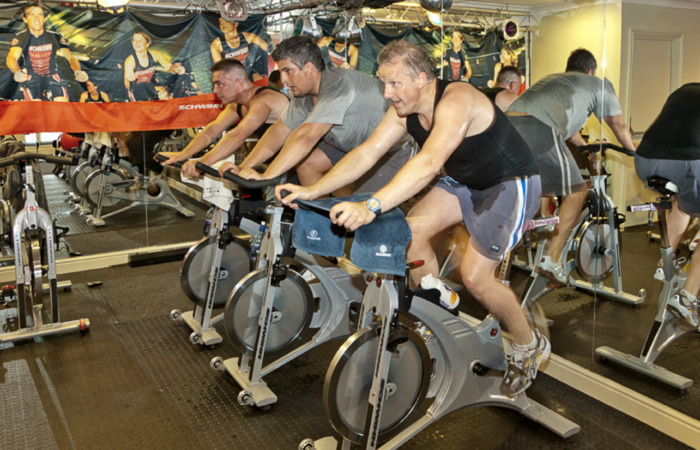
In short:
- Regular indoor cycling improves aerobic capacity and reduces the risk of cardiovascular disease.
- For beginners, 3 times a week for 30–45 minutes is a good fit, increasing the training load by 5–10% each week.
- HIIT on a bike delivers equivalent health results in much less time than a continuous moderate pace.
- The right saddle height and gradual progression prevent most common injuries.
Indoor cycling is one of the most accessible and effective forms of cardio — it suits all levels and doesn’t depend on the weather or the season. Stationary cycling works the body’s largest muscle groups, improves cardiovascular endurance and helps you maintain a healthy body weight. In this guide you’ll find an evidence-based 4-week plan and practical advice to help you start safely and keep improving your results consistently.
Why is indoor cycling effective for cardiovascular health?
Cycling activates the thigh, glute and calf muscles — the body’s largest muscle groups — which means high calorie expenditure and effective cardiovascular training. A systematic review found that regular indoor cycling significantly improves maximal oxygen uptake (VO₂max), reduces body fat percentage and lowers resting heart rate (Chavarrias et al., 2019).
The World Health Organization (WHO) recommends that adults get at least 150–300 minutes of moderate-intensity or 75–150 minutes of vigorous-intensity activity per week. An indoor bike is one of the most convenient ways to meet this target at home or in the gym.
According to the position stand of the American College of Sports Medicine (ACSM), aerobic training in the intensity zone of 64–95% of maximum heart rate (in sessions of 20–60 min) effectively develops cardiorespiratory fitness (Garber et al., 2011). In indoor cycling, intensity is easy to monitor and adjust with a heart rate monitor.
If you want to add a strength component to your cycling, check out our Functional gym plan… — it complements your aerobic base well and helps prevent muscle imbalances.
How do you put together an effective 4-week indoor cycling plan?
Three sessions a week, 30–45 minutes each, suit a beginner. Progression is the key to success: each week, increase the training load by 5–10% by extending the duration, raising the speed or adding resistance (Garber et al., 2011). Don’t jump straight into high intensity — your body needs 2–3 weeks to adapt.
Sample plan (4 weeks, 3 times a week):
| Week | Duration | Heart rate zone | Description |
|---|---|---|---|
| 1 | 30 min | 60–70% max HR | Steady base pace, getting used to the technique |
| 2 | 35 min | 65–75% max HR | Light surges in pace, short “hills” |
| 3 | 40 min | 70–80% max HR | Longer sustained effort |
| 4 | 45 min | 75–85% max HR | Introduction to intervals |
Balancing strength training goes well alongside cycling. The Two two-day plan offers a ready-made structure in which strength and cardio days alternate so that your body has enough time for recovery.
What is interval training on a bike and how do you do it properly?
High-intensity interval training (HIIT) means alternating short periods of maximal effort with a light recovery pace. Gibala et al. (2012) showed that HIIT improves aerobic capacity and insulin sensitivity at a level comparable to steady training at a moderate load, but in much less time — which makes it an excellent choice when you’re short on time.
Sample HIIT session (25 minutes):
– 5 min warm-up (low resistance, easy pace)
– 8 repetitions: 30 seconds of maximal effort + 90 seconds at an easy pace
– 5 min cool-down (slow pedaling)
It is not recommended to do HIIT sessions more than 2–3 times a week, because the muscles and the cardiovascular system need 48 hours to recover fully (Gibala et al., 2012). On your remaining training days, favor a longer aerobic session at a steady pace.
If you enjoy group training, the Fitstar Attack new program training session is a great way to apply the principles of interval training in a motivating group setting.
How do you set up an indoor bike correctly and prevent injuries?
Incorrect saddle height causes most of the knee and hip injuries that occur on indoor bikes. The correct height: at the bottom of the pedal stroke, your leg should be almost straight (a 5–10-degree bend in the knee). The handlebars should be at least level with the saddle to avoid excessive strain on the back muscles.
To balance the forward-leaning posture that develops during cycling, add regular upper-body work to your program. The One-day arm plan gives you a concrete structure for strengthening the shoulder, back and arm muscles.
Key safety rules:
– Always warm up for 5–10 minutes with low resistance
– Increase resistance gradually, not in sudden jumps
– Drink enough fluids: 600–1200 ml per hour, depending on intensity and temperature
– Wear breathable clothing suited to stationary cycling
– Rest at least one day between two training days
References
- Chavarrias M, Carlos-Vivas J, Collado-Mateo D, Pérez-Gómez J. (2019). Health Benefits of Indoor Cycling: A Systematic Review. Medicina (Kaunas). 55(8):452. PMID: 31450833
- Gibala MJ, Little JP, Macdonald MJ, Hawley JA. (2012). Physiological adaptations to low-volume, high-intensity interval training in health and disease. J Physiol. 590(5):1077–1084. PMID: 22289907
- Garber CE, Blissmer B, Deschenes MR, et al. (2011). American College of Sports Medicine position stand. Quantity and quality of exercise for developing and maintaining cardiorespiratory, musculoskeletal, and neuromotor fitness in apparently healthy adults. Med Sci Sports Exerc. 43(7):1334–1359. PMID: 21694556
Frequently asked questions
How often should you do cycling workouts?
For beginners, 3 times a week for 30–45 minutes is a good fit. More advanced exercisers can train 4–5 times a week, alternating HIIT sessions with longer, steady-pace workouts. For recovery, leave at least 48 hours between training days, especially after intense intervals.
Does a cycling workout help with weight loss?
Yes — depending on intensity, stationary cycling burns 400–700 kcal in a 45-minute session. To lose body weight, your calorie intake needs to be lower than your expenditure. Cycling is an effective tool for this, but it works best combined with balanced nutrition.
Is an indoor bike suitable for people with knee problems?
Generally yes — stationary cycling puts less strain on the knee joint than running, because there is no impact load. It is important to set the saddle height correctly (knee almost straight at the lowest position) and to start with low resistance. If you have more serious knee problems, consult a doctor or physiotherapist first.
What is the difference between a HIIT cycling workout and regular cardio?
HIIT alternates short periods of maximum effort (20–60 sec) with easy recovery pace, and the whole session lasts 20–30 minutes. A regular cardio workout is longer (30–60 min) and done at a steady, moderate intensity. HIIT improves aerobic capacity faster, but it requires longer recovery and is best suited to those who have already built a base level of fitness.
Does indoor cycling fully replace outdoor cycling?
In terms of cardiovascular training, the results are comparable. The difference lies in the balance and coordination demands: a road bike also develops the muscles that stabilize the body. Indoor cycling, however, is more controlled, safer and independent of the weather, which makes it an excellent supplement or a stand-alone option.
The most effective indoor bike: https://www.concept2.ee/tutvustus/bikeerg/
Come and work out! ArtGym




