
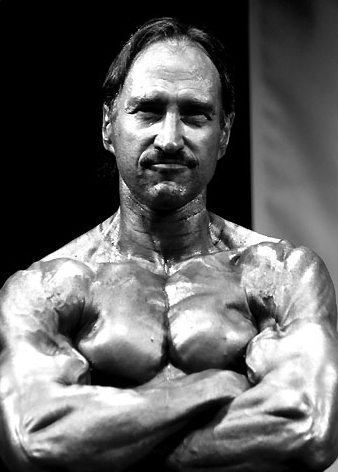
Indrek Otsus: thoughts on bodybuilding training
Indrek Otsus and the principles of bodybuilding training
Indrek Otsus is frank: science has played a smaller role in the development of bodybuilding training methods than it has in sports that push particular physical capacities—speed, strength and endurance—to their limits.
Training these capacities now rests on a fairly solid theoretical (scientific) foundation. This is only natural, since results in many sports depend directly on physical capacities. There has therefore been good reason to study training methods, and the findings have practical applications.
Bodybuilding, by contrast, is an unusual sport in which physical capacities have no direct effect on competition results. Put simply, the aim is to achieve maximum muscle hypertrophy alongside maximum atrophy of adipose tissue!
The broadest principles of sports training naturally apply to bodybuilding too. But the key variables of its specific training load—workout frequency, volume and intensity—have been developed over decades by practitioners through trial and error.
It is important to remember that bodybuilding training, like many new developments in the world, is subject to trends shaped by elite athletes or particular commercial interests. Over time, things often come full circle. This pattern is familiar in the development of training methods in other sports too.
So what have I learned in 50 years in bodybuilding? Above all, that it is still too early to proclaim the so-called ultimate truth. To establish that, bodybuilding would need to become attractive enough as a sport to draw serious scientific researchers.
The following discussion of bodybuilding training draws on an analysis of how the world’s top athletes train, as well as my own experience as an athlete and coach. It is aimed primarily at recreational bodybuilders with at least a year of training experience who would like to write their own plans. Perhaps even some elite athletes will find food for thought here.
When drawing up a plan, you need to consider many things: the number of training and rest days per week, how often you train each muscle group, workout volume, intensity, exercise selection and rep count. It is hardly surprising if a lack of experience makes it difficult to put the right package together: you may not yet know how to distinguish the important factors from the less important ones. The number of training days, exercise selection and rep count are relatively less important, provided you avoid extremes.
Three factors are decisive: how often you train each muscle group, volume (the number of sets per workout) and intensity. The last term needs clarification, as it has been defined in several ways. I mean the degree of effort at the end of a set (intensity is 100% when a set is taken to failure*). These three key training load variables are interdependent. The greater the load in a workout—that is, the number of sets and/or the effort you put into each set—the longer the recovery time needed before the next workout.
Every sport faces the question of when to apply the next training stimulus. Whether full recovery is always the goal is another matter. If you are aiming for muscle hypertrophy, there is no point in training before you have fully recovered. This raises an obvious question: should you do less, more often, or more, less often? There is no single answer. For strength development, the first approach often produces faster results, and the same applies to beginners’ training. The second approach usually proves more effective specifically for increasing muscle mass.
Over recent decades, training methods have tended toward lower frequency. Many top bodybuilders now train each muscle group only once a week. So where should you draw the line? I believe that, at the volume and intensity discussed below, there is no point in training a muscle group more than three times every two weeks.
If we examine training volume—the number of sets per muscle group—we see a remarkable variety of approaches. At the elite level, it ranges from 5-25. Volume has also tended toward moderation over the past 20 years. So why are the differences still so large? This is where the third major training variable, intensity, comes into play.
It is easy to understand that we can run at maximum speed only briefly. We cannot run both fast and for a long time. Increasing volume comes at the expense of intensity. The same principle applies to bodybuilding training: if you try to get the maximum out of every set, you cannot exceed a certain volume (number of sets) without causing excessive training stress—and, if this is repeated, overtraining.
So where is that limit? Experience suggests it lies somewhere between 5 and 10 sets (NB! These are sets taken to failure). A closer look reveals that bodybuilders doing 20 sets usually take only the final set of each exercise—the 4th-5th set—to failure. Meanwhile, those using extremely low volumes perform 2-3 warm-up sets before the set they count, giving us a logical explanation here too.
So how should you train in any given situation? If it were as simple as only sets taken to failure producing progress, there would be no point in doing so-called easy sets at all. In fact, sets with reps in reserve also have an effect, just a smaller one. You have to decide what suits you or what you prefer: training with higher volume but less effort, or with lower volume while taking every set to failure. You cannot combine the two!
I would also like to address two more issues that anyone putting together a training plan will inevitably face: exercise selection and rep count. I classified these as less important factors. Why? I do not agree with those who divide exercises into mass-building exercises and exercises for definition or shape. Any exercise performed through a full range of motion, with correct technique and close to failure, increases muscle mass.
Some exercises are better suited to lower rep counts and heavier weights, while others lend themselves to higher rep counts, if only for safety reasons. Nor would I pit barbells and dumbbells against machines. Both have a place in training, but you can also get by with just one or the other, especially now that machines have come a long way. The purpose of your first year of training is to try different exercises, starting with the staples, of course, and draw your own conclusions.
The rep count per set has also been surrounded by myths, with talk of 6-8 repetitions for mass and 10-15 repetitions for definition. In reality, anyone who uses a narrow rep range limits the maximum muscle mass they can develop. Different rep counts, as well as movement speeds, affect different muscle fiber types and different components of the muscle cell: the myofibrils or the amount of sarcoplasm.
The so-called white, or fast-twitch, or glycolytic fibers have the greatest growth potential. To target them maximally, you can perform 4-7 repetitions with an emphasis on movement speed (naturally, you cannot move a heavy weight quickly, but you should try to). You should not slow the negative phase of the movement excessively. Rest for 2-4 minutes between sets. This type of training has the greatest effect on the muscle cell’s contractile apparatus. To affect sarcoplasmic volume, you can perform 10-12 repetitions per set. Emphasize speed in some sets and use so-called constant tension in others. Rest for about two minutes.
To target oxidative (red) muscle fibers more strongly, you should use long sets of 20-30 repetitions. The recommendation is to perform them slowly, with so-called constant tension. Rest for 1-2 minutes between sets. To finish, here is one example of a chest workout.
1) Barbell incline bench press at 30 degrees: 3 warm-up sets (10-20 repetitions), with reps in reserve
3 x 5-6 to failure
2) Machine bench press: 1 warm-up set
3 x 6-8 to failure
3) Dumbbell incline fly at 30 degrees: 1 warm-up set
2 x 12 to failure
4) Pec deck machine (pec.dec)
2 x 20-25 to failure
*The term “to failure” means completing the last repetition you can perform in a set with correct technique, without putting yourself at risk or using assistance.
I believe that by using common sense and knowing how to distinguish what matters from what is less important, you can put together a training plan that suits you. Good luck with your training!
Author: Indrek Otsus
Source: WHO – physical activity.
Come and train! ArtGym




