Protein milk: does milk help your muscles?
Protein milk doesn’t always have to be a drink sold in its own bottle. Plain skim or low-fat milk can do the same simple job in a gym-goer’s diet: provide protein, calcium and fluid without much fuss.
If your goal is to build or maintain muscle, it’s worth looking at milk soberly. Not as a miracle product, but as a cheap, convenient addition alongside a meal or inside a protein shake.
Why protein milk interests people who train
Milk is an old-school food, but in gym terms it hasn’t fallen behind the times at all. Drinking skim or low-fat milk is useful for muscle development, because a liter of milk contains over 30 grams of protein. That’s a respectable amount, especially if your daily protein requirement otherwise tends to be covered only by chicken, quark or powders.
One glass contains 9 grams of protein and 30% of a person’s daily calcium requirement. That makes milk a fairly practical drink: you get protein, calcium and fluid all at once. In addition, fat-free protein milk contains vitamins A, D and B, as well as magnesium. They don’t make milk a magic wand, but the body genuinely needs them.
A simple truth: if the rest of your diet is in order, milk can help make your menu more convenient. If your diet is a mess, no protein milk will save the day.
How protein milk works for muscle
Muscle doesn’t grow just because you drink something protein-rich after training. You also need strength training, enough sleep and a daily food intake that suits your goal. Fat-free protein milk fits in well here, because it’s easy to add to ordinary food. A glass of milk with breakfast, milk in porridge or fat-free protein milk mixed with protein powder are all fairly ordinary options.
Skim milk and fat-free protein milk are especially suitable when you want to get protein but keep your fat intake lower. The big downside of full-fat milk is its high fat content, most of which is saturated fat. That’s why it makes sense to prefer skim or low-fat milk with up to 1% fat.
Sometimes you hear claims that unpasteurized full-fat milk is somehow better and healthier. That sounds natural, but it doesn’t automatically make it a better choice. When milk is processed into skim milk, the necessary nutrients are retained while the amount of fat drops. For people who train, this is often the clearer and simpler choice.
When to be careful with milk
It all depends on your goal. If you’re in a bulking phase and your daily energy intake is supposed to be higher, a couple of glasses of milk fit into your menu quite easily. But if you’re preparing for competition or lowering your body weight very precisely, even fat-free milk has to be logged.
You need to be careful when preparing for competition, because skim milk contains about 90 calories and 13 grams of carbohydrates. That’s not bad. It’s simply a number you can’t ignore when every meal is counted. So what actually happens? One glass won’t ruin your shape, but several glasses a day can already change the total.
If milk makes your stomach feel heavy, or causes gas or other discomfort, there’s no point forcing yourself. Some people tolerate milk well, others less so. Here it’s worth listening to your body rather than getting stuck on the idea that one food has to suit everyone.
Protein milk in the kitchen: simple ways to use it
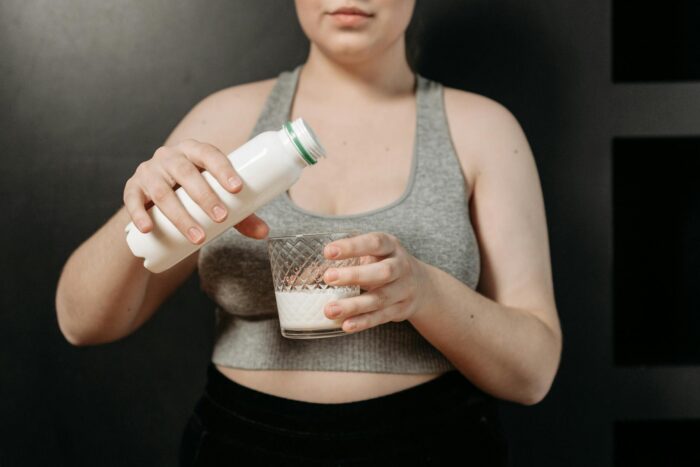
Drink skim milk cold or warm alongside a meal. That’s the simplest option. If you want more flavor, add a little vanilla extract to the milk or blend it with your favorite fruit. That turns an ordinary drink into something sweeter without having to reach straight for the sugary ready-made drinks in the store.
Milk also works well as the base of a protein shake. A shake made with water is lighter; one made with milk is more filling and creamier. If your workout has been long or the gap between meals drags on, a milk-based shake can be a convenient solution. Honestly, many people also find it tastes better.
A good trick is to use milk where it fits anyway: in porridge, smoothies, pancake batter or coffee. That way you don’t have to rebuild your menu. You simply swap some of your liquids for milk and get a bit more protein.
Protein milk FAQ
Can regular milk be protein milk?
Yes, essentially. If milk provides a noticeable amount of protein, it can play the role of a protein drink in a gym-goer’s diet. A product with a separate label isn’t always necessary.
Is skim milk better than full-fat milk?
If the goal is to get protein and keep your fat intake lower, skim milk or milk with up to 1% fat is the more sensible choice. Full-fat milk provides more saturated fat.
Is milk suitable during a competition diet?
It is, if it fits into your daily numbers. Keep in mind that skim milk contains about 90 calories and 13 grams of carbohydrates. At the end of a diet, even small amounts can count.
You’ll find proteins here: https://turg.fitness.ee/et
Author: Mikk-Alvar Olle (transl. Flex)
Source: WHO – physical activity.
Come and train! ArtGym