
At a glance:
- Kettlebell exercises develop strength, balance and endurance at the same time because the movements are explosive and engage your whole body.
- Beginners can start with arc snatches (forward and up), squats and core control exercises — use a light weight and a full range of motion.
- Technique comes before weight: keep your back straight and generate power through your legs and hips, rather than your lower back.
The kettlebell is one of the oldest and most versatile pieces of strength training equipment, and kettlebell exercises work just as well at home as in the gym: a single kettlebell can replace a whole range of equipment. Kettlebells feature prominently in Ervin Liebert’s classic handbook “Athletic Gymnastics” (Atleetvõimlemine): the movements are explosive, use a full range of motion and follow the principle of progressive resistance. In this guide, we look at what kettlebell exercises do for your body, how to perform them correctly and which training plan to start with as a beginner.
What do kettlebell exercises do for your body?
Unlike machines with a fixed movement path, a kettlebell requires constant adjustments to maintain your balance, engaging your smaller stabilizing muscles as well. A classic example in Liebert’s book is the kettlebell arc snatch (forward and up) (exercise no. 90): with your feet apart and knees slightly bent, snatch the kettlebell upward and behind your head with straight arms, extending your body and rising onto the balls of your feet. Liebert notes that this is a general conditioning exercise that places a training load on your back, shoulders and legs, while also benefiting your abdominal muscles. This whole-body involvement is precisely what makes kettlebells effective for developing both strength and overall fitness. Estonian kettlebell sport has reached the top of this discipline — see, for example, Kettlebell World Championships – 3 golds and Estonian Championships in kettlebell snatch to discover how far refining your technique can take you.
How do you perform a kettlebell arc snatch correctly?
Start with your feet apart and knees slightly bent, holding the kettlebell with your arms hanging straight down. Power comes from hip extension, rather than a pull from your arms — your arms simply guide the kettlebell’s movement. Keep your back straight throughout the movement and look straight ahead. At the top, fully extend your body and rise onto the balls of your feet, then lower the kettlebell in a controlled arc. Liebert consistently emphasizes the importance of a full range of motion: move through the greatest possible range, rather than stopping halfway. An overview of the Kettlebell Snatch Championships explores the principles of refining your technique in more detail. A common beginner mistake is trying to “yank” the kettlebell up using arm strength — this puts strain on your shoulders and lower back and causes your technique to break down. Learn the movement with a light weight before increasing it.
What kettlebell training plan is suitable for beginners?
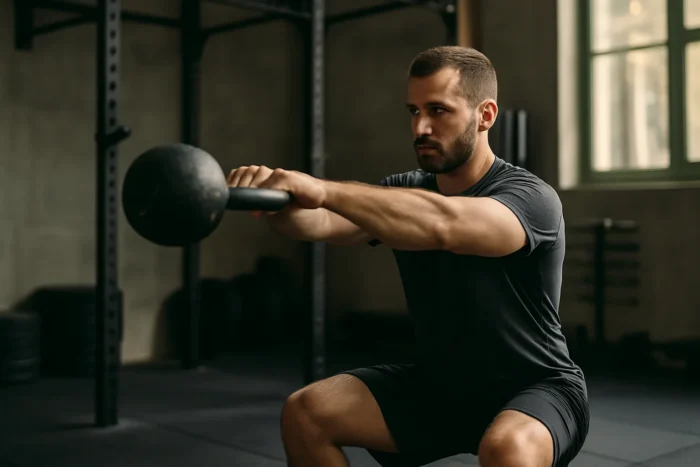
Two to three workouts a week are enough for beginners, with 3–4 sets of 8–12 reps for each exercise. A good starting selection draws on Liebert’s exercises: kettlebell arc snatches (no. 90) for explosive strength; jumps or squats from a deep squat position with a kettlebell (no. 68), holding the kettlebell in front of you with your arms hanging straight down and letting your legs do the work; and core control exercises for your abdominal and back muscles. The World Health Organization recommends muscle-strengthening activity at least twice a week (WHO physical activity recommendations), so just two kettlebell workouts a week meet that target. You can also find examples of how to structure your training week in Two two-day plans, which you can adapt to include kettlebell exercises.
How heavy should your first kettlebell be?
There is a simple rule for choosing a weight: it is right for you if you can complete the prescribed rep count with good form, but the final reps feel challenging. A kettlebell that is too heavy forces you to compromise your technique and increases your risk of injury, particularly during arc snatches and squats. Men often start with a 12–16 kg kettlebell and women with an 8–12 kg kettlebell, but the exact choice depends on your training background. Following the principle of progressive overload, only increase the weight once your technique is consistent and you can complete every rep with good form. If you feel sharp pain in your lower back or discomfort in your joints, stop the exercise and consult a doctor or physiotherapist if necessary.
What are the most common mistakes beginners make with kettlebell exercises?
The most common mistake is using arm strength to perform the movement instead of letting your legs and hips do the work. In the kettlebell arc snatch, this means “yanking” the kettlebell up with your shoulders and arms, which puts strain on your shoulder joint and lower back and disrupts the rhythm of the movement. Another common mistake is rounding your back at the bottom of the movement — Liebert consistently emphasizes a straight back and a full range of motion, because a neutral back position protects your spine. The third mistake is choosing a kettlebell that is too heavy before your technique is consistent: kettlebell exercises require coordination, which comes through practice, rather than adding weight. Beginners also often skip the warm-up — your hip, shoulder and wrist joints should be warm and mobile before explosive movements. A good rule of thumb is to film yourself from the side or have someone more experienced check your technique, because a mistake you do not notice will recur set after set. If you perform up to 12 reps and the final reps still feel easy, it is time to increase the weight gradually — this is progressive overload in practice in kettlebell training.
References
- Ervin Liebert. “Athletic Gymnastics” (Atleetvõimlemine). Online edition, atleetvoimlemine.fitness.ee (exercises no. 68 and 90).
- WHO (2020). Physical activity recommendations (including muscle-strengthening activity at least 2 times a week).
- NSCA (National Strength and Conditioning Association). Resistance Training guidelines for beginners.
Frequently asked questions
Are kettlebell exercises suitable for beginners?
Yes. Start with a light weight and simple movements such as arc snatches and squats, master the technique through a full range of motion, and only increase the weight once you can perform the movements with good form.
How many times a week should you train with kettlebells?
Two to three workouts a week are enough for beginners. WHO recommends muscle-strengthening activity at least twice a week, which kettlebell training easily covers.
How heavy should your kettlebell be?
Choose a weight you can lift for 8–12 reps with good form, with the final reps feeling challenging but without your technique breaking down. Men often start with a 12–16 kg kettlebell, women with an 8–12 kg kettlebell.
What is the most important technique rule?
Keep your back straight and generate power through your legs and hip extension, rather than your lower back or a pull from your arms. A full range of motion and controlled movement matter more than a heavy weight.
Come and play with kettlebells at ArtGym!




