At a glance:
- Doing lower back exercises regularly, 3–5 times a week, significantly reduces the risk of chronic pain.
- Bird-dogs, glute bridges and prone swimming are scientifically proven to be more effective exercises for core stabilization.
- After your first episode of lower back pain, the multifidus muscle does not recover on its own — it needs targeted training.
- If you experience severe sudden pain, numbness in your leg or bladder problems, stop exercising and seek medical attention.
Lower back pain is one of the most common health problems worldwide — according to WHO, it affects more than 600 million people each year. Taking a preventive approach means incorporating lower back exercises into your daily routine before pain develops. This guide draws on clinical studies to explain which movements strengthen your back effectively and safely.
Which lower back exercises are best for strengthening your back?
Core stabilization exercises activate two key muscle groups: the multifidus and the transversus abdominis. The best exercises according to EMG studies confirm that activating these muscles together is critical to lower back health.
The most effective exercises, according to the evidence:
1. Bird-dog
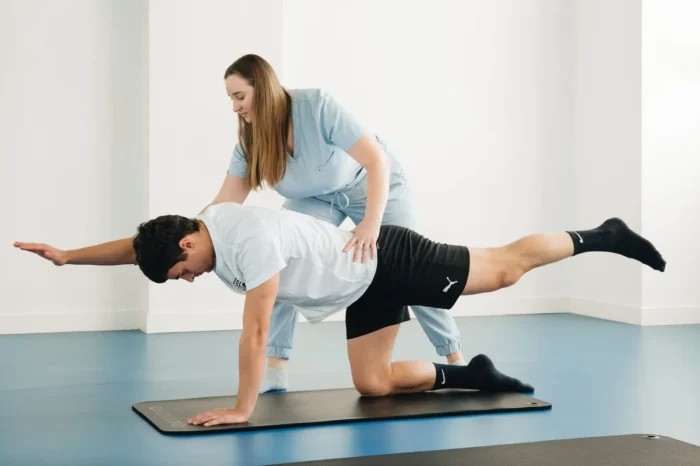
Start on all fours, with your hands under your shoulders and your knees under your hips. Engage your abdominal muscles and glutes. Extend your left arm and right leg simultaneously until they are horizontal. Keep your back straight and avoid tilting your hips. Hold for 3–5 seconds, then repeat on the opposite side. Do 10–12 repetitions on each side.
2. Glute bridge
Lie on your back with your knees bent and your feet on the floor. Press your lower back into the floor, keeping your spine in a neutral position. Lift your pelvis until your body forms a straight line from your shoulders to your knees. Squeeze your glutes and hold for 2–3 seconds. Lower slowly. Do 15 repetitions for 2–3 sets.
3. Prone swimming (superman)
Lie on your stomach with your arms extended overhead. Engage your spinal extensors to lift your arms, chest and legs off the floor simultaneously. Hold for 3 seconds, then lower. Do 10 repetitions.
Studies confirm that regular core stabilization training reduces the intensity of chronic lower back pain by up to 47% (Searle et al., 2015).
How many times a week should you do lower back exercises?
European clinical guidelines for spinal care recommend doing lower back exercises 3–5 times a week for 15–20 minutes per session (Airaksinen et al., 2006). Progression is important: start with easier variations and gradually increase your training load.
Recommended training frequency by level:
- Beginner (0–4 weeks): 3 times a week, 2 sets of each exercise, focusing on technique
- Intermediate (1–3 months): 4 times a week, 3 sets, adding weight or variations
- Advanced (3+ months): 5 times a week, more advanced variations and functional movements
Training using the Pilates method offers an excellent alternative to conventional strengthening exercises, especially if your joints need a gentler approach — Pilates emphasizes the same neutral spinal alignment recommended in clinical guidelines.
Why is multifidus training so important for preventing lower back injuries?
The multifidus is a small but extremely important muscle group that forms the spine’s primary protective mechanism. A landmark study by Hides et al. (1996) showed that after the first episode of lower back pain, the multifidus does not recover on its own — it needs targeted training. Without rehabilitation, the muscle atrophies, significantly increasing the risk of recurrent injuries.
To better understand how to get rid of lower back pain and reduce lordosis, you need to know that hyperlordosis often develops because of weak core muscles — and the same set of exercises treats both problems.
The core stabilization system consists of three components that must work together:
- Passive system — the vertebrae, discs and ligaments of the spine
- Active system — back muscles, abdominal muscles and the pelvic floor
- Neural control — coordination of the muscles by the central nervous system
A meta-analysis by Wang et al. (2012), which included 14 randomized controlled trials, found that core stabilization exercises are statistically significantly more effective than general physical training at relieving chronic lower back pain.
How do lower back exercises affect athletic performance?
Lower back strength helps prevent pain and provides a foundation for athletic performance. Force is transferred through your core: a weak back means power is lost with every movement. Interestingly, basketball players who want to jump higher also consider core and lower back strengthening exercises an integral part of their training programs — core strength translates directly into greater explosive strength in the legs.
McGill (2010) emphasizes that you should always maintain a neutral spine during core exercises. Excessive lumbar flexion under a heavy load can damage an intervertebral disc, which is why technique matters more than rep count.
When should you see a doctor or physiotherapist?
Some symptoms require immediate medical attention and a temporary break from exercise. Stop exercising immediately and seek medical attention if you experience:
- Severe sudden pain, especially after an injury
- Pain that radiates down your leg (possible sciatica, or inflammation of a spinal nerve root)
- Numbness, tingling or weakness in your limbs
- Problems with bladder or bowel control
- Fever accompanied by back pain
WHO recommendations and Estonian Health Board guidelines emphasize that if you have chronic back pain (lasting more than 3 months), you should see a specialist who can develop an individual rehabilitation program. In Estonia, you can see a physiotherapist through a referral from your family doctor or privately.
References
- Searle A, Spink M, Ho A, Chuter V (2015). Exercise interventions for the treatment of chronic low back pain: a systematic review and meta-analysis of randomised controlled trials. Clinical Rehabilitation. 29(12):1155–1167. PMID: 25681408
- McGill SM (2010). Core training: Evidence translating to better performance and injury prevention. Strength and Conditioning Journal. 32(3):33–46. DOI: 10.1519/SSC.0b013e3181d7b109
- Hides JA, Richardson CA, Jull GA (1996). Multifidus muscle recovery is not automatic after resolution of acute, first-episode low back pain. Spine. 21(23):2763–2769. PMID: 8855462
- Airaksinen O, Brox JI, Cedraschi C, et al. (2006). Chapter 4: European guidelines for the management of chronic nonspecific low back pain. European Spine Journal. 15(Suppl 2):S192–S300. PMID: 16550448
- Wang XQ, Zheng JJ, Yu ZW, et al. (2012). A meta-analysis of core stability exercise versus general exercise for chronic low back pain. PLOS ONE. 7(12):e52082. PMID: 23284879
Frequently asked questions
Can you do lower back exercises every day?
You can do gentle stabilization exercises such as bird dogs and bridges every day, but more intense strengthening exercises require 24–48 hours of rest for muscle recovery. The optimal frequency is 3–5 times a week.
Which lower back exercises are suitable for beginners?
Bird dogs, bridges and knee-to-chest stretches are best suited to beginners, as they do not put excessive strain on the intervertebral discs. Start with 2 sets of 10 repetitions and gradually build up from there.
Can lower back exercises help if you already have pain?
If you have mild to moderate pain, carefully performed stabilization exercises are often beneficial, but you should stop exercising if you have severe, acute pain. If you have chronic pain, consult a physiotherapist before you start training.
How long does it take to notice results?
The first noticeable results — less pain and greater mobility — usually appear after 4–8 weeks of regular training. Improvements in muscle tone and strength can be felt after 8–12 weeks.
Can you do lower back exercises at home without equipment?
Yes, you can do most of the more effective lower back exercises — bird dogs, bridges and prone swimming — at home without any equipment. All you need is enough floor space for a mat.
Come and train! ArtGym