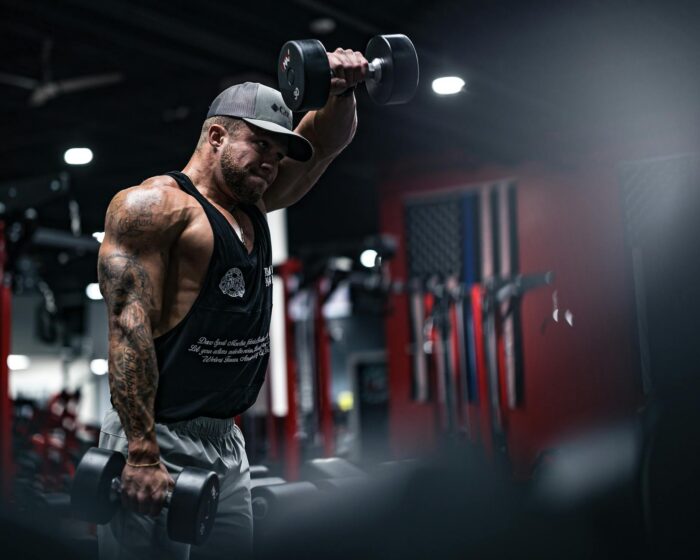
Mountain Dog training: shoulders
Here is another installment on what “Mountain Dog” gets up to. I’m skipping the long introduction, where the man describes where and how he picked up his knowledge, and trying to pass on the more practical, useful part. In short, it’s largely what you could call a street education, but it obviously works.
He has also struggled with shoulder width. His thick neck, already 42 cm at the end of high school and 46 cm in college, only made his poor shoulder genetics more obvious.
He starts by stressing the importance of the rear delts, and I fully agree with him on this. For a great many people the rear delt is a badly lagging area, and it leaves a big empty spot on the back when seen from behind. Personally, I think quite a few men could actually start their shoulder training with the rear delts, though it’s certainly not a must.
I’ve tried the free-weight tricks myself, and they’re quite good and interesting. They work great as the first exercises, but also as the second or third exercise after heavy presses, or right at the very end as a finisher for your shoulder workout. Using ultra-long sets for the rear delts is a rather interesting approach. “Six Moves”, “Front and Back”, “Shocking Finisher” and the ultra-long sets are all pretty good, refreshing approaches. “Six Moves” and “Front and Back” work great both at the start of a shoulder workout as a warm-up for the shoulders, and in the middle or at the end of the workout to give the shoulders a final polish.
Unfortunately I don’t have access to machines, so I can’t comment on them. Drop sets have always had their place in shoulder training. If you try the “Shocking Finisher”, I recommend starting with 40/20/10 reps, otherwise keeping the mind-muscle connection becomes very hard. It gets hard with a set this long anyway, but it can be done, and I find that feeling the rear delt while performing this marathon is precisely the key from a development standpoint. Now on to the article itself:
Mountain Dog training: rear delts
Train your rear delts. My first recommendation for shoulder training is to train the rear deltoids. It has become fairly clear that working the rear delts only through heavy back training is most likely far from always enough to look impressive from behind. It may work if you’ve been blessed genetically with a good back and rear side, but otherwise it won’t. Rear delt development is extremely critical, especially in poses where you stand side-on or half-side-on. A well-developed rear deltoid gives you a very powerful, thick and massive 3-D look from the side. That look will clearly set you apart from the others on stage.
Most of the time, train the rear delts with very long sets. After years of observation, I’ve concluded that the rear delt head responds very well to long and ultra-long sets. That burning sensation can be painful and tests your willpower, but if you can get through it, you’ll get your rear delts growing as well. Try the rep and set schemes below for a month and you’ll understand well what I’m talking about.
For the next four weeks, use the following approach for your chosen rear delt exercise. You can also swap the exercise every week.
Week I – 4 sets: 35 reps
Week II – 4 sets: 20 – 25 reps
Week III – 4 sets: 12 – 15 reps
Week IV – 4 sets – regular pyramid: 35 x; 25 x; 15 – 20 x; 8 – 12 x.
Do 4 sets with these rep counts. By the way, I increase the weight on every set myself.
Once a month, use a shock technique on the rear delts: heavy weight and a long set. How do you do it? I use the following method once a month in the period between competitions, and twice a month before competitions.
The shoulder workout “Shocking Finisher” goes like this: lie face down on an incline bench with your arms hanging straight down and heavy dumbbells in your hands. Be sure to use wrist straps, because the set is long and gripping can become difficult. Let’s start swinging:
1. Do 60 reps with heavy dumbbells. These are really partial reps, just swings like this.
2. Once you’ve done 60 reps, put the dumbbells down, immediately pick up a weight that is half of the first set’s weight and do the next set in the same style, but now 30 reps.
3. Once you’ve done 30 reps, halve the weight again and do 10 reps, but try to do these 10 reps with a full range of motion. Hold the peak contraction at the end of each rep for 2 seconds.
Watch the execution HERE.
Combined training for the front and middle delts
As a rule, I don’t do many isolation exercises for the front delts. I prefer to focus on exercises and approaches that load both the front delts and the middle delt head at once.
* Do incline presses for your chest every week. From my chest training you’ll remember that I also used incline presses to build shoulder width. I’ve noticed that when I leave out chest presses on a positive incline, my shoulders start to lose width and fullness. That’s how it is, and I’m sure of it. For incline presses I use a regular pyramid and don’t go through the full range of motion. To spare my shoulders, I lower the weight only a couple of inches. I also like training chest and shoulders together. I feel it works well.
* ”Six Moves”. This is a good combination that works. Sit with dumbbells in your hands, hanging down. Raise the dumbbells to the sides, from the sides to the front, from the front overhead, from overhead down to the front, from the front out to the sides, and from the sides back down. Everything I just described makes only one repetition, and you do all of it under control. Don’t drag it out excessively, but stay in control. I use 5 kg dumbbells for this exercise, and I don’t think there’s any point in overdoing the weight. I usually do sets of 10 repetitions.
Watch the execution HERE.
* Press sensibly. Pressing heavy weights every week has seriously injured my shoulders, and I don’t intend to ever do that again. My training philosophy is definitely also injury-free training. I do use presses when training my shoulders, but I do them in my own way:
1. Front and back. As the name suggests, you take a barbell and lift it over your head, moving it to the front and then to the back. These are a kind of half press, where you carry the barbell forward and back. One front-and-back pass makes one repetition. Do this exercise standing. Use a rep range of 8 – 12 repetitions. The exercise is very similar to the Bradford press.
Watch the execution HERE.
2. Ultra-wide press. This is basically a standing press, but take a very wide grip on the barbell. Lower the barbell to your chest. This position may feel awkward at first, because your shoulders aren’t used to such a position and range of motion, but you’ll soon adapt and enjoy the exercise. It’s a hard exercise, so don’t use heavy weight. I do sets of twelve and fifteen repetitions myself, with 30 – 40 kg.
Watch the exercise HERE.
3. Press in the rack. A standing press using a power rack for support. This kind of press adds some extra resistance and also gives good stability. Once the barbell is pressed overhead, tilt it forward; this helps you work the shoulders as hard as possible. I learned this exercise from the guys at Westside and still do it from time to time. It also works the trapezius nicely.
Watch the execution HERE.
Middle head of the shoulder muscles
There are excellent intensity techniques for loading the middle head of the shoulder muscles. Of the many options, these are also the safest in terms of injury risk and the most effective.
* Heavy negatives on the lateral raise machine. A phenomenal exercise. The correct way to do it is to perform the positive phase of the exercise on your own, as usual, but in the negative phase ask your training partner to add extra resistance. I love this exercise because it’s safe, and I can feel how this kind of execution recruits the deep fibers of the shoulder muscles.
Watch the execution HERE.
* Heavy weight and a long set on standing lateral raises (partial repetitions). Use a heavy weight on standing lateral raises and do a long set. Your arms should be bent only slightly at the elbow. Sets of 25 – 35 repetitions are appropriate with this approach. I demonstrate this exercise as the second exercise in the previous demonstration.
* Drop sets… dumbbell lateral raises standing (or on a machine). You’ve probably already done this yourself, so I won’t explain it at length. I’ll just say that it’s effective.
Sample workout
I usually train shoulders in two phases. In the first phase, the shoulders get a total of 8 working sets. That may seem like very little, but don’t forget that I always do chest training beforehand.
Phase I
1. Heavy dumbbell lateral raises with partial repetitions – 4 x 35
2. Rear shoulder on the machine – 3 x 35
3. “Shocking Finisher” – 1 set
Phase II (12 working sets in total)
1. Standing front-and-back barbell press – 4 x 12
2. Bent-over cable flyes – 4 x 25 (I hold the peak contraction for 2 seconds)
3. Seated “Six Moves” with dumbbells – 4 x 10
Summary
Like my back, my shoulder genetics aren’t the most perfect either. Once again, it’s creativity, a different approach, special techniques and pushing past pain thresholds that have started to make my shoulders grow. Maybe I’ve been able to help so that you don’t have to go through my long wandering.
There are always genetic freaks who grow from even the lightest training, but if you aren’t a genetically blessed freak, you can find a lot of help in my techniques.
Author: Janar Rückenberg (translation)
Come and train! ArtGym