At a glance:
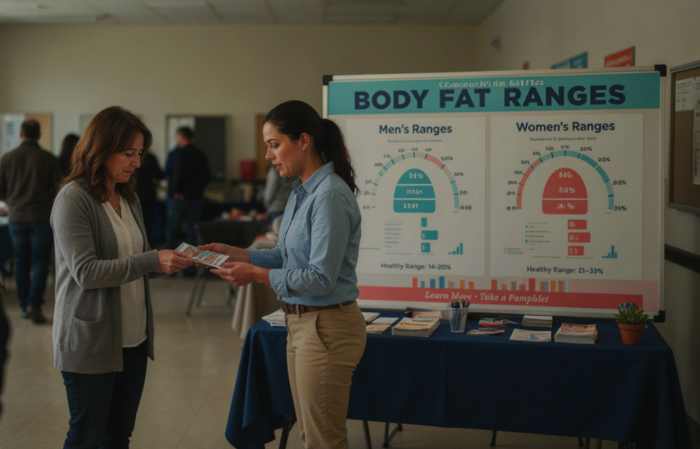
- For young adults, around 8–19% body fat in men and 21–32% in women is considered consistent with a healthy range according to a BMI-based model (Gallagher, 2000).
- The normal body fat percentage range shifts upwards with age because fat-free mass is usually lower at the same body mass index (Gallagher, 2000).
- One measurement does not establish a diagnosis: trends, waist circumference, blood test results, how you feel, and consistency in strength training and nutrition matter more.
Body fat percentage tells you how much of your body weight is fat tissue, but on its own it cannot tell you whether you are healthy, strong or fit. From an evidence-based perspective, a normal body fat percentage is a range, not a single magic number, and it needs to be interpreted alongside sex, age, muscle mass, training history and health markers.
What is a normal body fat percentage for men and women?
The most common question is what body fat percentage is normal. A useful starting point is the model developed by Gallagher and colleagues, which linked body fat percentage to the internationally used healthy body mass index range of 18.5–24.9 and used this to establish practical body fat ranges (Gallagher, 2000).
According to this approach, approximately 8–19% body fat in men and 21–32% in women is consistent with a healthy BMI range at ages 20–39 (Gallagher, 2000). At ages 40–59, the corresponding ranges are around 11–21% for men and 23–33% for women (Gallagher, 2000). At ages 60–79, the range shifts to around 13–24% for men and 24–35% for women (Gallagher, 2000).
These numbers do not mean that anyone outside the range is automatically unhealthy. They are estimated limits that help put body weight into perspective. The same body weight can reflect very different body compositions: one person may have more muscle mass, while another weighs the same but has more fat mass. For a broader look at the topic, see Body fat percentage: what percentage is normal?.
Why is the normal body fat percentage higher for women?
On average, women need and naturally carry greater fat reserves than men. The reasons relate to hormonal function, reproductive health and body structure. In Gallagher’s model, the ranges consistent with a healthy BMI were higher for women than for men in every age group (Gallagher, 2000). An analysis based on NHANES 1999–2004 data also found that body fat percentage cutoffs were higher for women than for men (Heo, 2012).
The practical takeaway is simple: it does not make sense to assess men and women using the same chart. Nor should you treat the condition bodybuilders achieve for the stage as a benchmark for health. For some athletes, a very low body fat percentage may represent a short-term competition condition, but it is not a suitable everyday health goal for many people. Being normal does not have to mean blending in with the average; this reflection from the Fitness.ee archive offers a fitting perspective: I don’t even want to be normal….
How do you measure body fat percentage, and how accurate is it?
The most accurate methods are the multicomponent models used in research settings, but you are more likely to encounter bioimpedance scales, skinfold measurements, DXA or visual assessments. Home scales can be useful for tracking trends, but you should not read too much into the absolute value of a single reading. A systematic review of bioimpedance compared devices with a four-component model. Across 12 studies, the average difference in body fat percentage ranged from around −3.5 to +4.4 percentage points, while individual limits of agreement often spanned 15 to 20 percentage points (Oliver, 2026).
It therefore makes more sense to measure under the same conditions: in the morning, with similar hydration levels and following a similar training load. If your average body fat percentage across several measurements is falling, your waist circumference is shrinking and your strength is holding steady, that tells you more than a single random number on a screen.
How can nutrition help reduce body fat percentage?
Body fat percentage falls when fat mass decreases and fat-free mass is preserved as much as possible. This does not require an extreme diet. An energy deficit, adequate protein intake, foods rich in dietary fiber and strength training are more practical than demonizing individual foods. WHO emphasizes balance, moderation, variety and nutrient density in healthy eating; Estonia’s national recommendations on the TAI website support the same approach. For background, see WHO’s principles of healthy eating and the TAI publication Estonian national recommendations for nutrition, physical activity and sleep duration.
A comparison of intermittent fasting and continuous energy restriction based on 28 randomized trials found that intermittent energy restriction offered no clear advantage over continuous energy restriction for changes in body mass or fat mass; the studies lasted 2–52 weeks (Schroor, 2024). This suggests that, when it comes to changing body fat percentage, how manageable your diet is and how consistently you follow it matter more than the particular name given to your fasting window.
It is also worth protecting your muscle mass. A meta-analysis of 114 studies in people with overweight or obesity found that strength training combined with calorie restriction was the most effective approach for reducing body fat percentage, with an estimated effect of −3.8 percentage points compared with groups receiving no intervention (Lopez, 2022). The same analysis found that strength training helped preserve or increase fat-free mass, which is central to body recomposition (Lopez, 2022).
When should you worry about body fat percentage?
Rather than worrying, it makes sense to look at the whole picture. If your body fat percentage is high, your waist circumference is increasing, your blood pressure or blood sugar is outside the normal range and your mobility is declining, that is a reason to take action with your family doctor, a dietitian or a trainer. If your body fat percentage is very low and you also experience fatigue, feeling cold, reduced libido, menstrual cycle disturbances or declining training performance, a lower number is no longer better.
A good goal is not the lowest possible body fat percentage at any cost, but a body composition you can maintain without constant hunger, compulsive exercise or social isolation. If the sheer volume of health information leaves you confused, you could also read Top 5 health articles for a change of pace and keep your focus on the basics: regular physical activity, adequate sleep, a sensible food environment and recovery. When it comes to nutrition myths, it is also worth taking a critical view of claims that your health depends on a simple acid–alkaline framework; the related article pH and healthy eating explores this topic.
References
- Gallagher D, Heymsfield SB, Heo M, Jebb SA, Murgatroyd PR, Sakamoto Y (2000). Healthy percentage body fat ranges: an approach for developing guidelines based on body mass index. The American Journal of Clinical Nutrition. PMID: 10966886. DOI: 10.1093/ajcn/72.3.694
- Heo M, Faith MS, Pietrobelli A, Heymsfield SB (2012). Percentage of body fat cutoffs by sex, age, and race-ethnicity in the US adult population from NHANES 1999-2004. The American Journal of Clinical Nutrition. PMID: 22301924. DOI: 10.3945/ajcn.111.025171
- Oliver CJ, Del Vecchio L, Minehan M, Climstein M, Tinsley GM (2026). The Validity of Bioelectrical Impedance Analysis Compared to a Four-Compartment Model in Healthy Adults: A Systematic Review. Journal of Functional Morphology and Kinesiology. PMID: 41718193. DOI: 10.3390/jfmk11010065
- Schroor MM, Joris PJ, Plat J, Mensink RP (2024). Effects of Intermittent Energy Restriction Compared with Those of Continuous Energy Restriction on Body Composition and Cardiometabolic Risk Markers – A Systematic Review and Meta-Analysis of Randomized Controlled Trials in Adults. Advances in Nutrition. PMID: 37827491. DOI: 10.1016/j.advnut.2023.10.003
- Lopez P, Taaffe DR, Galvão DA, Newton RU, Nonemacher ER, Wendt VM, et al. (2022). Resistance training effectiveness on body composition and body weight outcomes in individuals with overweight and obesity across the lifespan: A systematic review and meta-analysis. Obesity Reviews. PMID: 35191588. DOI: 10.1111/obr.13428
Frequently asked questions
What is a normal body fat percentage for men?
For young adult men, approximately 8–19% body fat is consistent with a healthy range according to a BMI-based model, but the normal range shifts higher with age (Gallagher, 2000).
What is a normal body fat percentage for women?
For young adult women, approximately 21–32% body fat is consistent with a healthy range according to the same model. For physiological reasons, the range for women is higher than for men (Gallagher, 2000).
Do home smart scales measure body fat percentage accurately?
Home bioimpedance scales are better suited to tracking trends, as studies show that individual readings can differ substantially from those obtained using a reference method (Oliver, 2026).
Do you need to practice intermittent fasting to lower your body fat percentage?
No. A meta-analysis of randomized trials found that intermittent energy restriction was not clearly superior to continuous energy restriction in terms of changes in fat mass (Schroor, 2024).
What helps reduce body fat percentage without losing muscle mass?
The most practical combination is a moderate energy deficit, adequate protein and strength training; a meta-analysis found that strength training combined with calorie restriction reduced body fat percentage and helped preserve fat-free mass (Lopez, 2022).
Come work out! ArtGym