
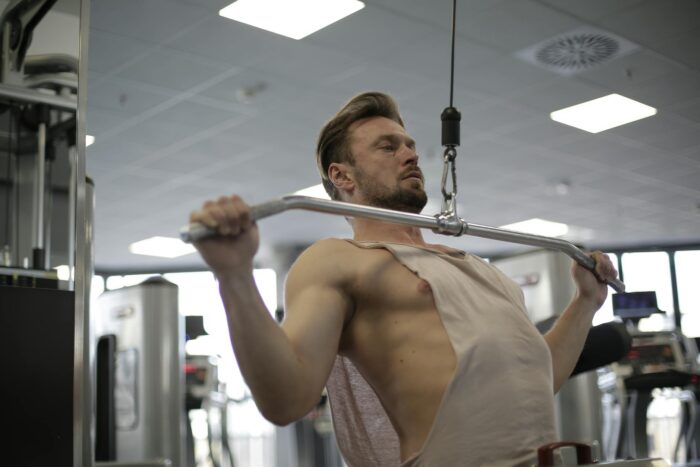
Off-season training between competitions
Training between competitions isn’t simply “do more and hope for the best.” This is the period when you have to keep muscle mass, strength, rep tempo and recovery working together, because one weak link quickly wrecks the whole plan.
Below is a practical framework for choosing exercises, sets, reps, rest intervals and aerobic work in the mass phase. The principle is simple: as much as necessary, and as little as possible.
Why does training in the mass phase have to be precise?
In the mass phase there’s often a temptation to simply add more exercises, sets and weight. At first glance that seems logical. If more work gives more results, why not do endless sets? In bodybuilding, it doesn’t work that way.
For a large muscle group you usually pick 3 – 5 exercises, with 5 being the rarer choice. For a small muscle group, 2 – 3 exercises are usually enough. The exercise order should go from larger and heavier to smaller and more isolated. You start with movements that recruit many muscles and finish with an exercise where the target muscle gets more precise work.
For example, a chest workout can look like this:
- Bench press
- Flyes on a flat bench or barbell press on an incline bench
- Incline dumbbell flyes
- Chest machine, also known as the pec deck (butterfly)
Lat training can start with the pullover and move on to heavier rows:
- Pullover
- Bent-over barbell rows
- Bent-over dumbbell rows, one arm at a time
- Seated pulldowns behind the neck
The point here isn’t that exactly these plans suit everyone. The point is the order. Big, technically demanding exercises are done while the nervous system is fresh. Isolation work comes at the end, when the weight no longer has to be the main yardstick.
Training, sets and reps in the mass phase
The number of sets doesn’t have to be as high as possible. For large muscle groups people generally do 10 – 15 sets, for small muscle groups 6 – 12 sets. Whether you choose 10 or 15 sets, or 6 or 12 sets for a small muscle, depends on how you feel, your nutrition and your recovery.
An important yardstick is intensity. It depends on the resistance used and the length of the rest intervals. Endless low-tension sets don’t add much from a mass-gaining standpoint. They tire you out, but they may not stimulate the muscle enough to make it grow.
The rep count per set depends on the muscle, the exercise and the person. Large muscles need not only a medium and high rep count but also a low rep count with heavy resistance. In the squat, deadlift and presses, the rep count in the last sets can be quite low. With heavy basic exercises you sometimes reach such heavy weights that you do only 1 – 2 reps.
There’s a simple link behind this: muscle strength and muscle mass are connected. Lifting heavier weights for a low rep count helps recruit new motor units. When you later use a higher rep count, those units get a better growth stimulus.
The difference between muscle fibers matters too. When type I fibers dominate, a higher rep count often suits better: 10 and more. You could reach failure at around 12 – 15 reps. When type II A and II B fibers predominate, on average 4 – 12 reps can work well in the mass phase.
For a genetically average trainee, the rep range is indeed 4 – 12. One practical option is to do the first set with a weight at which failure comes at 12 reps, the second at 10 reps, the third at 8 reps and the fourth at 4 – 6 reps. This isn’t a sacred rule, but a workable starting point.
Honestly, this is exactly where many people get stuck on a plateau. They aren’t training too little, they’re training too uniformly.
Rep speed: training isn’t only about weight
Rep execution speed (Estonian: KSK) means how fast a single rep is performed. In English, the term time under tension, or TUT, is often used. Put simply: how long the muscle is actually under tension during one rep and one set.
Rep speed distinguishes between the concentric, or positive, phase and the eccentric, or negative, phase. Fast reps often allow you to use a heavier weight. A slower, more controlled rep keeps the muscle under tension for longer. For hypertrophy, both the magnitude of the tension and its duration matter.
For muscle building, the concentric phase of a rep could last 2 – 3 seconds and the eccentric phase 3 – 4 seconds. This keeps the movement under control and gives the muscle enough time under tension. When developing strength and speed, the tempo is often faster, which is why weightlifters and powerlifters look different from bodybuilders. That said, a bodybuilder’s training cycle should also include strength phases.
An advanced lifter can split a repetition into 3 or even 4 parts. A four-part notation accounts not only for the positive and negative phases but also for the pauses at the start and end of the movement. For example, a barbell biceps curl could be written like this:
- 3 eccentric phase
- 0 at the point where the muscle is at maximum stretch
- 2 concentric phase
- 0 at the end position of the movement, when the muscle is contracted
If the goal is relative strength and speed, a set can last 20 seconds or less. To build muscle, a set should last at least 30 seconds, and better still 40 – 70 seconds. A simple calculation, 32/8 =4 and 40/8=5, shows that if your average rep count for mass gain is 8, one repetition should last at least 4 – 5 seconds.
In practice, this tends to fall apart, especially for beginners who try to move too heavy a weight at any cost. Control disappears, the tension ends up in the wrong place and the risk of injury goes up.
If type I fibers dominate, a set can last longer: 70, even up to 90 seconds. If fast-twitch muscle fibers predominate, a set is usually shorter: 30 – 50 seconds. The assumption is that one repetition lasts 4 – 6 seconds. That 4 – 6 seconds comes from the fact that different authors give slightly different ranges.
Not all exercises can be done with the same scheme. For example, the scheme 3 0 2 – 0 may not suit every movement. In dumbbell lateral raises, the deltoid is not under high tension in the bottom position. If you hold it there too long, it becomes more of a half-rest. In presses, squats and leg presses, the tension can actually drop at the end if you lock out your elbows or knees.
The summary? KSK is a powerful tool. In a mass phase, set length should not fall below 30 – 40 seconds if the goal is primarily muscle mass. Below that, the emphasis shifts more toward relative strength and speed.
Workout length, rest and recovery
Workouts should be short but intense. If you train one muscle at a time, the workout should not exceed 45 – 60 minutes. For two muscles, such as chest and triceps, the workout could stay within 75 – 90 minutes.
A long workout raises the level of catabolic hormones, especially cortisol. Cortisol is involved in breaking down muscle proteins and can start to pull your intensity down. When glycogen stores are empty, the body looks for extra energy elsewhere. Part of it can come at the expense of amino acids taken from muscle tissue.
That is why many advanced lifters split the body into smaller parts across their workouts. If the plan is chest/triceps, chest can be in the morning and triceps in the evening. With intense work, both can be done in about 40 – 45 minutes. This isn’t necessary for everyone, but it shows the principle: quality before dragging it out.
Rest intervals in a mass phase usually fall between 1 – 3 minutes. If you use about 70% resistance and do 12 reps, the rest can be 1 minute to a minute and a half. If the resistance is 90 percent, the rest can stretch to 2 – 3 minutes. Heavy compound exercises, such as the squat, deadlift and pull-ups, usually require more recovery time.
That doesn’t mean 1 – 3 minutes is set in stone. If you have recovered, the rest can also be 45 seconds. On the other hand, rest that drags on beyond 3 minutes often lowers the intensity of the workout. The average, practical rest interval among bodybuilders is 1 – 1.5 minutes.
Sports scientists have also put forward the idea that before starting a new set, your heart rate should recover to at least 100 beats per minute. This, too, is individual. Some people’s breathing settles earlier, others’ later. Pay attention to what actually happens in your working sets.
How do you break out of a training plateau?
The first rule of bodybuilding is that training must be progressive. This applies equally to a genetic phenomenon and to a hardgainer. If you do the same exercises, the same weights and the same reps month after month, the body adapts. Progress slows down or stops.
The standard scheme 4*12-6 or 4* 12 – 6 can be a good base. But that doesn’t mean this is the only way to train. Continuous progress needs periodization. Rep ranges can be divided, for example, like this: strength phase 3 6, mass + strength 5 9 and predominantly hypertrophy 7 12, even up to 15 reps.
If you are in the 9 5 phase, 2/3 of your sets can stay in that range and 1/3 outside it. With twelve working sets, this means 8 sets are in the priority range and 4 sets elsewhere: a couple of sets in the strength range and a couple in the 7 12 range. That way, neither strength nor mass drops off too quickly.
Good training surprises the muscle. That doesn’t mean chaos, but organized disorder. The lifter changes the exercises, their order, the sets, reps, tempo and rest intervals so that the muscle has to adapt all over again. Weider principles can help here if you use them thoughtfully, not simply to generate fatigue.
The main ways to vary your training
- Manipulating the weekly plan. Change the days you train each body part and combine muscle groups differently. For example, chest with triceps instead of chest with shoulders.
- Changing the exercise order. Sometimes start with the exercise you usually finish with. For example, do flyes before pressing.
- Manipulating the rep count. Don’t stay in one range for too long. Alternate between the ranges 3 – 6; 5 – 9; 7 – 12.
- New exercises. Try exercises and machines you have used little so far.
- New techniques and variations of old exercises. Change the angle, grip, incline or handle.
- Manipulating the speed of each repetition. If a repetition normally lasts 3 – 5 seconds, occasionally try 8 – 10 seconds or negative training.
- Using different methods to vary and intensify your training. Use methods systematically, not at any cost.
Aerobic training and mass-building exercises
Aerobic training is usually kept to a minimum during a mass-building phase, because a high aerobic volume can conflict with strength and mass work. That doesn’t mean aerobic work is off limits. A sensible minimum, for example 2 – 3 aerobic sessions of about 25 – 30 minutes per week, can help keep your body fat percentage in check and make the transition to the pre-contest regimen easier.
Your choice of mass-building exercises should cover the larger areas of the body. The list below keeps the original logic and gives you a practical base to build your own plan from.
Mass-building exercises by muscle group
- TRAPS: barbell upright rows, shrugs.
- DELTOIDS: seated presses behind the neck and in front, dumbbell presses, incline front presses with a barbell or dumbbells, Arnold presses.
- LATS: wide-grip pull-ups to the front and behind the neck, bent-over rows, pulldowns to the chest with a palms-facing or wide grip, behind-the-neck pulldowns, T-bar rows.
- LOWER BACK: deadlift, weighted back extensions, deadlift with the legs kept still.
- CHEST: bench press with a barbell or dumbbells, incline presses, decline presses, dumbbell pullover.
- BICEPS: standing barbell curl, seated preacher curls, underhand-grip pull-ups, seated incline dumbbell curls and standing dumbbell curls.
- TRICEPS: weighted dips, close-grip bench press, French press, cable pushdown.
- QUADRICEPS: squat, barbell back squat, leg press, barbell front squat.
- HAMSTRINGS: lying leg curl, straight-leg deadlift.
- CALVES: seated calf raise, standing calf raise, bent-over standing calf raise with added weight, calf press on a leg press machine.
The exercise list is not a command. It’s a toolbox. Pick the movements that suit your build, technique and recovery. If an exercise causes pain or your technique falls apart, it isn’t the best choice for you at the moment.
FAQ: training between competitions
How long should a workout in the mass-building phase be?
When training one muscle, keep the session to about 45 – 60 minutes. For a workout with two muscles, a sensible limit is 75 – 90 minutes. Longer is not automatically better, especially if your intensity drops.
Do you always have to do 4 – 12 repetitions in the mass-building phase?
No. 4 – 12 is a good basic range, but progress requires variety. Use phases such as 3 – 6, 5 – 9 and 7 – 12, and if needed even up to 15 repetitions.
Does aerobic training interfere with building mass?
Too much volume can interfere, but a small amount can be useful. For example, 2 – 3 aerobic sessions of about 25 – 30 minutes per week help you keep your condition under better control.
I put this article together mostly from my own knowledge, experience and reading, and it is a chapter that was once planned for a thesis. There is nothing groundbreaking here, but it brings the main training principles and positions into focus. Repetition is the Mother of Wisdom, after all!
Author: Janar Rückenberg
Come and train! ArtGym




