Olev Annus: a classic of Estonian bodybuilding
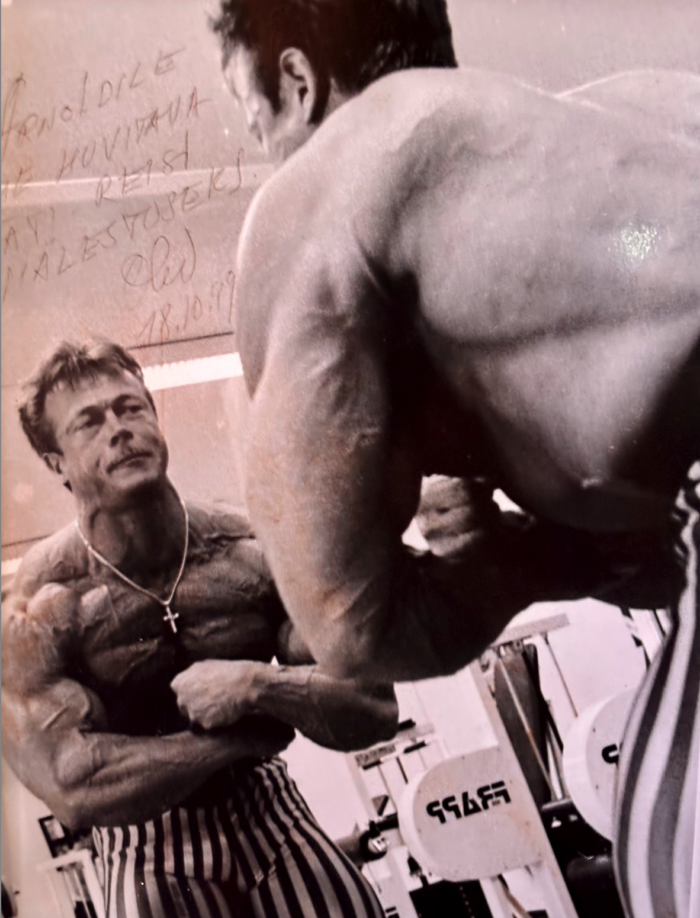
Olev Annus is not just an old name from the archives of Estonian bodybuilding. He is a man whose victories, stage condition and stubborn determination still serve as the yardstick by which many people judge our bodybuilding history.
This story sums up his journey in human terms: where it all began, how people trained at a time when gyms were scarce, and what today’s trainees can genuinely learn from it.
Why is Olev Annus a classic of Estonian bodybuilding?
Olev Annus was born on April 26, 1951, in Kohtla-Järve. His athletic career did not begin on a bodybuilding stage but in a wrestling hall. At around 15, he trained on Rataskaevu Street in Tallinn, where the same building housed a wrestling hall, a boxing club and a weightlifting floor. The young boy’s role models were, naturally, Georg Lurich and Georg Hackenschmidt. In those days, such names stood as symbols of strength and willpower.
Wrestling demanded more strength, and that is how the barbell ended up in his hands. Annus himself has recalled that he did with the barbell whatever he knew how to do. He no longer remembered his exact first strength training session, but one thing stuck: his muscles began to grow and his strength went up.
A major turning point came with the publication of Ervin Liebert’s book “Athletic Gymnastics”. It became his first coach. Not a person, but a book. Today that sounds a little unbelievable, since you can find training programs in a matter of seconds. In 1960s and 1970s Estonia, however, good information was a treasure in its own right.
Results came quickly. At the Tallinn Kalev freestyle wrestling championships, he beat his opponents in less than a minute. Then came a knee injury, and wrestling was set aside. Bodybuilding remained.
After serving in the Soviet army, Annus studied at the Faculty of Physical Culture of the Tallinn Pedagogical Institute. It was no random choice. If the goal was to become a Soviet Union champion, he had to understand physiology, anatomy, nutrition and muscle development. A simple truth: willpower alone is not enough if you don’t understand how the body works.
By his recollection, his first competition took place in Tallinn in 1972. The result was the Estonian junior overall champion title. Already in 1973, he competed among the adults and won the title of Estonian overall champion. The hall was packed, the audience was fully behind him, and the next day the young athlete felt as if everyone he met on the street recognized him.
Later came bigger names, bigger stages and bigger pressure. Annus’s most important achievement remained his NABBA Professional Universe win. In the bodybuilding world, the name of Arnold Schwarzenegger is also associated with the same title. In the professional class there were no weight or height categories. Everyone lined up together. That is what makes the win carry so much weight even today.
How Olev Annus trained and ate
In summer, he trained in Rahumäe. He and his buddies built a training room in the yard, with a roof and a floor. A barrel of water sat on the roof. When the sun warmed the water, you could wash off with lukewarm water after training. For its time, that was a luxury.
In winter, he trained in the TPI weightlifting hall. He also went to the Mining Technical School’s hall and later to the Tartu Road gym. For a while, the area beneath the Song Festival stage served as the headquarters of Estonian bodybuilding, but the trip there from Mustamäe was not tempting every day. He did not complain much about the conditions. Dumbbells, barbells and a few machines were available.
In Finland, the picture changed, though not right away. At first, the training conditions did not seem enormously different from Estonia. Later, at Gold’s Gym on Mikonkatu in Helsinki, there was already a world-class selection of machines. By then Annus’s name was well known, and in many gyms he did not have to pay to train.
When it came to training, Annus was always detailed. He has said that explaining the complete program would take too much time. At seminars, the training theory alone could last four hours. Still, one clear line can be drawn: before major competitions, he trained twice a day. Sometimes that even meant a night session from around midnight until two in the morning.
In addition to strength training, he used a stationary bike, usually for about 30–45 minutes a day. In Finland, walking and the stationary bike replaced much of the running and skiing. It is an interesting detail, because many bodybuilders are still looking for the right balance: how to improve conditioning without sacrificing muscle mass.
In his nutrition, Annus kept the share of protein high. The closer the competitions came, the more emphasis went on protein-rich food, and the fewer carbohydrates and fats were on the menu. In Soviet Estonia, that was not easy. A good butcher among your acquaintances could make life much easier. In Finland, the difference was huge: you could get both lean meat and lean fish from the store.
One thing is worth saying calmly here. His workload and discipline are not a template for a beginner to copy blindly. Two workouts a day suit only a very specific goal, along with the right recovery and experience. But the mindset is transferable: make a plan, watch your body, learn and adjust.
Role models and rivals
Annus’s role models were the big names of the era: Arnold Schwarzenegger, Rick Wayne, Frank Zane, Robby Robinson, Sergio Oliva and Franco Columbu. These were men whose photos and results gave him a direction. He considered Indrek Otsus his greatest rival in Estonia, with whom he shared a friendly but sharp competitive tension.
Otsus reportedly kept threatening to “put him in the bag.” In Budapest, a competitor went out running the very next morning after the contest and repeated the same thought. Annus’s dry humor was typical of him: “What else could I do? I left for Finland. He didn’t follow me here.”
On the international stage, Annus met many of the sport’s big names. He also competed against Dorian Yates and beat him. Toward the end of his career, the stage featured names such as Boyer Coe, Chris Dickerson, Lou Ferrigno, Danny Padilla, Robby Robinson and Ed Corney. This was no longer just an Estonian sports story but part of the bigger history of bodybuilding.
The Finland years and pressure from the federations
In Finland, Annus was well received at first. He lived in Jyväskylä for a while and later trained in Helsinki. The IFBB gave him permission to represent Finland at the European Championships in the Netherlands, provided the Finnish federation agreed. It did not, and he appeared there only as a guest poser.
Later he received permission to represent Finland at the World Championships in Las Vegas. The result was third place in the heavyweight class. For many, that would have been a big win. Annus was disappointed, because he had gone there to win.
When it became clear before the next World Championships that Finland would be represented only by Finnish citizens, he contacted NABBA. He got permission to take part in the NABBA World Championships, plus a special permit for the Professional Mr. Universe contest. He won his category, the amateur world title and then the professional title as well.
This, however, brought a conflict with the IFBB. Annus received a lifetime competition ban, by his own account even on two occasions, because he had competed in another federation. To today’s reader this may seem strange, but in the bodybuilding world of that era, the borders between federations and the power struggles were very sharp.
What a young athlete can learn from this
Annus’s advice to young bodybuilders was blunt: first, look in the mirror with a critical eye. What is your build like? Are your shoulders wide or narrow? How do your hips and shoulders relate? How long are your legs compared with your upper body? Some predispositions can be developed, some cannot.
That may sound harsh, but competitive bodybuilding is a harsh sport. Not everyone can be the overall winner on stage. That doesn’t mean training is worthless, though. The gym teaches patience, self-control and consistency even to people who never step on a stage.
If the predispositions are good and the desire is serious, the second half comes in: willpower. Annus emphasized determination, self-control and readiness for disappointments. Wins are visible; sacrifices are not. The audience sees the physique on stage but not the evenings when you have to go to the gym even when you don’t feel like it.
Today’s trainees can take three simple things from this. First: learn the basics before you go looking for a miracle method. Second: nutrition is not an add-on to training but part of the result. Third: choose your goal honestly. A healthier body, better posture and a stronger back are real goals too, not a consolation prize.
Annus himself viewed modern bodybuilding from a cautious distance. He noticed that many categories have been added, and the split into bodybuilders and classic bodybuilders raised questions for him. In his day, the IFBB had only four weight categories: 70, 80, 90 and over 90 kg. The system is different now, in some ways more open, in some ways more confusing.
The end of his career was determined partly by injuries and partly by a feeling that fighting for the top spot was no longer the same. After winning the 1991 NABBA Professional World Championships, he injured his right biceps and the lower and middle part of his pectoral muscle. The surgery did not go as it should have. He carried on, learned to hide injuries on stage and won the 1994 Jan Tana Classic Professional Men contest, but his former level was gone.
At the 1994 Masters Olympia he placed fifth. In 1995 the result did not improve. Then he stopped competing. Later he worked as a managing director at a company, sold his shares to a business partner years afterward and described himself as an almost free man.
Does he still keep in shape? His answer was honest: the gym is just across the street, and perhaps one day he will become an active visitor again. It is a rather human ending for a man whose name is associated in Estonian bodybuilding with exceptional condition and a will to win.
FAQ: Olev Annus
When did Olev Annus start bodybuilding?
He came to strength training as a teenager through wrestling. After a knee injury, wrestling was set aside, but barbell and dumbbell training continued, and bodybuilding became his main sport.
What was Olev Annus’s greatest achievement?
His greatest achievement is considered to be winning the NABBA Professional Universe. That title carried particular weight because in the professional ranking, everyone competed in the same category.
What can today’s trainees learn from him?
The most worthwhile lessons are consistency, honest self-assessment and a readiness to gather knowledge. Good form is born not only of hard training but also of nutrition, recovery and long-term patience.
Author: Tallinna Terminaator
Come and train! ArtGym