In short:
- After illness or bed rest, recovery starts with early movement agreed with a doctor or physiotherapist.
- The strongest practical foundation is gradual strength training combined with adequate energy and protein intake.
- Protein powder can be a convenient aid, but it does not replace meals, training or medical rehabilitation.
Rebuilding muscle mass in older adults after illness or bed rest is first and foremost a matter of restoring function: can the person get up from a chair, walk more steadily and manage everyday tasks? The WHO describes healthy ageing as maintaining and developing functional ability, not simply the absence of disease: WHO healthy ageing. That is why rebuilding muscle mass in older adults is worth pairing with close tracking of strength, balance, appetite and recovery.
How does rebuilding muscle mass in older adults after bed rest work?
Bed rest reduces the mechanical load on muscle. This means the muscle receives fewer signals for protein synthesis, the nervous system uses the muscle less efficiently, and appetite may drop at the same time. In a study where older adults were on bed rest for ten days and ate protein at 0.8 g per kilogram of body weight per day, muscle protein synthesis, fat-free mass and lower-limb strength were assessed before and after bed rest (Kortebein, 2007). The practical conclusion is simple: after illness it makes no sense to wait for strength to “come back on its own”; recovery requires carefully reintroducing training load.
EWGSOP2 stresses that when assessing sarcopenia, low muscle strength is the central criterion, not just the amount of muscle mass (Cruz-Jentoft, 2019). So the first goal doesn’t have to be muscle growth you can see in the mirror, but steadier movement: standing up from a chair, climbing a stair, a short walk and a safe resistance exercise. If the background includes falls, marked weight loss, difficulty swallowing, heart failure, kidney disease or a recent surgery, the training load and protein amount should be agreed with the treating doctor.
A good starting point is to think of recovery in three parts: eating, the strength signal and repeated everyday movement. The article Factors that build muscle mass helps with the theoretical background, but after illness the same principles need to be applied more conservatively.
How soon after illness can you start strength training?
The timing depends on the illness, the treatment and the risk of falls. The general rule is that movement should begin as soon as it is medically permitted, but the training load must stay within the person’s capacity to recover. The ACSM position stand for older adults supports combining endurance, strength, flexibility and balance training and stresses that exercise must be adapted to the person’s health status and functional capacity (Chodzko-Zajko, 2009).
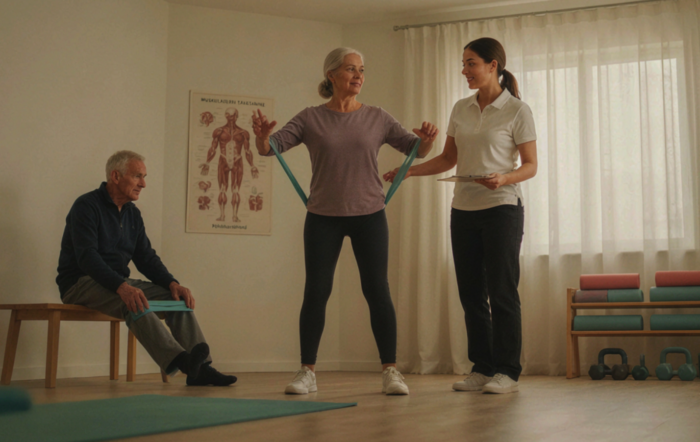
The first steps can be very simple: standing up with assistance, short walking segments, light band rows or seated knee extensions. If the person can move without symptoms getting worse, resistance can be added gradually. You will also find a practical starting approach in the guide How to start building muscle mass in older age.
In strength training, it is better to start with simple, controllable exercises: chair stands, wall push-ups, band rows, hip thrusts, calf raises and carrying light shopping bags. If an exercise makes your gait less steady the same day, or fatigue lasts into the next day and is clearly beyond the usual, the training load was probably too high.
How much protein is needed to recover muscle mass?
Protein provides the building material for muscle, but simply increasing protein intake does not automatically make a weak muscle strong. The PROT-AGE study group recommended a daily target of roughly 1.0-1.2 g of protein per kilogram of body weight for healthy older people, and in the case of illness or a risk of malnutrition the need may be higher, if kidney function and the treatment situation allow it (Bauer, 2013). This is where individual counseling is especially important, because kidney disease, fluid restriction, diabetes treatment and digestive problems can change the recommendation.
From food, every main meal should include a protein source: egg, fish, meat, a dairy product, quark, legumes or tofu. If appetite is poor, a protein supplement can be a convenient way to reach the daily amount, but it is worth treating it as a “complement”, not the centerpiece of rehabilitation. A more systematic general background is provided by Essential information for muscle building.
Meta-analyses show that the combined effect of protein supplementation and resistance training in older people is moderate and depends on baseline status, training, energy intake and study design (Liao, 2017; Kirwan, 2022). So the practical order of priorities is this: first adequate total energy and regular protein-rich eating, then consistent strength training, and only then a supplement, if the goal isn’t being met with regular food.
What recovery plan suits an older person at home?
A home plan should be short, repeatable and measurable. One day can focus on walking and chair stands, another day on upper-body rows and light carries. The ACSM guidance for older adults supports strength exercises for the larger muscle groups on at least two days a week, if health status permits (Chodzko-Zajko, 2009). If the person is very weak, the same principle can start with smaller “microdoses”: a few chair stands several times during the day.
Four signs are worth monitoring: body weight, appetite, grip strength or your everyday sense of strength, and steadiness when walking. If body weight drops while you are trying to rebuild muscle, review energy and protein intake. This is especially important after illness, because weight loss can come from fat as well as from muscle. The logic of preserving muscle while reducing fat mass is covered in Losing weight without losing muscle mass, but in the recovery phase aggressive dieting is usually not a good idea.
Training load should be increased in small steps. If the person does chair stands confidently, a slower lowering phase can be added. If the band is too light, a slightly stronger band can be chosen. If walking doesn’t cause excessive fatigue, a short extra segment can be added. The goal is not to endure pain, but to give the muscle a repeated signal: this strength is needed again.
When should you seek professional help?
Seek help if the person cannot get up safely on their own, falls, loses weight unintentionally, eats very little, is short of breath, or if training causes chest pain, dizziness or unusual weakness. When sarcopenia is suspected, clinical practice assesses muscle strength, muscle mass and physical performance. According to EWGSOP2, low muscle strength points to possible sarcopenia, and low muscle mass confirms the diagnosis (Cruz-Jentoft, 2019).
A physiotherapist can choose safe exercises, assess balance and teach how to progress the training load. A family doctor or care team can check whether the fatigue is caused by anemia, inflammation, medication side effects, a heart problem, impaired kidney function or malnutrition. Evidence-based recovery is therefore a team effort: training gives the muscle its signal, food provides the building material, and medical monitoring reduces the risks.
References
- Cruz-Jentoft AJ, Bahat G, Bauer J, Boirie Y, Bruyere O, Cederholm T, et al. (2019). Sarcopenia: revised European consensus on definition and diagnosis. Age and Ageing. PMID: 30312372. DOI: 10.1093/ageing/afy169
- Kortebein P, Ferrando A, Lombeida J, Wolfe R, Evans WJ. (2007). Effect of 10 days of bed rest on skeletal muscle in healthy older adults. JAMA. PMID: 17456818. DOI: 10.1001/jama.297.16.1772-b
- Chodzko-Zajko WJ, Proctor DN, Fiatarone Singh MA, Minson CT, Nigg CR, Salem GJ, et al. (2009). Exercise and physical activity for older adults. Medicine and Science in Sports and Exercise. PMID: 19516148. DOI: 10.1249/MSS.0b013e3181a0c95c
- Bauer J, Biolo G, Cederholm T, Cesari M, Cruz-Jentoft AJ, Morley JE, et al. (2013). Evidence-based recommendations for optimal dietary protein intake in older people: a position paper from the PROT-AGE Study Group. Journal of the American Medical Directors Association. PMID: 23867520. DOI: 10.1016/j.jamda.2013.05.021
- Liao CD, Tsauo JY, Wu YT, Cheng CP, Chen HC, Huang YC, et al. (2017). Effects of protein supplementation combined with resistance exercise on body composition and physical function in older adults: a systematic review and meta-analysis. American Journal of Clinical Nutrition. PMID: 28814401. DOI: 10.3945/ajcn.116.143594
- Kirwan RP, Mazidi M, Rodríguez García C, Lane KE, Jafari A, Butler T, et al. (2022). Protein interventions augment the effect of resistance exercise on appendicular lean mass and handgrip strength in older adults: a systematic review and meta-analysis of randomized controlled trials. American Journal of Clinical Nutrition. PMID: 34673936. DOI: 10.1093/ajcn/nqab355
Frequently asked questions
Is it possible to rebuild muscle mass in older adults even after a long period of bed rest?
Yes, but recovery requires a gradual increase in training load, adequate food intake and, where needed, guidance from a physiotherapist. How quickly it happens depends on the severity of the illness, previous fitness and any coexisting conditions.
Is protein powder necessary after illness?
Not always. It can help when you cannot get enough protein from ordinary food, but the priority is your overall daily nutrition and getting back to strength training.
Which exercises are safest at the start?
Chair stands, short walks, band rows and wall push-ups are often suitable. If there is a risk of falling or marked weakness, it is best to start under a professional’s supervision.
When is the training load too high?
The training load is probably too high if you get dizziness, chest pain, unusual shortness of breath, a worsening gait, or fatigue that does not ease with normal recovery.
Come and train! ArtGym