
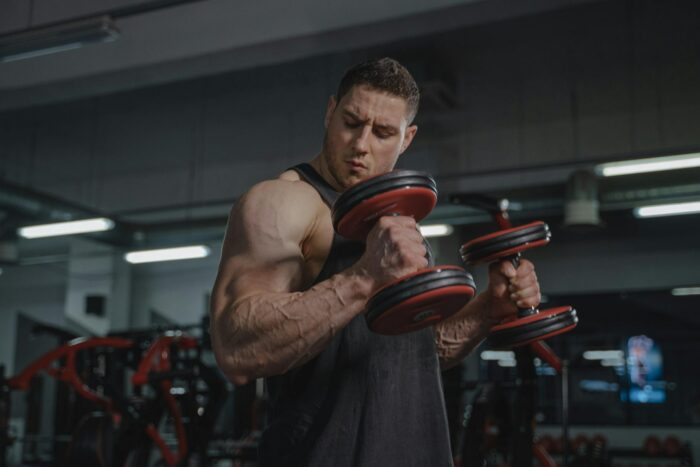
Big arms with Ronnie Coleman’s program
Big arms don’t come only from a heavy barbell, but also from how the biceps feels tension while it works. Ronnie Coleman’s program is an example of old-school bodybuilding: lots of control, a clear rhythm and a periodic shock to the muscle.
Why big arms need variety
FLEX once wrote about the pros’ training with a simple idea: there are many styles that work in bodybuilding, because different competitors have tested them all the way to the stage. Ronnie Coleman was one of those men for whom it wasn’t only about the weight. How the repetition looked mattered too.
If your biceps gets exactly the same training load every week, your body learns to cope with it. Progress is fast at first, then the feeling goes dull. The pump isn’t the same anymore, you don’t feel the stretch, and the exercise turns into just a movement.
This is where variety comes in. Coleman used a Workout A and Workout B system and recommended doing it for 3 months. That doesn’t mean you have to turn your whole-body plan upside down. Rather, you give your biceps a new stimulus for a while and honestly check whether it works for you.
A simple truth: an arm doesn’t grow just because you add weight. It grows when the muscle does real work.
How big arms work with this program
In the original, the emphasis was on giant sets. Every other week, Workout A and Workout B are done as giant sets: one set of each exercise, three sets back to back in total without stopping. It’s a hard way to train, because rest moves to the background and the biceps has to keep the tension on.
Sometimes supersets were added too: leaning forward with an EZ barbell, paired with standing biceps curls on the cable machine. A pair like this makes the muscle work from different angles. One exercise gives you the stretch and the control, the other keeps the tension on even when the free weight tends to get lighter at the end of the movement.
Workout A
- Barbell curl 4 x 8-12
- Seated alternating dumbbell curl 3 x 8-12
- Leaning forward with an EZ barbell on the biceps machine 3 x 8-12
- Standing cable curls 4 x 8-12
Workout B
- Leaning forward with an EZ barbell on the biceps machine 4 x 12-15
- Incline dumbbell curls 3 x 12-15
- Standing cable curls 3 x 12-15
- Concentration dumbbell curls 3 x 12-15
NOTE: This is a 2x-a-week program. Workout A on Monday and Workout B on Tuesday. If you have a heavy back workout in the same week, watch your elbows and grip especially carefully, because the biceps also does its share in pulling exercises.
Good form and constant tension
Coleman’s core message was “good form”. It sounds boring until you try to do every repetition to the very end with control at the same weight. Feel the tension. Feel the pump. Feel the stretch. If those three things disappear, you’re most likely already doing more with your body than with your biceps.
For standing cable curls, he used the Weider Continuous Tension Training Method. The idea is simple: slow movements, constant tension and not quite a full extension. When your arms are 90% extended, you move back up. This way the biceps can’t rest during the set.
The same 90% limit applies on the biceps machine. The reason isn’t only muscle feel, but safety too. If you use so much weight that a full-range rep could tear the muscle, the repetition has to be smooth. Jerking the weight and a “just get it up somehow” mentality don’t belong in this program.
Honestly, this is where many people go wrong. They read the program, see the numbers and think the work is done. The real work starts when you can do every 8-12 or 12-15 repetitions so that your shoulder doesn’t steal the movement.
Big arms in practice: what to watch
Before you put this program into your plan, look at your recovery. Two biceps days in a row can work, but only if the rest of your training doesn’t leave your forearms and elbows locked up. If you feel sharp pain, that’s not a “good pump”. It’s a sign that you need to back off.
Choose a weight so that the last repetitions are hard, but not ugly. On the barbell curl, keep your torso still. On incline dumbbell curls, don’t rush out of the bottom position. On concentration curls, let your wrist and elbow work calmly, and don’t start yanking the dumbbell up with your shoulder.
So what actually happens? You give your biceps volume, tension and a controlled stretch all at once. That’s the whole point of this old-school program. Not fancy theory, but work you can feel already in the middle of the set.
Run it for 3 months, as the original prescribes, and keep notes. Which exercise gives you the best feel? Where does your technique start to break down? Does your pump improve, or are your elbows just tired the next day? Those answers tell you more than anyone else’s perfect program.
FAQ
Is this program suitable for a beginner?
Not really, if you’re a complete beginner. You should first be comfortable with standard barbell, dumbbell and cable technique. If your form breaks down even with light weights, start with a simpler biceps program.
Is training biceps 2x a week too much?
It depends on your recovery and the rest of your program. The original was a 2x-a-week program: Workout A on Monday and Workout B on Tuesday. If your back, forearms or elbows aren’t recovering, reduce the volume.
Do I have to use exactly the same exercises?
If your goal is to try an approach in the style of Ronnie Coleman, keep the exercises as close to the original as possible. Swap one out only if you don’t have the right machine or the exercise causes pain.
Author: joker
Source: WHO – physical activity.
Come and work out! ArtGym




