Sculpturism began with a sleepless night and a fiercely determined decision: to treat my body as a work of art that could be shaped over years. This is not a story about getting beach-ready quickly, but about the idea that appearance, discipline and aesthetics can be as creative a pursuit as painting.
Sculpturism and the decision to turn the body into art
In 1974, I made two decisions that seemed almost impossible at the time. The first was to become an artist. The second was to shape my body to resemble a classical sculpture. Both decisions came with the confidence of youth, but there was something more serious behind them than a passing whim.
I did not simply want to play sports. My goal was neither a record nor a medal nor a place on a competition stage. What interested me was aesthetic appearance. The body as a whole. Proportion, complexion, posture and muscle shape.
A bodybuilder builds the body, but I saw it differently. I wanted to sculpt it. Not a massive Heracles, but something closer to the Achilles of my imagination: lean, muscular, harmonious and pure in form. The simple truth was that, for me, the body was a medium, not an end in itself.
That idea grew into a lifelong art project. The guiding principle was uncompromising and clear: look better every year. Not just in youth, not just for a single season, but across the decades.
Why sculpturism is not ordinary training
Ordinary training often starts with a desire to be stronger, lighter or healthier. Sculpturism starts with looking. What impression does the body make? Is its shape balanced? Does the person look complete, not just trained?
This distinction matters. When the goal is artistic, biceps or abs alone are not enough. One muscle does not make a whole. You need the overall picture, just as you do in a painting or sculpture. An individual detail may be strong, but if the proportions are off, the beauty is lost.
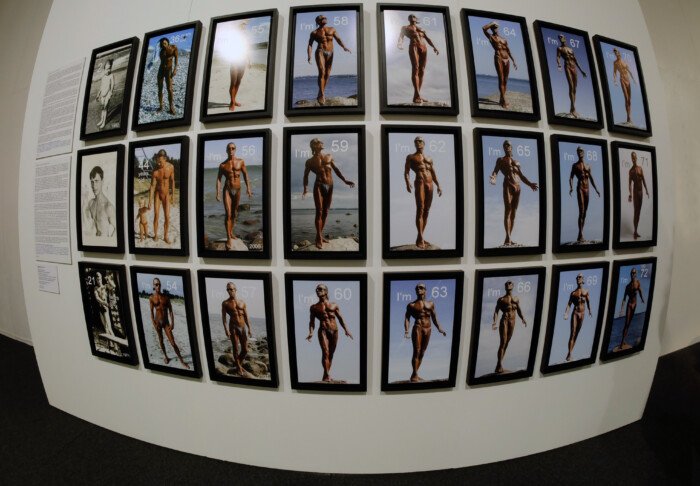
In 2004, this idea was presented to the public in a solo exhibition, “Miami Beach,” at Gallery Viviann Napp in Tallinn. Alongside paintings were photographs of the body as a sculpture receiving its finishing touches. It was a kind of progress report: thirty years of work made visible.
Honestly, there is something very Estonian about it. Quietly keeping at one thing for a long time, without much fuss. Year after year. You prepare in winter, make adjustments in spring, and at the end of summer see what has actually lasted. Judging by the photograph, not by talk.
How the body becomes a work of art
The process is simple, but it is not easy. Every year, I prepare for a new photograph. Once I have the shot I want at the end of summer, the next cycle begins immediately. A new year, a new opportunity to improve my physique, refine its lines and maintain its aesthetics.
So what actually happens? The body does not change all at once. It changes through repetition. Training, nutrition, rest, skin, complexion and overall condition eventually begin to support one another. If one element is neglected, the whole suffers.
By my definition, a truly aesthetic result comes from the interplay of three things: a beautiful body, flawless skin and the right complexion. This does not mean pursuing perfection at any cost. Rather, it means paying close attention to how a person looks when all the elements work together.
Shaping the body here is a creative pursuit just like painting. In a painting, you seek color, rhythm and balance. In the body, you seek shape, contours revealed by the light and an overall impression of youthfulness. In both cases, you strive to improve.
Sculpturism in practice: what to consider
If you approach sculpturism as a mindset, the first step is not a new training program. The first step is an honest look. What is your body like now? What is working? What needs time? A photograph helps more than a mirror here, because a photograph does not argue back.
The second step is consistency. One month of intense effort cannot replace ten years of steady work. The body as a work of art needs a rhythm. Training must be regular enough, nutrition sensible enough and the goal clear enough that you do not lose sight of it at the first sign of fatigue or on a dark November evening.
The third step is moderation. Sculpturism does not demand extremes. On the contrary, taking things too far often spoils the aesthetics. When a physique becomes merely a display of effort, it loses its ease. A good physique does not need to shout about the work that went into it.
The fourth step is to rethink age. Aging happens regardless. The question is how long you can maintain a youthful, aesthetically pleasing appearance. Can you look better at 70+ than you did 30, 40 or 50 years earlier? My experience tells me that this question is worth putting to the test.
This is how sculpturism becomes more than physical culture. It is long-term self-observation. An anthropological experiment on yourself. How long can a process continue when its guiding principle is to look better every year?
FAQ: sculpturism and body aesthetics
Is sculpturism the same as bodybuilding?
No. Bodybuilding often focuses on building muscle mass and achieving competition condition. Sculpturism emphasizes the body’s aesthetics, proportions and artistic unity.
Is the body as a work of art only for the young?
No. The very core of this idea is continuity over time. The goal is not to stop aging, but to keep the body in shape, full of life and aesthetically pleasing for as long as possible.
Does sculpturism require a special training method?
Not necessarily. What matters more is consistent work, a clear aesthetic goal and the ability to see the body as a whole, rather than as individual muscles.
Come and train! ArtGym