
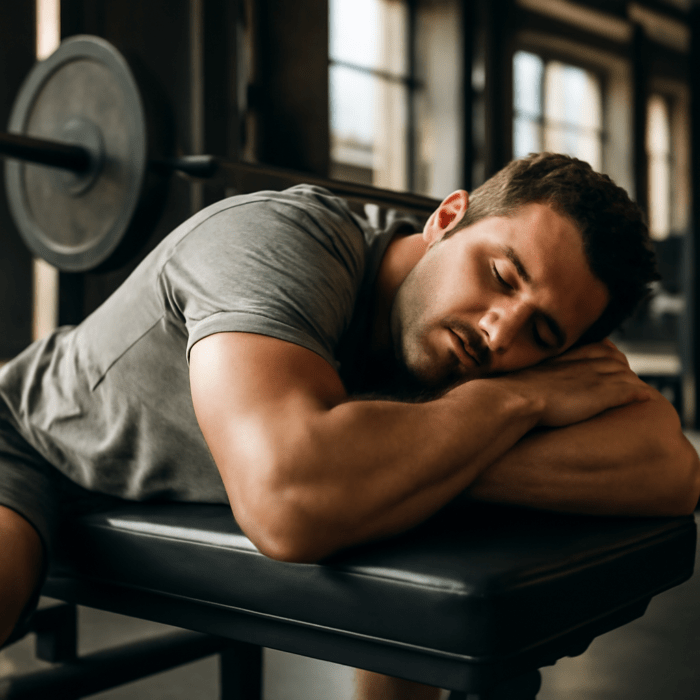
Sleep and men’s health: why it matters
Sleep is the foundation of men’s health for a simpler reason than people often think: your body repairs itself when you actually sleep. When the night is too short, recovery, appetite, hormones and, in the end, the work you do in the gym all suffer.
Why sleep matters so much for men’s health
Until the middle of the 20th century, sleep was regarded as fairly passive rest. Today the picture is different. The brain doesn’t simply switch off at night; it keeps working in its own rhythm. Sleep has 5 stages: 1,2,3,4 and REM (rapid eye movement). Stages 1 and 2 are called light sleep, and stages 3 and 4 deep sleep.
The deeper sleep gets, the slower the brain waves become. In stage 4, particularly slow delta waves dominate. After that, the sleeper enters REM sleep. Breathing becomes more irregular and shallower, the eyes move rapidly, blood pressure rises and the heart rate speeds up. We also dream during REM sleep.
One pass from the first stage through to the end of REM sleep is called a sleep cycle. Its length is usually between 90 and 110 minutes. At the beginning of the night, deep sleep is longer and the REM stage is shorter. Toward morning it goes the other way: REM sleep gets longer, and right before waking, sleep consists mainly of lighter sleep and REM sleep.
How sleep affects hormones and body weight
One important topic for men is testosterone. Studies have found that sleep is the single largest variable in shaping both a man’s bioavailable and total testosterone levels [1]. A link has also been described between poor sleep quality, meaning fragmented sleep, and low testosterone levels [2].
An interesting example comes from a study of Chinese men aged 29-72. There, sleep duration was associated with both bioavailable and total testosterone, regardless of age, aerobic fitness and body fat [3]. The simple truth: if you want your body to work well, you can’t treat sleep as a side issue.
Sleep also affects inflammatory processes [4]. This matters because inflammatory processes are linked to the risk of cardiovascular disease, cancer, Alzheimer’s disease, diabetes and stroke. Bad sleep doesn’t just mean a tired morning. Over a longer period, it can change your whole body’s training load tolerance.
The third big topic is body weight. Poor sleep quality and short total sleep promote obesity [5]. Sleep deprivation can impair glucose metabolism, reduce insulin sensitivity and raise levels of the stress hormone cortisol. At the same time, ghrelin levels may rise and leptin levels may drop. Ghrelin is a hormone that increases appetite. Leptin helps curb the feeling of hunger.
So what actually happens? A tired man wants to eat more, moves less, recovers worse and often makes poorer decisions in training. This isn’t a question of character. Your body is simply asking for energy from wherever it can get it fast.
How much sleep you actually need
In studies on sleep duration, the general finding has been that the optimal amount of sleep is 7 hours. Sleeping less than that can, over a longer period, lead to a sleep deficit. Sleeping more than 8 hours may in some cases be linked to the same health risks as sleep that is too short [6][7].
But a person is not a reference table. Your actual sleep need can differ. Your environment also has to be taken into account. In Estonia, autumn and winter are dark, and there is less sunlight than in warmer climates. Men living in colder, darker conditions may have higher-than-average melatonin levels [8]. Melatonin is a hormone that helps regulate sleepiness.
Honestly, there’s no point in boasting that you sleep 5 hours a night and still cope. For a while, it may work. Then the signs start to pile up: constant appetite, lower motivation to train, irritability, poorer concentration and a feeling that recovery can no longer keep up.
How to get your sleep back on track
If you want to know how much sleep your body really needs, start by restoring your sleep rhythm. For at least a couple of hours before bed, stay away from screen devices: TV, computer or smart devices. Their light can interfere with melatonin production.
It’s also worth avoiding alcohol in the evening. A nightcap may make it easier to fall asleep, but it disrupts sleep cycles and worsens sleep quality. The same caution applies to drinks containing caffeine. These include coffee, strong green and black tea, and many soft drinks.
Go to bed when you feel tired. Make the bedroom dark. If you can, go without an alarm clock for a period and wake up when sleep fades on its own. Keep this routine up for at least one week. Only then will an honest picture start to emerge of how much sleep your body needs.
Don’t draw conclusions from the second or third night. Your body may still be catching up on earlier sleep debt. By the end of the week, the picture is usually clearer: whether 7 hours of sleep is enough for you or you need a little more.
FAQ: sleep and men’s health
Is 7 hours of sleep right for everyone?
Not necessarily. 7 hours is a good starting point, but how much sleep you actually need depends on the person, training load, light exposure, stress and whether you’ve already made up for any earlier sleep debt.
Can sleeping too much be bad for you?
Studies have found early signs that sleeping too much may be linked to cardiovascular disease [6] and obesity [7]. The cause may not be sleep itself, but also other health conditions.
What should you do if you can’t fall asleep in the evening?
Start with the simple things: less screen time in the evening, less caffeine in the second half of the day, a dark bedroom and a calmer routine. If the problem lasts a long time, it’s worth seeking help from a healthcare professional.
Study references
1. Association between sleep and morning testosterone levels in older men. Penev PD. Sleep. 2007 Apr;30(4):427-32.
2. Sleep regulation and sex hormones exposure in men and women across adulthood. Lord C, Sekerovic Z, Carrier J. Pathol Biol (Paris). 2014 Oct;62(5):302-10.
3. Sleep, sex steroid hormones, sexual activities, and aging in Asian men. Goh VH, Tong TY. J Androl. 2010 Mar-Apr;31(2):131-7.
4. Sleep Quality and Duration are Associated with Higher Levels of Inflammatory Biomarkers: the META-Health Study. Morris A, Coverson D, Fike L, Ahmed Y, Stoyanova N, Hooper WC, Gibbons G, Bliwise D, Vaccarino V, Din-Dzietham R, Quyyumi A. Circulation, 23 Nov 2010; 122: Abstract: A17806.
5. Sleep and obesity. Beccuti G, Pannain S. Curr Opin Clin Nutr Metab Care. 2011 Jul; 14(4): 402–412.
6. Associations Between Sleep Duration and Prevalence of Cardiovascular Events. Aggarwal S, Loomba RS, Arora RR,, Molnar J. Clinical Cardiology 2013 Nov; Volume 36, Issue 11, pages 671–676
7. The Association Between Sleep Duration and Weight Gain in Adults: A 6-Year Prospective Study from the Quebec Family Study. Chaput JP, Després JP, Bouchard C, Tremblay A. Sleep. 2008 Apr 1; 31(4): 517–523.
8. Benefits of Sunlight: A Bright Spot for Human Health. M. Nathaniel Mead. Environ Health Perspect. 2008 Apr; 116(4): A160–A167.
Author: Turg.Fitness.ee
Come and train! ArtGym




