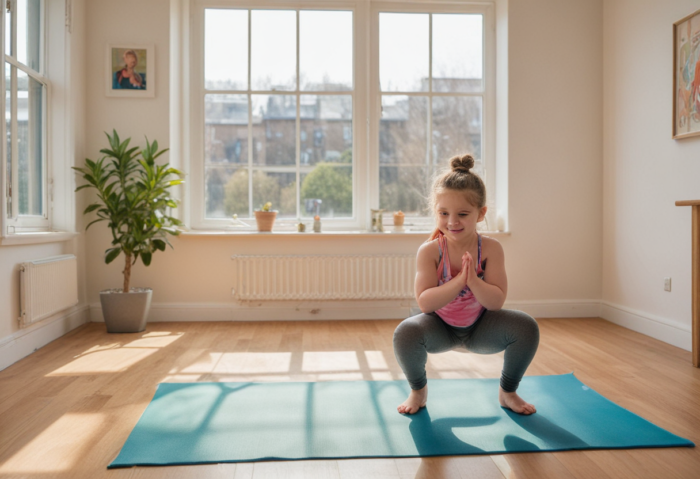
Many parents, as well as physical education teachers and gym trainers, are still timid and hesitant when it comes to children and strength training. In a way, there is a good reason for that, since rumors and myths that strength training is harmful to children have circulated for quite a long time. Fortunately, science has by now shown that for a healthy child, strength training is an effective training option and, even more importantly, a completely safe one.
Correcting misconceptions
Strength training for children is surrounded by numerous myths, which parents and teachers alike often base their attitudes on. The most common myth is that strength training stunts growth and that children shouldn’t train with weights at all before they turn 12. It should be said, however, that these “rumors” have no scientific backing. What is more, all the leading US fitness and medical organizations actually recommend strength training for young people, assuming of course that all the instructions given are followed and that exercises are performed with correct technique and under supervision. As for the age at which children can train with weights, the rule of thumb is that they can do so as soon as they are able to understand the performance requirements and follow the instructions given by the teacher/coach. In general, children can meet these criteria already at the age of 7-8.
Benefits
The benefits gained from strength training are actually the same for children as for adult trainees. That said, you shouldn’t place too much importance on starting early. Rather, one of the first benefits of strength training could be considered the fact that a step has been taken toward an active, athletic lifestyle. And if that alone isn’t enough for parents, then general fitness and improved muscle tone, bone mineral density, changes in body composition, better coordination, increased performance and greater resistance to injuries of any kind should be convincing enough arguments to let your little one start strength training.
Children themselves, of course, see the first benefit as strength training improving their results and boosting their performance in other sports too; in addition, they begin to notice a change in social status that comes with strength training. That isn’t bad either, of course, but at first children can’t grasp the longer-term positive benefits of strength training on their own. That starts to sink in at the age of 11-14, and it is more the case that things like changes in bone density and injury-prevention prophylaxis don’t motivate them at all and may even demotivate some children. What does motivate them is going to the gym and visibly improving their speed on the soccer field as a result.
It’s important that children sense their own improvement and success, and of course training shouldn’t be turned into a routine too soon — training should be fun.
Translator’s note: the translator can’t fully agree with the last sentence, of course. OK, you shouldn’t start killing them with training too early, but I believe it is every coach’s duty to start explaining and instilling in the child from the very beginning that results require work and effort, and quite often feeling pain and discomfort, which isn’t always “fun”. Many coaches, instructors and teachers love to stress the importance of “fun” and playfulness, which really is important, but I still maintain that gym training isn’t something that should always be fun. Otherwise success won’t follow you, that’s guaranteed!!!
That said, in many cases, in many sports, this so-called fun and competitive element really is necessary among beginners. In the gym, in my opinion, it works minimally. At a certain level and a certain degree of awareness it does, but not with beginners. Think about what happens to technique when people come to the gym only to beat their opponents’ results or only to outdo their classmates. Technique goes straight out the window, because people try at all costs to do more repetitions than the classmate did, or have to lift more at all costs than the guy on the next bench. As a coach, I believe it is vital that any competitiveness among gym beginners be SHUT DOWN!!!
Article continues…
Fun and emotion are children’s number one motivator.
Another important argument for the positive effect of strength training on children is increased self-esteem, the development of discipline and a sense of duty, and more effective socialization.
Let’s think back to our own school days. What games did you play, and what games have been played in school physical education through the ages? Naturally the same old soccer, basketball, volleyball — all of them require speed, good physical condition, jumping ability, reaction and so on. These are the qualities that determine success in ball games. At the same time, all of these qualities rest, to a greater or lesser extent, on muscle strength.
On the other hand, it is often overweight children who are shut out and shy in team games. Yet the physical ability that is often more developed in overweight children than in a non-overweight child is precisely strength and strength performance. So strength training would be a great alternative for overweight children. Why suffer in a team sport and perhaps be constantly excluded and a punching bag, when the gym, an entirely individual setting, could be a great outlet? Moreover, it would raise self-esteem, and precisely in those who need it most.
How to get started?
It’s important that coaches and teachers don’t start imposing extreme exercise techniques and philosophies that may have worked well on themselves. Stay general and follow general guidelines. Every child’s “concern” should be responded to and addressed. The attitude of the coach, teacher or instructor, and their attitude toward the children they train, is of the utmost importance.
Training should start slowly and calmly; at first you should always err on the side of underestimating yourself (the children) rather than putting them to the test with heavy weights right away. This is not only safer, but also leaves room for adequate development and progress. And such regular progress, which the children themselves can understand, is very necessary and motivating.
Translator’s note: this last paragraph means that you shouldn’t immediately put a lid on them, so to speak, and “rein them in!!!
The primary focus must be on teaching correct technique and the basic principles of strength training. Children should be introduced to a variety of exercises, as well as to training loads of different kinds (machines, free weights, exercise balls, etc.). Full-body training should be preferred, keeping in mind that all the major muscle groups get worked.
Training in the gym should be fun, safe and help children become more interested in physical activity.
Translator’s note[/url]: I dug up the most important points online to keep in mind when you start working with children or putting together a training program for them:
1. When the technique of a new exercise is introduced, an instructor should always be present and watch the learning process very closely.
2. Children learn exercises best by doing them. Let them try exercises and experiment with new ones, but only under your watchful eye.
3. The training environment should be as safe as possible. Equipment should be in working order and unbreakable; make sure of this before the session begins.
4. The training room should be well ventilated. At the same time, there shouldn’t be too much of a draft, since children are more susceptible to illness than adults. Encourage them to drink during training, even if they claim they aren’t thirsty.
5. Light stretching and gymnastic exercises can be done before and after a gym workout.
6. Start with a full-body workout in a single session. Choose 6-8 main basic exercises for the whole body (for both the lower and upper body). Begin with 1 set of each exercise and stay within the 10-15 repetition range. Start with long sets, and as strength develops and coordination improves, gradually keep increasing the training load and reducing the repetitions. Long sets make it easy to learn technique, don’t provoke injuries and give children time to find a feel for the equipment.
7. Lifting maximal weights is not recommended. This means that right from the start, they shouldn’t be grinding out weights they can lift for only 1-6 repetitions.
8. 2-3 workouts a week on non-consecutive days is a good place to start.
9. As mentioned, the training load should be increased gradually, in line with the individual’s development.
10. As they progress, you can also increase the number of sets, as well as the number of exercises in a workout.
11. When adding heavy basic exercises such as squats to the training program, you should take into account each trainee’s individual characteristics and capabilities.
12. Treat children with respect, too, and talk to them in a way they can understand. Children should feel relaxed and comfortable at training and look forward to their next session.
13. Strength training should definitely be part of a child’s overall physical training and physical activity.
And one more thing…
Age 7 or younger:
Introduce them to the main exercises, using their own body weight and light added weights; introduce the nature of training with weights; teach different ways of exercising – gymnastic exercises, exercises in pairs and with a partner, and with light added weights; keep the training volume low.
8-10:
Gradually increase the number of exercises, try different techniques and learn new ones; start keeping a record of the training loads for the different exercises, slowly start thinking about increasing the load, and watch how they respond to the exercises and to increases in load.
11-13:
Continue teaching the technique of different exercises; continue progressively increasing the training loads; emphasize the importance of technique; continue introducing new, even more complex exercises.
14-15:
Increase the training volume. Introduce training splits for advanced lifters.
16 and older:
You can introduce adult training splits and training programs, provided the knowledge from the earlier stages is in place. Training volume increases, and they train similarly to adults.
A retrospective review that examined the relationship between injuries and strength training in prepubescent children found that, in terms of injury risk, strength training is safer, more reliable and less hazardous than any other sport or physical activity (Hamill, 1994).
Translated and compiled by: Janar Rückenberg
Come train! ArtGym