
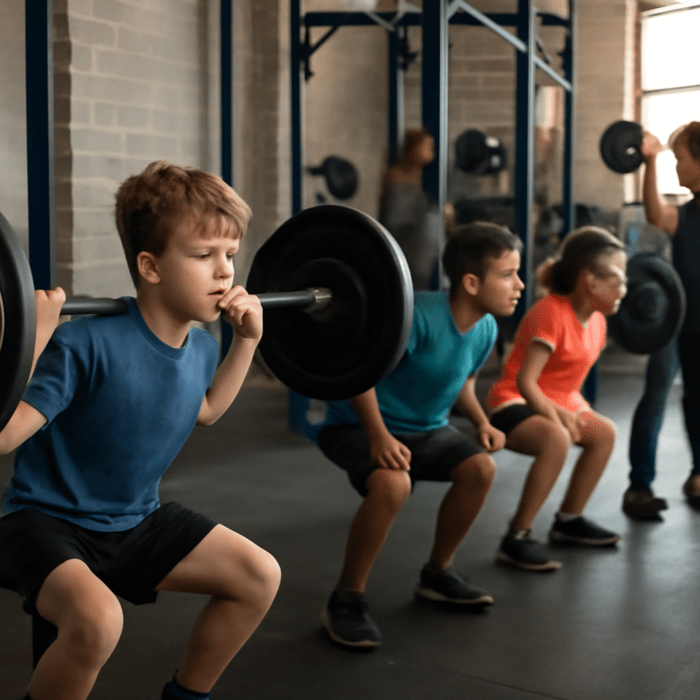
Strength training for kids: how to start safely
Strength training for kids seems risky to many parents. In fact, research shows the opposite: properly supervised training is safe for children as young as 7–8, and it helps develop both muscles and body awareness. In this article we look at what actually happens in a growing child’s body in the gym, and how to start so that technique stays solid and motivation lasts.
Why strength training suits children
The most stubborn myth is that lifting weights stunts a child’s growth. There is no scientific support for this claim — growth plates are far more likely to be damaged by accidental falls and badly landed jumps in ball games than by a controlled squat next to a coach.
Gym trainer Ain Kimber, who has worked with children for years, stresses that the goal of a child’s training is not muscle building. What matters more is learning how your own body moves: how to stand in balance, how to squat without the knee caving inward, how to breathe during effort. These skills last a lifetime.
How strength training affects the body
A well-designed training program gives a growing body several concrete benefits:
- Stronger core muscles. The back, abs and hip area learn to work together. This reduces back pain and the risk of injury in everyday life — carrying a school bag, bouncing on a trampoline, skiing.
- Better coordination. The movement patterns a child learns in the gym carry over directly to football, basketball and swimming.
- Denser bones. Moderate training load stimulates gains in bone mineral density that last for life.
- Growing confidence. Every week the child sees that effort brings results. This is especially valuable for children who don’t find their place in team sports.
Strength training for children of different ages
One size does not fit all. A child’s body develops in leaps, and each age range needs its own approach.
- Ages 7–8. The main focus is bodyweight work: squats, lunges, light push-ups from the knees. The goals are mobility, balance and play. Dumbbells can weigh a few kilos, but mainly as part of a game.
- Ages 9–10. Simple exercises with light resistance are added — resistance bands, medicine balls, an empty barbell for learning technique. The rep count is high, the weight low.
- Ages 11–14. The training load can be increased gradually, but with care — during a growth spurt the tendons and growth plates are especially vulnerable. Kimber recommends spending at least the first year mainly working on technique and only then adding weight.
Practical tips for parents
Honestly, the most important decision you will make is the coach. Look for someone with experience specifically in working with children — an adult program can’t simply be scaled down for a 9-year-old. Many gyms in Estonia offer separate youth groups, so don’t hesitate to ask.
For the first few months, come along to the sessions. Watch whether the coach corrects technique in a friendly way, whether your child laughs now and then, and whether they leave the workout tired but content — or tired and grumpy. The latter is a sign that the training load or the atmosphere isn’t right.
Two sessions a week of 45–60 minutes is enough for most children. The rest of the week is filled by free play, time outdoors and other sports. Variety beats specialization every time when a child is under 14.
Frequently asked questions
Does strength training stunt a child’s growth?
No. Reviews by the major sports medicine organizations have found no evidence that properly supervised training damages growth plates. The risk comes rather from poor technique or too much weight without supervision.
What age can children start?
If a child can concentrate for 30 minutes and follow instructions, they can start as early as 7–8. Some children get there younger, others later — age is a guideline, not a rule.
How many times a week should a child train?
Two training sessions a week are enough to see results. A third session can be added from the teenage years, if other sports allow it.
Come and train! ArtGym




