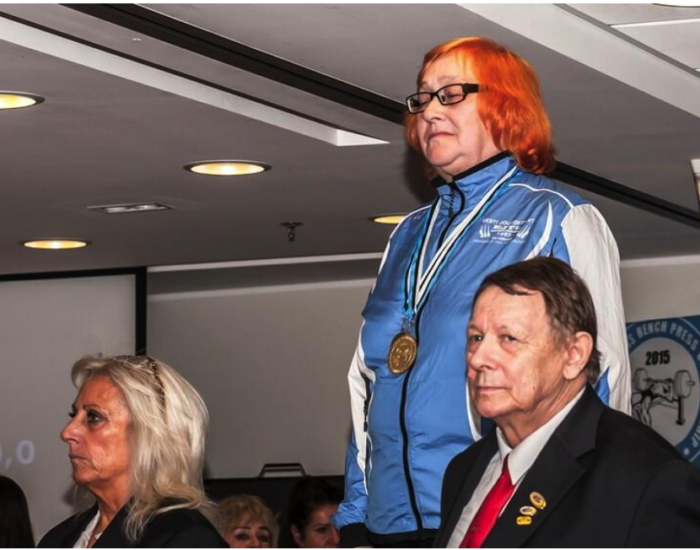
Tiiu Kimber and her Masters World Championships medals
Tiiu Kimber established herself as a major name in Estonian powerlifting at the 2009 Masters World Championships in Ostrava, winning four silver medals and one gold. This story looks back at the second day of competition and explains why Heino Maiste, Kalev Teder, Mihkel Laurits and Kimber left such a strong mark on Estonian powerlifting.
Tiiu Kimber at the 2009 Masters World Championships
The Masters World Powerlifting Championships in Ostrava, Czech Republic, were intense and emotional for the Estonian team. Competing on the second and final day were M3 lifters Kalev Teder in the -82.5kg weight class and Mihkel Laurits in the -90kg class, along with Masters World Championships in the women’s M2 age group and +90kg weight class.
The accomplished Powerlifting, a photographic artist and gym coach in everyday life, turned 61 the day before the competition. It was this lifter’s performance that stood out most at these championships. Four silver medals and one gold are more than just an impressive entry on a results sheet. They are the mark of an athlete who can hold their own on the platform when every attempt counts.
Why Tiiu Kimber’s performance stood out
A 100kg squat earned Tiiu Kimber a silver medal. Her 100kg bench press also secured silver and set an Estonian M3 record. A 130 kg deadlift, which Tiiu herself considered unremarkable, brought another silver.
Her 330 kg total was enough for silver, but it meant more than a medal. It was also a personal best and an Estonian M3 record. She set three Estonian records in all, as the totals achieved with her last two deadlift attempts were also national records.
The final medal was gold. Tiiu Kimber earned it as the highest-ranked female lifter over 60 on Wilks points. There was otherwise no M3 category in the overall women’s Masters standings, making this recognition particularly significant.
Other Estonian powerlifters in Ostrava
Kalev Teder opened his competition with an Estonian record squat of 185kg. He went on to bench press 115kg and deadlift 205kg. His 505kg total matched his best in the M3 category and earned him sixth place in a closely contested field.
Unfortunately, Mihkel Laurits was unable to register a total across the three lifts. His opening squat weight was 195kg, which he lifted on all three attempts, but minor errors in establishing the required start and finish positions prevented the lifts from counting. His opening bench press of 125kg was his only attempt, but it set an Estonian record. In the deadlift, Mihkel Laurits set an all-time personal best with 212.5 kg on his second attempt.
On the first day of competition, Heino Maiste represented Estonia in the M3 age group and -75kg weight class. Maiste, from Märjamaa, turned 60 that year. He earned silver in the deadlift and finished fourth overall in a very closely contested field with a total of 510kg.
Heino Maiste’s results were clear-cut: squat: 180kg; bench press: 105kg; deadlift: 225kg. In all, he broke Estonian M3 records eight times. Had the M2 records broken with those same lifts been included, the record count would have been even higher.
Tiiu Kimber and the message of Masters powerlifting
Frankly, the strongest message from results like these is simple: powerlifting is not just a sport for the young. Heino Maiste achieved his personal best Wilks score of 367.557 points at 60. Kimber won medals in the over-60 standings. These were no flashes in the pan, but the result of years of work.
The competition numbers speak for themselves: 170kg on the second squat attempt and 180kg on the third, 105kg on the second bench press attempt, and 215kg on the second deadlift attempt and 225kg on the third. Every deadlift attempt improved the total record. What actually happens when an athlete stays consistent for years? Results sheets like these are the answer.
The Estonian Powerlifting Federation specifically noted how proud it was of the experienced athletes who competed at the World Championships: Heino Maiste, Kalev Teder, Mihkel Laurits and Masters World Championships. Estonia’s team was small, but its results made for a very strong showing.
Schedule and following the competition
According to the original announcement, you could follow the competition online through a regularly updated results table, which you could refresh by pressing CTRL+R or F5. The Estonian athletes’ start times were: Kalev Teder in M3 -82.5kg on 30.09.2009 at 09.00, Powerlifting in women’s M2 -90kg on 30.09.2009 at 16.00, and Mihkel Laurits in M3 -90kg on 01.09.2009 at 18.00.
The original story included links to the full competition results on Goodlift, but those old web addresses no longer work reliably. The focus here is therefore on the results, the athletes and the Estonian records, rather than an outdated link.
FAQ
How many medals did Tiiu Kimber win at the Masters World Championships?
Tiiu Kimber won four silver medals and one gold. The silvers came in the squat, bench press, deadlift and total, with gold awarded on Wilks points.
What were Heino Maiste’s results?
Heino Maiste won silver in the deadlift and finished fourth overall. His total was 510kg, with individual lifts of squat: 180kg; bench press: 105kg; deadlift: 225kg.
Which other Estonian athletes competed?
Heino Maiste, Kalev Teder, Mihkel Laurits and Kimber competed for Estonia in Ostrava. They took part in the Masters World Powerlifting Championships in Ostrava, Czech Republic.
Rain Karu
Estonian Powerlifting Federation
Board member
Author: Estonian Powerlifting Federation
Source: WHO – physical activity.
Come and train! ArtGym