An extraordinary strongman in Ukraine: a gym encounter
The extraordinary strongman I met in Ukraine was no star of the competition stage. He was a local gym regular whose lifting numbers left me momentarily speechless. This is the story of one workout in Kyiv, Aleksandr Artjomenko, and why sheer strength sometimes makes a greater impression than a row of medals.
What made this extraordinary strongman in Ukraine stand out?
While in Kyiv for a competition, I also managed to fit in a few workouts at a local gym. This was more than a random place to lift weights. Its owner was Vitali Usõt?enko, president of the Kyiv Bodybuilding and Fitness Federation, who was also the competition’s lead organizer and had invited me to take part.
Workouts like these stay with you. An unfamiliar city, an unfamiliar gym, but familiar sounds: a barbell hitting the rack, plates coming off the storage pegs, men around you working through their sets. In a gym, you quickly learn who just talks and who actually lifts.
Vitali introduced me to the local club’s strongman. He had never competed. At least, he was not someone whose name I would have recognized from the competition program at the time. But once we started talking about how much he could lift, the picture changed completely.
His name was Aleksandr Artjomenko. He was the reason a simple gym encounter became a story worth telling afterward.
An extraordinary strongman and lifting numbers that speak for themselves
Bench press – 250kg. And an important detail: without any specialized equipment. That means no bench shirt, supportive aids or competition gear—just pure, raw strength.
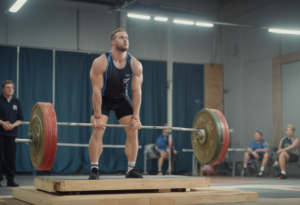
His stiff-legged deadlift was something else, too: 5 – 6 repetitions per set with 290kg. If you have done this exercise, you will understand. The stiff-legged deadlift leaves little room for cheating. Your back, hamstrings and grip all have to work together.
His biceps were especially strong. Standing barbell curls with 110kg. This is well beyond the usual ego-driven set in the gym, where you heave the barbell up with your body and your arms simply come along for the ride. With that much weight, your whole body has to act as one solid unit.
I also noted down 6 -8 repetitions x 3 sets, and a maximum of 150 kg 1x. These numbers are so big that it is easy to skim over them and move on. But from the perspective of an average lifter, most people do not use that much weight even for compound exercises, let alone a biceps curl.
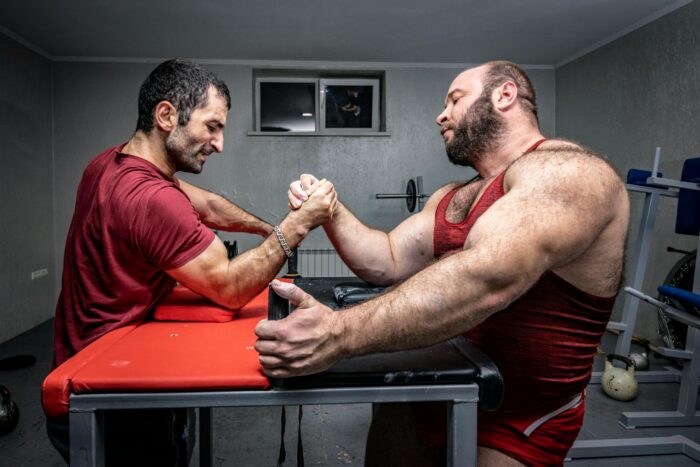
His triceps were no less impressive. A close-grip bench press of 160kg x 8 and a French press of 130kg x 8 show that his strength was not limited to just one movement. His arms were powerful all round. His biceps measured 55cm in circumference.
What can you learn from a strongman like this?
The simple truth is that great strength does not come from just one good day. Numbers like these are built on years of repetition, heavy training on the basic lifts and a body accustomed to high training loads. You cannot replicate that quickly.
That does not mean everyone should aim to lift the same weights. Aleksandr Artjomenko was a phenomenon in his own right. Seeing someone like him is more a reminder of just how many levels there are in the gym. Some people train for their health. Some want to get into better shape. Others reach a point where every set looks like a small demonstration of strength.
If you take anything away from this story, it should not be the idea that you need to load the same weight onto your barbell tomorrow. Look instead at the attitude behind it. Building a strong body takes consistency. You need to know how to perform the exercises properly. The weight should increase with time, not pride.
A practical perspective: how to interpret big lifting numbers
Lifting numbers always mean more when you know how to put them in context. The bench press and close-grip bench press give you an indication of upper-body pressing strength. The stiff-legged deadlift tells you about the posterior chain. The biceps curl reveals control of the arms and torso, especially when the weight gets very heavy.
So what is actually going on? If someone is strong in only one movement, that may reflect their specialty or something specific to the exercise. If they are strong across several different movements, the picture changes. Then we are talking about their overall strength, rather than a one-off record.
He weighed around 110kg. That adds another dimension to the numbers. A high body weight often helps in powerlifting, but it does not do the work for you. You still have to lift the barbell.
That is the kind of man you find in Ukraine.
FAQ: an extraordinary strongman and strength training
Should an average lifter aim for numbers like these?
Generally, they should not be your direct targets. For an average lifter, sound technique, consistent training and improving on your own previous results are more sensible goals. Very heavy weights require a long period of preparation.
What makes a 110kg biceps curl so remarkable?
Because a biceps curl is closer to an isolation exercise than, for example, a press or a row. With 110kg, your torso and grip have to work alongside your arms, and your whole body has to stay stable.
Does never competing make these lifts less valuable?
Not necessarily. Competition provides an official benchmark, but the strength you see in a gym can still be impressive. In Aleksandr Artjomenko’s case, it was his training numbers that stayed with me.
Author: Ott Kiivikas
Source: WHO – physical activity.
PS Come and train! ArtGym