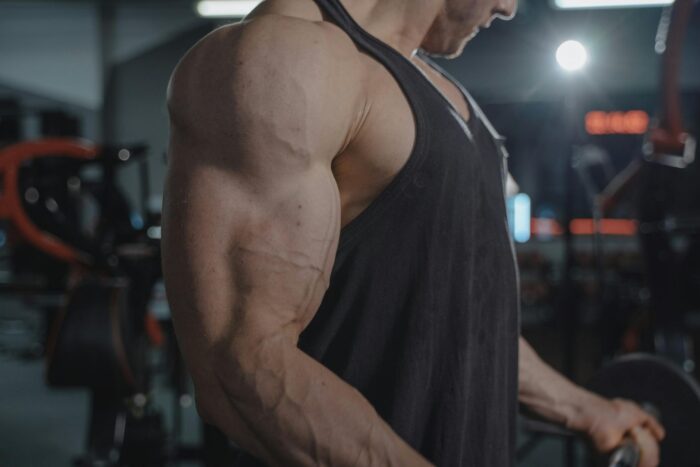
How to make your muscles more visible in 7 days
Muscles don’t appear out of thin air in one week. But if you already have the shape and your body is holding on to water, a 7-day depletion and loading plan can make you look much drier: less subcutaneous water, more glycogen in the muscle and clearer definition.
Why don’t your muscles sometimes show?
Honestly, this is an old bodybuilders’ trick, not a miracle cure. Professional bodybuilders have used depletion and loading for years to sharpen their look in 7 or 9 days before going on stage. The same idea applies before a photo shoot, a progress check or a competition.
So what actually happens? First, carbohydrates are brought down low, to around 40-70 grams a day for three days. At the same time, you train with higher volume so that the muscles use up their glycogen stores. Then carbohydrates are raised sharply to 5-7 grams per kilogram of body weight per day. A 90 kg bodybuilder would therefore get 450-630 grams of carbohydrates a day.
When glycogen returns to the muscle, it pulls water in with it. Carbohydrates act like a sponge here. That’s why the body can look bigger and drier at the same time. Salt and water provide the finishing touch: more at the start, less at the end.
How to sharpen your muscles in 7 days
The plan starts with salt. Two days before carbohydrate depletion, add salt to your food so that it tastes clearly salty. The original recommendation was at least ¼, even ½ teaspoon of salt for each of five or six daily meals. Salt raises aldosterone levels, which makes the body retain fluid. Later, when you take the salt away, that level drops and the body lets go of more water.
Water intake goes up at the same time. If you normally drink 8 glasses of water a day, over the first two days the amount can be 13-15 glasses, or 5-7 extra glasses. It isn’t comfortable, but that’s the point: the body gets used to the larger amount of water before the water is pulled back at the end.
Depletion comes on the third, fourth and fifth days. Carbohydrates stay at 40-70 grams a day. In your workouts, raise reps to 12-15 per set and increase the number of sets by about 50%. If you normally do 12 sets for chest, now it would be 18. You can continue aerobic work, but at lower intensity.
Loading starts on the sixth, seventh and eighth days. Carbohydrates rise to 5-7 grams per kilogram of body weight, workouts are skipped, no extra salt is added and fluid drops to half of what it was before the plan began. If you drank 8 glasses before, now it’s down to 4 glasses.
A practical 9-day plan for visible muscles
Day 1. Add salt to your meals. Use at least ¼, even ½ teaspoon of salt for each of five or six meals. Increase your water intake by 5-7 extra glasses. For example, 13-15 glasses instead of 8.
Day 2. Carry on the same way: salt in your food, more water, the same 5-7 extra glasses. Your body is preparing for depletion.
Day 3. Carbohydrates down to 40-70 grams a day. Reps up to 12-15 per set, with the number of sets up 50%. Train chest and back.
Day 4. Carbohydrates still 40-70 grams. Reps 12-15, 50% more sets. Train thighs and calves.
Day 5. The last depletion day. Carbohydrates 40-70 grams, reps 12-15, 50% more sets. Train biceps, triceps and abs.
Day 6. Carbohydrates up to 5-7 grams per kilogram of body weight, split across six meals during the day. Don’t train. Don’t add salt. Cut your water to half. If you drank 8 glasses before, now go down to 4 glasses.
Day 7. The same loading continues: 5-7 grams per kilogram of body weight, across six meals. No workouts, no added salt, water stays at half.
Day 8. Hold the same line. Carbohydrates 5-7 grams per kilogram of body weight, a day without a workout, no added salt, water restricted.
Day 9. Get your camera out. If your starting condition was good, the difference may be visible to the naked eye.
What to eat during depletion and loading
A depletion day for a 90 kg man can look simple and dry: Meal 1: 8 egg whites, 2 whole eggs, salt, pepper, 1 dl mushrooms and 3 glasses of water. Meal 2: 280 g chicken breast, green salad, carbohydrate-free salad dressing with salt and 3 glasses of water. Meal 3: 225 g lean steak, Cajun seasoning with salt, 5 dl green beans and 3 glasses of water.
Next: Meal 4 is a whey protein shake with 2 glasses of water. Meal 5 is 2.5 dl cottage cheese and 2 glasses of water. Meal 6 is 280 g chicken breast with salt or a salt-containing lemon pepper, 2.5 dl broccoli and 2 glasses of water.
On loading day the picture becomes richer in carbohydrates. Example for a 90 kg man: Meal 1: 170 g lean steak, 350 g potatoes without fat and 1 glass of water. Meal 2: 280 g chicken breast, 280 g sweet potato and 1 glass of water. Meal 3: 225 g lean steak, 5 dl cooked rice, 2.5 dl green beans; no water, as the rice contains fluid.
Meal 4: 280 g chicken breast, 350 g potatoes and 1 glass of water. Meal 5: 170 g turkey breast and 5 dl rice; no water, since the rice contains liquid. Meal 6: 280 g chicken breast, 350 g potatoes, 2.5 dl broccoli and 1 glass of water.
Glutamine, potassium and muscles during loading
The original article highlighted two helpers: glutamine and potassium. Carbohydrate depletion makes the body produce the enzymes needed to build new muscle glycogen. During loading, glutamine may help you store glycogen more effectively. The original recommendation was to take 3-5 g of glutamine three times a day on days 6, 7 and 8.
Potassium also helps with glycogen formation and with holding water in the cells. The more water inside the cells, the less is left under the skin. The original plan recommended 1 g of potassium a day throughout the entire 8-day transformation, split into 200 mg doses at five of the six meals.
Be sensible here. If you have a blood pressure, kidney, heart or medication-related issue, don’t experiment with salt, water and potassium on your own. This plan is meant for a healthy, already fit trainee, not for someone just starting to lose weight.
FAQ
Do muscles really grow during these 7 days?
Not noticeably. What mainly changes is the distribution of water and glycogen. Your muscles may look bigger and harder, but that isn’t new muscle mass.
Is it suitable for fat burning?
Not really. It’s a short-term touch-up of your appearance, not a fat-loss plan. If your body fat percentage is high, manipulating water won’t make your abs visible.
Is restricting water safe?
Moderate, short-term restriction can work for a healthy athlete, but going overboard is a bad idea. Dizziness, cramps or feeling unwell are a sign that you need to abandon the plan.
Translated from Body magazine, author: Chris Aceto
Author: Greta
Come and train! ArtGym