
What is the ATP molecule and how does it work
The ATP molecule is the main energy carrier in every living cell – without it, no muscle contracts, the brain doesn’t function and no biosynthesis takes place. In this article, we explain what adenosine triphosphate is, how it releases energy and how the body constantly replenishes it.
What is the ATP molecule?
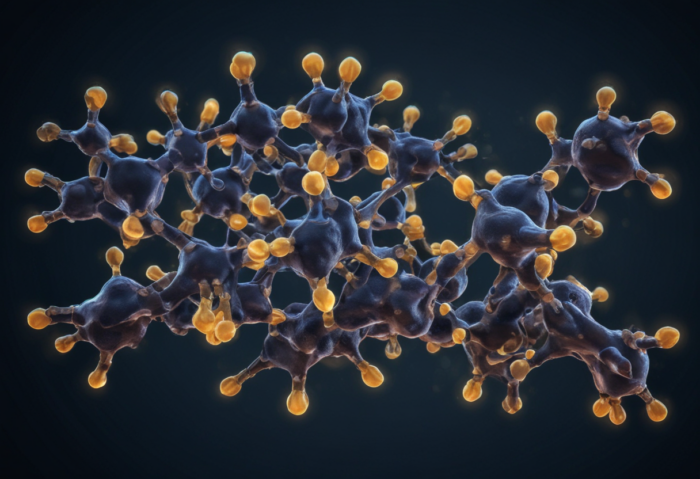
ATP, or adenosine triphosphate, is chemically a nucleotide. It consists of a nitrogenous base (adenine), a carbohydrate (ribose) and three phosphate groups – and that is where all of its power lies. Ordinary nucleotides carry one phosphate group; ATP has three.
The cell’s internal environment is close to neutral. In this environment, ATP exists not as an acid but as a salt: in place of the OH groups of the phosphate groups, there are negatively charged oxygen atoms (–O²). Like charges sitting close together repel each other, which makes the molecular structure of ATP unstable. This instability is actually a useful property – it is exactly what makes ATP a perfect energy carrier.
How does the ATP molecule release energy?
Under the action of specific enzymes, ATP is broken down by hydrolysis:
ATP + water → ADP + phosphate
The last phosphate group splits off and ATP becomes ADP, or adenosine diphosphate. This reaction releases about 40 kJ of energy per mole of phosphate released – energy that the cell uses immediately.
ATP holds an absolutely central place in the cell’s metabolism. Movement, biosynthesis, transport of substances across membranes, electrical energy production – all of it runs on the energy released when ATP is hydrolyzed. So what actually happens in the muscle? In muscle, the ATP stores are enough for only 20–30 contractions. Over the course of hours, however, a muscle performs thousands of contractions, which means the body has to restore ATP continuously and without interruption.
During intense but short-lived work, muscles run almost exclusively on the ATP already present. That is exactly why we pant after exertion – during this period, carbohydrates and other substances are broken down and the ATP stores are rebuilt. ATP is thus the cell’s single, universal source of energy.
ATP synthesis: glycolysis and aerobic breakdown
To replenish ATP stores, the cell uses energy obtained from the breakdown of carbohydrates, lipids and other substances. ATP synthesis takes place mainly in the mitochondria. In human cells, the main energy source is glucose, which is broken down in two consecutive stages.
Glycolysis (the anaerobic stage) does not require oxygen – but it does involve ADP and phosphate, a small reserve of which is always present in the cell. Glucose is broken down in a multi-step process: a six-carbon glucose molecule yields two three-carbon organic acid molecules, and 2 ATP molecules are synthesized. The total energy in this stage is 200 kJ per mole: 60% of it is dissipated as heat and 40% is stored in ATP.
Aerobic breakdown takes place in the mitochondria and requires intact membranes. The end product of glycolysis – an organic acid – enters the mitochondria, where enzymes break it down into water and carbon dioxide. Hydrogen atoms are oxidized in the membranes: electrons move toward the inner side of the membrane and are bound to oxygen, while protons (hydrogen cations) move to the outer side. A potential difference builds up.
In certain parts of the membrane sit molecules of the enzyme that synthesizes ATP. When the potential difference exceeds a critical threshold, protons pass through a channel in the enzyme to the inner side of the membrane, where they react with oxygen to form water. This movement releases a significant amount of energy: 45% is dissipated as heat and 55% is stored as the energy of ATP’s chemical bonds.
In summary: the complete breakdown of one glucose molecule into carbon dioxide and water yields 38 ATP molecules – 2 in the anaerobic stage and 36 in the aerobic stage. The aerobic process is therefore 18 times more efficient. The breakdown of organic substances in the cell is often compared to combustion, because in both cases oxygen is absorbed and oxidation products are released. In combustion, all of the released energy is converted into heat; in the intracellular oxidation of glucose, however, about 45% is converted into heat and about 55% of the released energy is stored in ATP.
FAQ
What is the difference between ATP and ADP?
ATP carries three phosphate groups, while ADP carries two. When ATP is broken down by hydrolysis, one phosphate group splits off and energy is released – leaving ADP behind. Inside the cell, a constant cycle runs: ATP → ADP + energy, and then ADP is recharged into ATP using new energy.
Why is ATP important for an athlete?
A muscle can contract only on ATP. During intense training, ATP stores are used up quickly – enough for only 20–30 contractions. After that, the body has to produce new ATP through glycolysis, which causes lactate to build up. During endurance training, the body switches to aerobic metabolism, which is 18 times more efficient than the anaerobic stage.
Where exactly is ATP synthesized?
Mainly in the mitochondria during aerobic breakdown (36 ATP molecules per glucose molecule). A smaller amount is synthesized without oxygen in the cell’s cytoplasm during glycolysis (2 ATP molecules per glucose molecule) – this matters especially during short, very intense efforts.
These help synthesize ATP – choose yours here!
Author: Mikk-Alvar Olle
Source: WHO – physical activity.
Come and train! ArtGym




