Glute training: better shape and greater strength
Glute training delivers results when training load, technique and recovery are in balance. Here is a practical plan for training your glutes so that your quads or lower back do not end up doing all the work.
Why glute training matters
Your glutes are about more than appearance. They help extend your hips, maintain pelvic alignment and support your body when you squat, run or climb stairs. If your glutes are weak, your lower back, quads or hip flexors often take over. Your workout may then feel hard, while the muscles you are targeting do not get enough work.
Many people start glute day with dozens of light reps. That can make your muscles burn, but building muscle also requires enough weight. The simple truth is that if the same exercise feels too easy for several weeks in a row, your body has little reason to get stronger.
A good glute workout does not have to last two hours. Often, 4–6 well-chosen exercises are enough, provided you take your time, use controlled technique and increase your training load gradually.
How to make glute training work
Start by choosing exercises that involve different directions of movement. Your glutes work when you extend your hips, move your leg out to the side and stabilize your body. If your workout consists only of squats, some of that work gets missed. If you only do band lateral walks, you miss out on heavier loading.
Do heavy exercises first
Squats, hip thrusts, deadlifts and lunges require concentration. Do them at the start of your workout, when your nervous system is fresh and you can maintain better technique. For example, you could start with hip thrusts, move on to Bulgarian split squats and finish with lighter machine or band work focused on feeling your glutes working.
Aim for around 8–15 reps in most sets. This is not a magic number, but it helps balance strength work and muscular effort. Higher-rep sets also work well for some exercises, such as hip abductions. Keep technique your priority in heavier exercises.
Do not train your glutes every day
Your glutes need recovery. If you give them a substantial training load, 1–2 targeted workouts a week are usually enough. In between, you can train your upper body, do some light activity or have a technique day with a lower training load. More does not always mean better.
If your muscles are sore for several days, you are sleeping poorly and the weights you can lift are dropping, your training load may be too high. If, on the other hand, the exercises keep getting easier, add weight, reps or one extra set. Small steps work better than sudden, unplanned jumps.
Glute training and technique in the gym
The most common mistake is rushing. During hip thrusts, you let the weight drop and throw your hips upward before your glutes have a chance to do the work. Try slowing the movement down. Hold the tension briefly at the top and stay in control at the bottom. The same applies to squats and lunges.
Foot placement matters. Some people engage their glutes better with a slightly wider stance and their toes turned outward. Others do better with a narrower stance. The truth is, there is no single ideal stance for everyone. Find a position where your knees track steadily, your feet stay flat on the floor and you feel the effort where you want it.
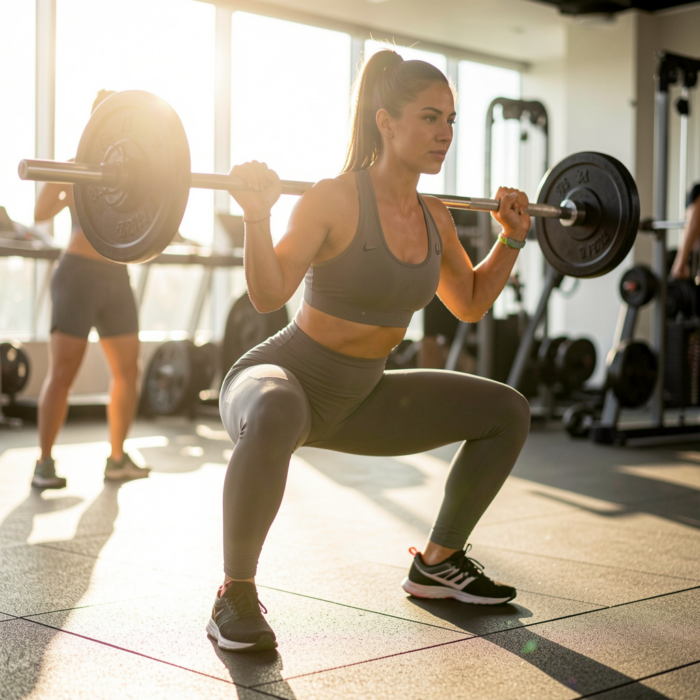
The squat is an effective exercise, but it is not the only answer. Deep squats can work your glutes well, but if your mobility or technique does not allow them, you do not need to force the depth. Hip thrusts, Romanian deadlifts, step-ups, cable kickbacks and hip abductions together offer a much more complete approach.
Before moving on to heavy sets, warm up for 5–10 minutes. Walk on an incline, do a few bodyweight squats and perform a couple of light sets of your main exercise. Your warm-up does not need to be a separate workout. Its purpose is to wake your body up and help you perform better in your first working set.
Practical tips for training your glutes
Keep a training log. Record the exercise, weight, reps and how it felt. It may sound dull, but it quickly helps you see whether you are progressing or doing the same thing every week. Your glutes grow through consistency, not from one especially hard Monday.
Keep one main exercise in your training for at least 6–8 weeks. If you change everything every time, your body cannot adapt or get stronger. You can add variety at the end, but your main movements should stay consistent. For example, focus on hip thrusts for one training block and Romanian deadlifts for another.
Do not forget food and sleep. If your goal is to build muscle, your body needs the raw materials to recover. Enough protein, regular, wholesome meals and 7–8 hours of sleep often do more than one extra exercise. What actually happens? Training provides the signal; recovery does the building.
If you are a beginner, ask for feedback on your technique. A trainer can often see straight away whether your hips are moving correctly or your lower back is taking over. This can save you months of trial and error. If you have been training for longer, occasionally film your sets from the side. Even an experienced lifter’s technique can break down as the weight increases.
Glute training FAQ
How often should you train your glutes?
For most recreational exercisers, 1–2 times a week is enough. If your training load is high, allow at least a couple of recovery days between workouts.
Are squats alone enough?
Squats are an excellent exercise, but they often fall short on their own. Add hip thrusts, lunges and hip abduction exercises to work your glutes from different angles.
Why can I not feel the exercise in my glutes?
You may be using too much weight, placing your feet incorrectly or rushing the movement. Reduce the training load for now, slow down and find a position that lets your hips move freely.
Author: Turg.Fitness.ee
Come and train! ArtGym