
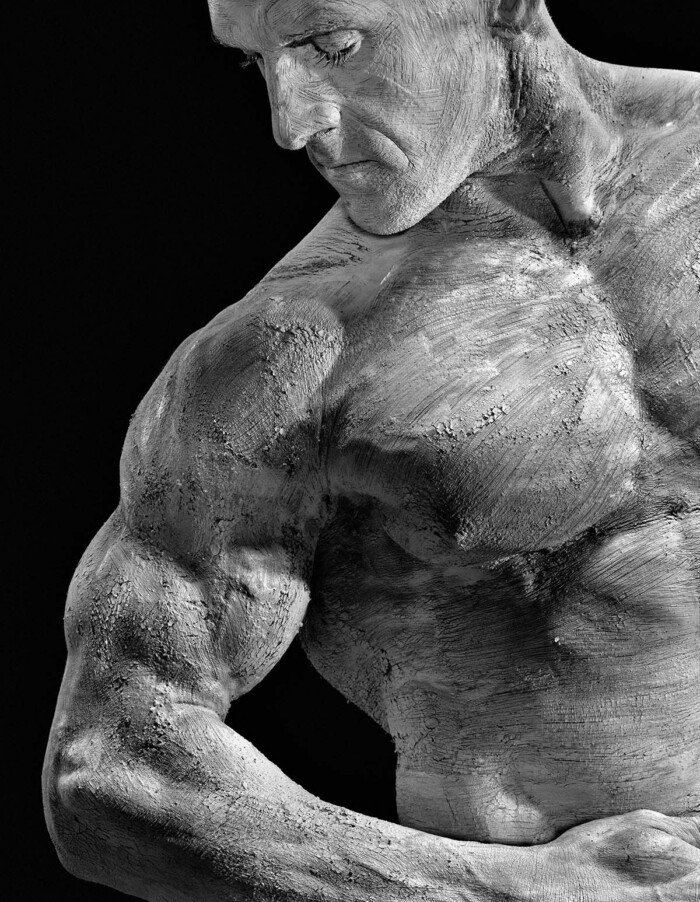
Bodybuilding is not just a sport. When you see a trained body on stage under a beam of light, you see something that resembles a sculpture — proportions, shadows, lines. In this article, we look at how bodybuilding and art intertwine, and why so many bodybuilders talk about their body as a creative work that has taken years to make.
Bodybuilding as a visual art form
In classical art, the materials are canvas, marble or bronze. For a bodybuilder, they are muscle, skin and symmetry. The difference is that the body belongs to the artist and changes with every workout. A sculptor finishes a piece at some point and puts it on a pedestal. A bodybuilder can never say the work is done — skip a week of training, and the “sculpture” starts to change.
Aesthetics is a deliberate choice here. The width of the shoulders compared with the waist, the ratio of calves to thighs, the line of the upper arms — none of it happens by accident. A training program is built so that weaker muscle groups grow faster and the body as a whole looks balanced. That is why experienced bodybuilders talk about symmetry and proportions as seriously as a painter talks about composition.
The body as a canvas: how bodybuilding shapes aesthetics
The real work happens between the kitchen and the gym. Muscle mass comes from consistent strength training and enough protein from food. Definition — what makes the muscles “pop” — comes from a low percentage of body weight, which in turn requires months or years of keeping track of your nutrition.
So what actually happens? In training, you create micro-damage in the muscle, which the body repairs between meals and sleep. Each recovery cycle leaves the muscle slightly bigger. It is a slow process. A year of consistent work produces a visible change; three years produces an entirely different physique. There are no shortcuts here — and it is this demand for consistency that makes bodybuilding similar to art. Neither can be pulled off in a single evening.
Seen from the stage: posing and performance
On the competition stage, a performance lasts only a few minutes. All those years of work have to be shown to the judges in that time. Posing is not just standing — it is an art of movement, where every muscle has to be tensed at the right moment, the shoulders turned into the right position and the facial expression kept calm.
A good poser knows how to hide weaknesses and emphasize strengths. The same body can look completely different from one pose to the next. Stage lighting amplifies this — light falling from above sharpens the lines between muscles. That is why bodybuilders practice poses in front of the mirror as much as they lift in the gym.
Photography is a chapter of its own. The results of training are often captured in a studio, where the light, background and composition are carefully chosen. A good picture can show muscle structure in a way you would not notice when meeting someone in person. This is where the line between art and athleticism grows, making bodybuilding more than just a strength sport.
Self-expression: why it matters
For many people, bodybuilding is not primarily about competing. It is a way to gain control over yourself. When other things in life are messy, your training plan and your meal plan are something you can steer yourself. The results are visible — in the mirror, in photos, in the way your clothes fit. From this grows a dedication that lasts for decades.
For a beginner, two to three training sessions a week are enough to visibly change body shape in just half a year. You don’t need a competition stage — it is enough to see progress in the mirror.
FAQ: bodybuilding and art
Is bodybuilding really an art or just a sport?
It is both. The athletic side is clear — strength, endurance, discipline. The art side comes in when you start shaping your body deliberately for an aesthetic result. Competitions judge precisely that aesthetic quality.
How long does it take to achieve a visible change?
You will notice the first changes yourself within six to eight weeks. An outside observer will see the difference after about half a year. A more serious transformation takes two to three years of consistent work.
Do I have to compete to do bodybuilding?
No. Most enthusiasts never step on stage. The goal can simply be the shape of your own body and your health — that does not make the pursuit any less valuable.
Edited by: Arnold Tokko
Illustrative photo: Kaupo Kikkas
Come and train! ArtGym




