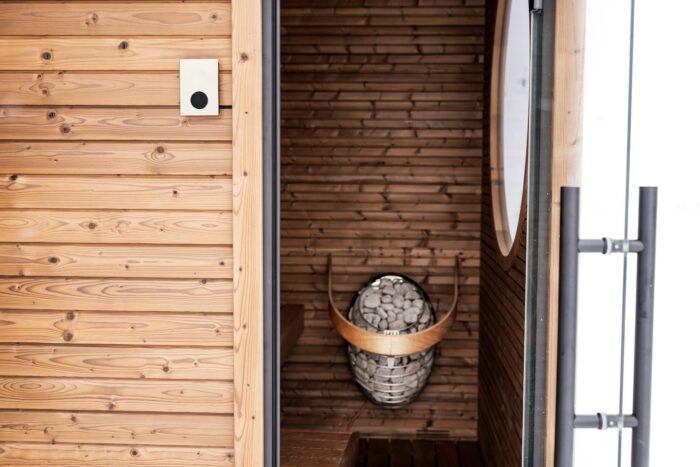
Infrared sauna: risks and health benefits
The risks of infrared saunas are a topic people talk about more and more — some warn, some praise. What is true and what is myth? In this article we take an honest look at who this gentler kind of sauna suits, who it doesn’t, and what is worth knowing before your first session.
Infrared sauna risks: what’s true and what’s myth?
The first thing to know: for a healthy adult, the risk from an infrared sauna is small. The heat radiation used has a long wavelength — 4.5–5.5 micrometers — and is fundamentally different from the sun’s UV radiation. There is no radioactive background of any kind, the heating elements don’t glow, and jewelry stays cool in the cabin.
A common fear is that infrared heats the body “from the inside.” To some extent that’s true: tissue warms up from a depth of 4–5 cm, and the temperature of body cells can rise up to 38.5 °C. That explains the heavier sweating at a lower air temperature — the cabin is usually around 45 °C, which feels milder than the 80–90 °C of an Estonian wood-fired sauna. That doesn’t mean the body is being “cooked.” The temperature stays within the physiological range.
The technology itself was developed in Japan, and later research has been continued by medical universities in the Netherlands and the USA. The core tool — heat radiation with a wavelength close to the body’s own radiation — is used in spas, rehabilitation and sports medicine alike.
Who might be affected by infrared sauna risks
The contraindications are largely the same as for a regular sauna, and in some cases stricter. Be cautious if:
- you are pregnant or suspect you might be
- you have an acute inflammation, a fever or a recently overcome virus
- you take medications that affect fluid balance (diuretics, some blood pressure medications)
- you have a severe heart or cardiovascular disease
- you have consumed alcohol
- you have open wounds, eczema in an active phase or a fresh tattoo
Children tolerate an infrared sauna differently from adults — their thermoregulation isn’t fully developed yet. Until the teenage years, it’s worth cutting the session length in half and keeping the temperature low.
If you are being treated for a chronic condition, ask your family doctor first. This isn’t a formal recommendation — it genuinely protects you.
When infrared sauna risks actually show up
A simple truth: most bad experiences come not from the sauna itself but from how it’s used. Typical mistakes are:
- a session that’s too long the first time (over 30 min)
- too little water before and after
- combining alcohol and sauna
- going in right after a heavy meal
For a beginner, a 25 min session at about 45 °C is enough. The cabin itself reaches operating temperature in about 7 minutes and power consumption stays in the 1300–2500 W range — a morning session before work is no fantasy. That was exactly one of the reasons infrared saunas became so popular in Estonia at the start of the 21st century. (In the 20th century, the electric sauna heater made the same breakthrough.)
A practical rule of thumb: drink about 200 ml of water before the session, bring a water bottle along, and drink more afterwards. More fluid leaves with sweat than it seems at first glance.
How infrared affects the body
Heat radiation penetrates deep into tissue, so muscles relax and circulation improves. A typical 30-minute session burns about 600 kcal — roughly as much as an easy-paced run of the same length, although the mechanism is quite different (here the energy goes to thermoregulation, not muscle work).
With regular use — at least 3 times a week, with 30 min sessions, over a month — people usually notice the following:
- less muscle soreness after training
- better sleep
- tension relief in the shoulder girdle and lower back
- skin with a fresher tone
A quality cabin has a body made of aromatic cedar or a similar natural material, heating elements with a long warranty (around ten years is a good sign), and digital control of the temperature in the 35–75 °C range and of session length up to 1 hour. As for cellulite: yes, there is a small cosmetic effect, mainly through fluid balance and circulation. Still, an infrared sauna is no miracle fat burner — if anyone sells it that way, that’s an exaggeration.
FAQ
Are infrared saunas more harmful than regular saunas?
Not for healthy people. The air is cooler (about 45 °C vs 80 °C), but the body heats up more deeply. The risk of overdoing it is similar in both types of sauna — it’s dictated by time and fluid intake, not by the type of sauna itself.
Can you use an infrared sauna every day?
Not at first. During the first month, 3 times a week is enough. Later you can increase the frequency if your body feels good and your sleep doesn’t suffer.
Does an infrared sauna replace a wood-fired sauna?
No. It’s a different experience — gentler, drier, better suited to mornings. The wood-fired sauna is a tradition that was, is and will remain.
You can find your own everyday sauna here: https://revalsport.ee/vaiknespa/
Author: Ero Viik
Source: WHO – physical activity.
Come and train! ArtGym