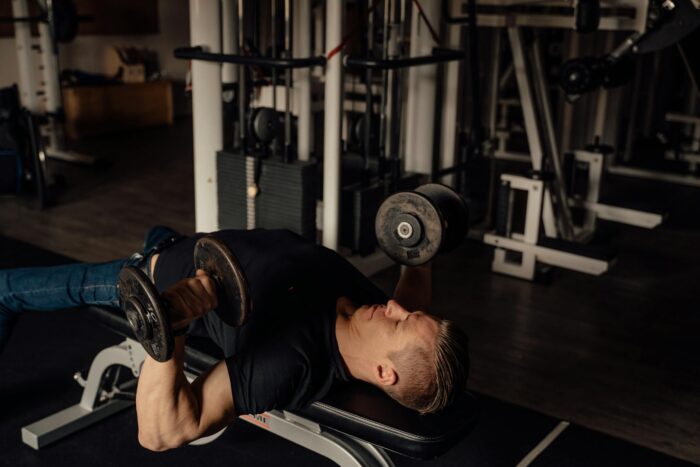
Chest exercises for a stronger chest
Chest exercises deliver results when your chest actually does the work, rather than your shoulders and triceps. Here you’ll find clear technique guidance, exercise choices and a training program that keeps tension in your chest muscles and helps you manage your progress.
Why do chest exercises work?
Chest training often comes down to a simple measure of strength: how much can you bench press? It’s a useful benchmark, but it doesn’t tell the whole story when it comes to building muscle. If you let your chest sink toward the bench, your shoulders roll forward and your elbows tuck in against your sides, your shoulder girdle and triceps take on much of the training load.
The simple truth is that your chest muscles grow better when you load them under control in the stretched position and contract them strongly at the top of the movement. That’s why this program emphasizes slow lowering, a wider grip, partial reps at the right moment and exercises in which your arms move inward.
That doesn’t mean the weight is unimportant. A heavy training load stimulates muscle growth in three different ways. First, it directly stimulates fast-twitch muscle fibers. Second, it improves strength, allowing you to use heavier weights in the next training phase. Third, it helps your nervous system recruit more fast-twitch muscle fibers, which have considerable growth potential but are difficult to fully engage.
Chest exercises and technique
Barbell bench press
Lift your chest as high as possible. Aim for a position that makes your chest muscles do the work, rather than your shoulders. Lower the bar to the upper part of your sternum, about 2 cm below your collarbones. Use a fairly wide grip, about 12-16 cm wider than shoulder width, and lower the bar slowly with your elbows out to the sides.
Press inward throughout the movement, as though you were doing a dumbbell fly. This helps you contract your chest muscles more effectively. A useful technique is the double rep: lower the bar to your chest, press it halfway up, lower it again, then press it all the way up. This counts as one rep. Use only ¾ of the range of motion to keep tension in your chest and prevent your triceps from taking over.
Incline barbell press
Lower the bar to collarbone level with your elbows pointing outward. Grip the bar slightly wider than you would for a flat bench press, about 16-20 cm wider than shoulder width. Lower the bar slowly over 3-4 seconds. Don’t just focus on getting the weight up. Think about how your chest muscles are working.
Flat dumbbell fly
Lift your chest, lower your arms as far as possible and hold the bottom position for 2-3 seconds. Then raise the dumbbells only halfway up. This keeps constant tension in the muscles and maintains the stretch. If you feel the exercise mainly in your shoulders, you’re moving too quickly or holding your chest too low.
Cable bench press
Set the cable pulleys to their lowest position and attach the handles. Start with your arms straight above your chest. Lower your arms as you would during a regular bench press, with your elbows pointing outward. When your elbows are bent at a 75 degree angle, press the handles up and rotate your hands toward each other so that your knuckles meet at the top.
Combined dumbbell and cable press
Use wrist cuffs and set the cable pulleys to their lowest position. Then pick up lighter dumbbells and lie back on the bench. This exercise combines a press and a fly: you press the dumbbells up while the cables pull your arms out to the sides. At the top, use a neutral, or hammer, grip and keep the dumbbells shoulder-width apart.
How should you structure your workout?
The workout begins with a heavy training load. Sets and reps: 5 sets, 3-6 reps. Exercise options: bench press, dip, cable press. This phase gives your chest muscles a strong growth stimulus and lays the foundation for the work that follows.
The second phase is a superset. Here, you pair one compound exercise with one isolation exercise. Superset 1: 3 sets, 8-10 reps. Superset 2: 3 sets, 12-15 reps. Exercise options: Superset 1: incline press. Superset 2: flat dumbbell fly.
The third phase uses a specialized exercise to improve muscle definition. Sets and reps: 3 sets, 8-10 reps. Exercise option: combined dumbbell and cable press.
The fourth phase supports recovery, but it isn’t just a few easy movements. The aim is to bring blood and nutrients into the muscles and help remove metabolic waste products. Sets and reps: 1 set, 100 reps. Exercise options: cable crossover, pec deck, machine presses. Perform half the reps from the stretched position to the midpoint of the range of motion to maintain tension.
Chest exercises in sample training programs
If you train your chest every 5-7 days, the following structure works well: bench press 5 x 3-6; incline press 3 x 8-10 superset; dumbbell fly 3 x 12-15 superset; cable press 3 x 8-10; partial pec deck 1 x 100.
If you train your chest 2x a week, split the work into two workouts. Day 1: bench press 4 x 3-5; cable press 2 x 8-10. Day 2: incline press 2 x 8-10 in a superset; dumbbell fly 2 x 12-15 in a superset; half-rep pec-deck 1 x 100.
If you train your chest 3x a week as part of full-body training, change exercises every 4 weeks. Day 1: bench press 6 x 3-6. Day 2: incline press 4 x 8-10. Day 3: combined dumbbell and cable press 3 x 12-15.
Honestly, writing out the program isn’t the hardest part here. Keeping your ego in check is harder. If the movement turns into a short shove, your chest drops and your shoulders take over, reduce the weight. A clean rep is better than an impressive number in your training log.
FAQ
Are chest exercises suitable for beginners?
Yes, but start with the basics. First, learn to perform the bench press and dumbbell fly with control. Double reps, 1 x 100 sets and cable combinations can come later.
Why do I feel chest exercises in my shoulders?
Usually, your chest drops too low on the bench or your shoulders roll forward. Lift your chest, get your shoulder blades under control and lower the weight more slowly. Reduce the weight if needed.
Can you train your chest 3x a week?
Yes, provided the volume is reasonable and the exercises are spread across your workouts. In the 3x a week version of this program, each day has one main focus rather than being a full chest workout.
Translated from Body magazine, author: Joachim Bartoll
Author: Greta
Come work out! ArtGym