In short:
- A barbell lets you move more absolute weight and suits main lifts like the squat and deadlift.
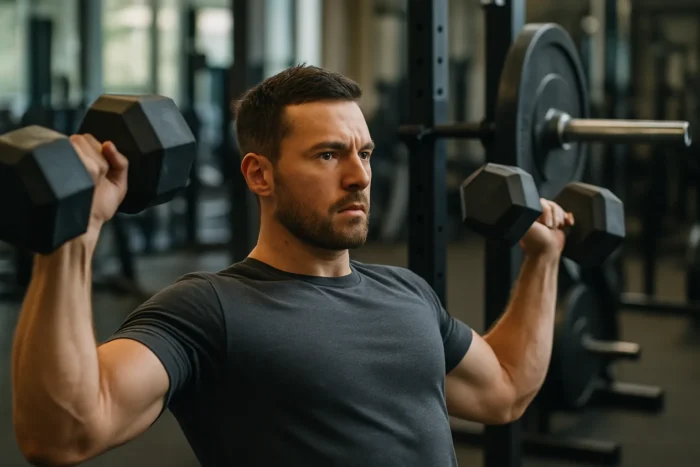
- Dumbbell training gives a greater range of motion, improves balance and exposes differences between the two sides of the body.
- The best solution isn’t one or the other, but combining both — at the gym and at home.
Dumbbells vs barbells is the eternal gym debate, but the truth is simple: both are excellent free weights, and the best program uses them together. The 8-week plan in the Summer Shape Workbook does exactly that — bench press with a barbell alongside dumbbell presses on an incline bench, squats with a barbell alongside lunges with dumbbells. In this article we look at when a barbell and when dumbbells work better in training.
How does dumbbell training differ from barbell training?
The main difference is stability and range of motion. A barbell joins both hands on a single axis, which gives the body greater stability and lets you move more absolute weight — which is why the barbell is ideal for main lifts like the barbell squat, deadlift and bench press. Dumbbell training, by contrast, requires each arm to stabilize the weight independently, which recruits more assisting muscles and gives a greater range of motion. The National Strength and Conditioning Association (NSCA) points out that free weights recruit more stabilizing muscles than machines — and dumbbells do so even more than a barbell. In practice, this means a barbell builds maximal strength, while dumbbells build balance, coordination and symmetry. Another difference is the natural movement path of the joints: a barbell fixes the hands in a set position, while dumbbells let the wrist and shoulder rotate freely, which is often more comfortable for shoulder health. That’s why some lifters prefer dumbbell presses and rows when they have shoulder problems.
When should you choose a barbell and when dumbbells?
Choose a barbell if the goal is to lift heavy and progress quickly in the basic movements — it’s easy to add small plates to a barbell (e.g. +2.5 kg), which makes progressive overload precise. Choose dumbbells if you want to improve your range of motion (e.g. dumbbell flyes while lying down stretch the chest deeper than a barbell), work on a weaker side of the body or train more safely without a spotter. Dumbbell training is especially useful for isolating the shoulders and arms, where lateral raises and hammer curls work only with dumbbells. When training alone, dumbbells are often the safer choice, because a heavy barbell can get stuck on your chest without a spotter. The right footwear also affects stability — read more in Squat shoes or sneakers? Which to choose.
How do you combine dumbbells and barbells in a program?
The strongest solution is to combine them: start the workout with a heavy barbell movement while your nervous system is fresh, then add dumbbell exercises for assistance and isolation work. The push day in the Summer Shape Workbook does exactly this — first a barbell bench press (4×6–8), then an incline dumbbell press (3×8–10) and dumbbell lateral raises (3×12–15). The same logic applies to the legs: a barbell squat as the main movement, dumbbell lunges as the assistance exercise. The American College of Sports Medicine (ACSM) recommends combining multi-joint main lifts with isolation movements and training each muscle group at least twice a week — the barbell and dumbbells fill these roles, complementing each other. For hygiene and comfort, bring a towel to the gym; for tips on choosing one, see How to choose a towel for the gym.
What should you choose for home training?
For a home gym, adjustable dumbbells are often the most flexible first investment: they take up little space, cover a wide weight range and let you do presses, lunges, rows and curls. A barbell with plates and a power rack is the next step for those who want to squat and deadlift heavy at home. If space and budget are tight, start with dumbbells and add a barbell later. Remember that technique matters more than equipment — learn the movements with light weights before you add training load. In special cases, such as during pregnancy, consult a doctor before you start training and adjust the training load; the topic is covered in Training at the gym during pregnancy. Whichever you use, the same law of growth applies — progressive overload. With dumbbells the weight jumps are often larger (e.g. 2 kg per pair), so use extra repetitions and better technique as “bridges” until you get the next pair of dumbbells; with a barbell you can add load more precisely using small plates. Keep a training log to see which tool moves you forward best in which exercise. All in all, the question isn’t “dumbbells vs barbells” but how to use both smartly — dumbbell training and barbell training together give the most complete result.
References
- National Strength and Conditioning Association (NSCA). Essentials of Strength Training and Conditioning — free weights vs machines.
- American College of Sports Medicine (ACSM, 2009). Progression Models in Resistance Training for Healthy Adults — Position Stand.
- Summer Shape Workbook (Fitness.ee), Chapter 6: 8-week training program.
Frequently asked questions
Are dumbbells or a barbell better for muscle growth?
Both build muscle when you apply progressive overload. A barbell lets you move more weight in the main lifts, while dumbbells give a greater range of motion and recruit more assisting muscles. It’s best to combine them.
Should a beginner start with dumbbells or a barbell?
A beginner should learn the basic movements with light weights. Dumbbells are often the safer place to start when training alone, while barbell movements (squat, deadlift) are worth learning with coaching.
What should you buy first for home training?
Adjustable dumbbells are the most flexible first investment — they take up little space and cover a wide weight range. A barbell with plates and a power rack is the logical next step.
Do dumbbells help improve body symmetry?
Yes. Because each arm works independently, dumbbells expose and correct strength differences between the two sides better than a barbell.
Machines are the best! ArtGym