
Biceps and the good old pump method
The biceps is often the first muscle people really chase a pump in at the gym. Here is a specific, exhausting and fairly honest shock method for a day when your usual arm workout no longer excites you or your progress has stalled.
This is not a plan to follow every week. It works better as one strong finisher or a standalone challenge for days when you have plenty of energy and want to feel the front of your upper arm being truly put to work.
Why biceps sometimes need a shock
Most people start lifting iron in a similar way: grab a barbell, do a few biceps curls and feel good. After a while, though, the body adapts. Same weight, same rest, same movement. The pump is there, but progress doesn’t seem to come.
At that point, a method can help that doesn’t make the exercise complicated but makes a simple one hard. Honestly, that is the whole point of this workout. One exercise, precise rests and a steadily increasing training load. No tricks. Just work.
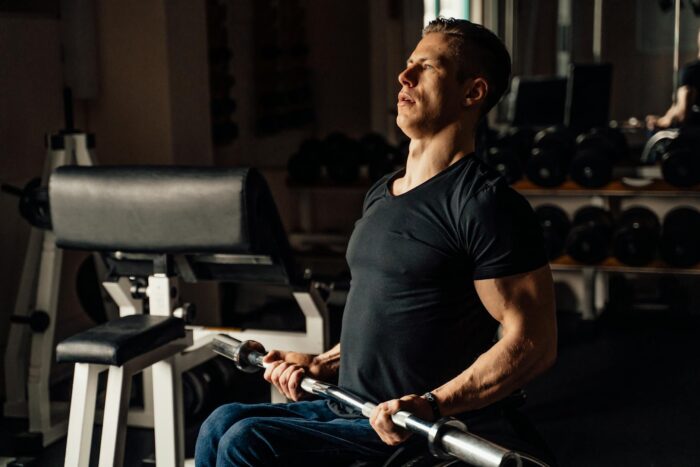
The exercise is the seated barbell biceps curl on an incline bench. If possible, set the backrest almost vertical. Sit on the bench, press your back against the backrest, put your feet out in front of you and keep your soles firmly flat on the floor. Your legs, feet and thighs stay together. This position cuts down on swinging the body to build momentum.
How the biceps works with this method
The barbell starts on your thighs. Hold it with an underhand grip, hands on either side of your thighs, outside your legs. At the bottom, the barbell touches your thighs. At the top, it moves slightly above your chest, but you don’t pull it into your chest.
The key point is tension. When you feel a strong contraction in the biceps, start lowering. Don’t pull past that point. Your body stays still, there is no bouncing off the thighs and the movement is smooth. Not too slow, but controlled.
Now the work itself. Start with 15 or 17.5 kg. Rest the barbell on your knees and do 5 x 12. That means: do 12 repetitions with 15 kg or 17.5 kg, don’t put the barbell down, rest 15 seconds and do the next 12 repetitions. That adds up to 5 sets.
Once 5 x 12 is done, rest 1.5 minutes. Then load the barbell with 20 kg or 22.5 kg and do 5 x 10. After each set of ten, rest 15–20 seconds. Keep a stopwatch handy, because this is where the short rests really start to count.
The last part is the hardest. After another 1.5 minutes of rest, load the barbell with 25 kg or 27.5 kg and do 5 x 8. Rest 15–20 (25 if needed) seconds. If you get through it properly, the work is done.
Practical tips: biceps and choosing the weight
The weight has to be honest, but not stupid. You need to be able to finish the whole thing. If the first 5 x 12 feels too easy, don’t let it fool you. That is just settling in. The second and third blocks show where you really stand.
If you feel halfway through that the weight is a bit light, don’t start piling on more right away. Slow down the negative phase instead. Lowering can be just as painful for the biceps as lifting, if you really control it.
Should this be your entire biceps workout? That depends on the day. The original idea was to do a heavier exercise first, for example standing alternating dumbbell biceps curls, 4 x 8 with a heavier weight, and then finish with this pump block. After work like that, the biceps usually don’t need anything more.
- 5 x 12 (17.5 kg) — rest between sets 15 seconds.
- 5 x 10 (22.5 kg) — rest between sets 15–20 seconds.
- 5 x 8 (27.5 kg) — rest between sets 15–20 (25 if needed) seconds.
Rest between the five-set blocks is 1.5 minutes. Use a stopwatch. If the rests become random, the effect of the method becomes random too.
FAQ: biceps
Can you do this method every week?
Preferably not. It suits occasional use, when you need a new stimulus in your training or you have been stuck for a while.
Do I have to use exactly the same weights?
No. These weights are an example from a training log. Choose a training load so that the repetitions get done, but the last sets demand real effort.
What should I do if my technique starts to break down?
Reduce the weight or end the set. Swaying your body and bouncing the barbell off your thighs take the work away from the biceps.
Author: Janar Rückenberg
Source:Turg.Fitness.ee
Come and train! ArtGym




