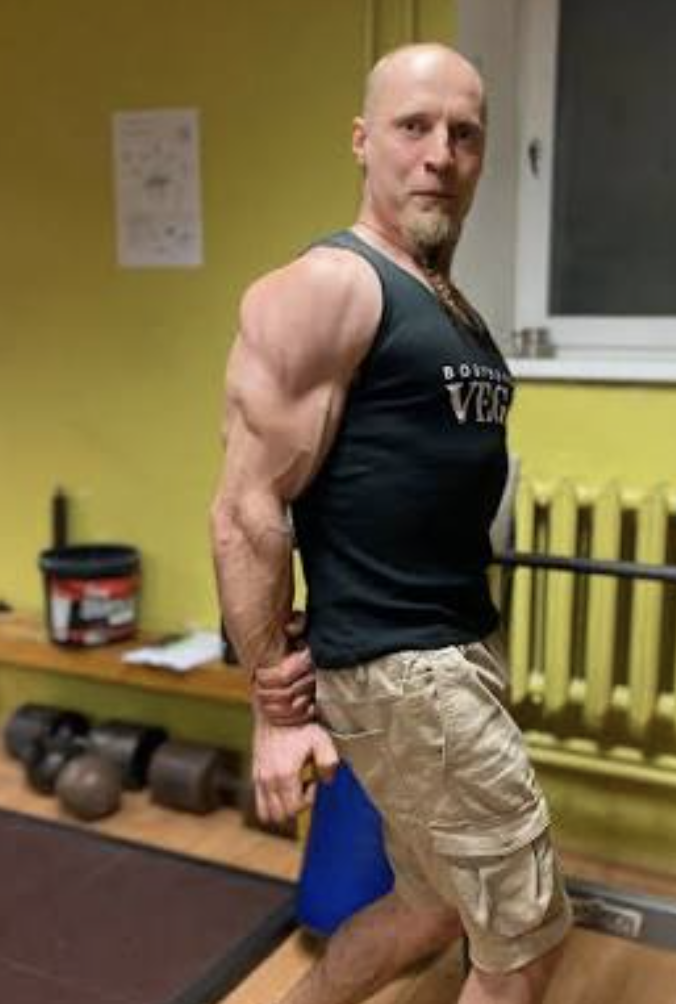
Biceps and shoulders in Silver Sõrmus’s workout
Biceps, shoulders and forearms get their training load in this workout just the way Silver Sõrmus did it in the Sparta gym: with free weights, at a brisk pace and without machines. The focus isn’t on fancy exercise names but on the kind of work that makes your muscles announce themselves the next day.
Biceps come after heavy shoulder work
Silver Sõrmus was at the center of this Tegijate Trenn for a reason. Even the handshake signaled that this is someone who doesn’t joke around in the gym. At the autumn championships, Silver was talked about as a gold contender in the junior bodybuilding category, and a physique like that doesn’t come from random flailing.
The workout started at the Sparta sports club with a short warm-up on a rowing machine. Then it was down to business. The plan for the day was simple: shoulders, a little trapezius, then biceps and finally forearms. All with free weights. No cables, no machines, no settling comfortably into an apparatus.
Honestly, this kind of training is a good reminder. When the weight is in your hands rather than on the end of a cable, your body has to do more of the stabilizing itself. That doesn’t automatically make the exercise better, but it demands more attention. When your technique breaks down, it shows immediately.
Shoulders before biceps: the training order
The first serious exercise was the standing barbell overhead press from the chest, 4 x 6-8. Warm-up sets with a lighter weight came before the working sets and didn’t count. The grip was fairly narrow, shoulder-width according to Silver. A simple truth: if your shoulders are narrower, it feels narrow; if they’re wider, it already feels more ordinary.
The repetitions were kept within the prescribed range. The weight went up from set to set. Silver finished with 80kg for 6 repetitions. That’s not a number to chase blindly. What matters more is that the press stays under control and your lower back doesn’t start rescuing every repetition.
Next came the dumbbell front raise, a.k.a. “Hitler”, 4 x 10. The name comes from old gym slang and sounds awkward today, but the exercise itself is clear: you raise a dumbbell to the front and load the front of the shoulder. An interesting nuance was that both dumbbells were picked up, but one arm was worked through first and only then the other. That makes it easier to focus on one side.
Silver’s training was characterized by brisk, fast movements. That suits someone who already has a good feel for the muscle. It isn’t the best place to start for a complete beginner, because momentum can take the work away from the muscle and turn the exercise into simply throwing weight around.
Sideways and back: your shoulders get the full treatment
The third exercise was standing dumbbell lateral raises, 4 x 10. The sets and repetitions stayed the same; only the direction of movement changed: the arms went out to the sides, and both sides worked at the same time. That shifted the emphasis to the middle part of the shoulder, which gives the shoulders a wider look.
The last shoulder exercise was bent-over lateral raises, 4 x 10. Here the attention went to the rear part of the shoulder. You lean forward, pick up the dumbbells and raise your arms out to the sides. When the repetitions no longer hold up at the end, lighter weights are taken for the last set. That makes more sense than yanking with your body and hoping the shoulder does something anyway.
Biceps and traps: a short but brutal finish
Once the shoulders were done, it was the traps’ turn. Seated dumbbell shrugs, 4 x 12 + superset, looked easy on paper, but felt different. You sit on a bench, pick up the dumbbells and start shrugging. Here too Silver used a fairly brisk movement.
A superset meant something specific in this workout. In the fourth set, 12 repetitions were done with a heavy weight, then, without resting, a lighter weight was picked up and repetitions were added until the muscle was squeezed dry. So what actually happens? The muscle doesn’t get a chance to calm down in between, and the burn arrives quickly.
Only then did the biceps come up. The exercise was seated dumbbell curls, 4 x 10. You sit on a bench, pick up the dumbbells and lift. The strategy was the same as with the front raises: first one arm, then the other, not alternating. That keeps your attention on one side and makes cheating harder.
The last set was again a superset. Once the second arm was done, lighter dumbbells were picked up without resting and the biceps were exhausted completely. That needs no complicated explanation. If the weight is right and your elbow isn’t wandering in every direction, the exercise does its job.
Your biceps need strong forearms too
The forearms were saved for last: reverse barbell curls (overhand grip). By then the workout had already dragged on. The rest breaks weren’t very long, but they were enough to get the next set done. Looking back at the first shoulder exercise, it already felt as if it had happened the day before.
Reverse curls are a good exercise for anyone who wants stronger wrists and forearms. You grip the barbell overhand, keep your body still and curl the forearms. The plan was 4 x 10 + superset. In the last set you reduce the weight and add as many repetitions as you can manage.
All in all, there weren’t an enormous number of exercises, but the training volume added up nicely. The shoulders got worked from the front, side and rear. The traps got their share. The biceps got only one main exercise, but after the previous work and the superset, that was enough. The next day and the day after, the muscles certainly made themselves known.
Training plan: biceps, shoulders and forearms
- Standing barbell press 4 x 6-8
- Dumbbell front raises, a.k.a. the “Hitler” 4 x 10
- Standing dumbbell lateral raises 4 x 10
- Bent-over dumbbell lateral raises 4 x 10
- Traps (shoulder raises) 4 x 12 + superset
- Seated with dumbbells 4 x 10 + superset
- Barbell overhand-grip forearm curls 4 x 10 + superset
FAQ
Is this biceps and shoulder workout suitable for a beginner?
A beginner can use the same structure, but at a calmer tempo and with lighter weights. Fast-paced repetitions are worth doing only once your technique holds up even when you’re tired.
Why is there only one biceps exercise?
Because the whole workout wasn’t just for the arms. Before that, the shoulders and traps did a lot of work, and the biceps got a strong finish with a superset.
Does the absence of machines make a workout better?
Not always. Free weights demand more control and balance, but machines have their place too. In this workout, the aim was to do all the work with the barbell and dumbbells.
Source: Turg.Fitness.ee
Come and train! ArtGym