
Muscle shape and the trapezius in training
Muscle shape isn’t something you can mold in the gym like a lump of clay, but training can shift the emphasis. If you choose exercises by angle, grip and movement pattern, one part of a muscle can get more work than another.
That doesn’t mean you can change where a muscle attaches or rewrite your genetics. What it does mean is that the trapezius, triceps, chest, quadriceps and abs don’t always work as one big, uniform block.
Muscle shape: why does this topic matter at all?
It’s easy to spot in the gym. Some people have a strong lower chest but an empty upper chest. Others grow their triceps well, yet that famous horseshoe shape just never shows up. And some have strong shoulders but almost no visible middle trapezius on their back.
The simple truth: a muscle isn’t always one straight, uniformly working piece. Skeletal muscle can consist of sections, heads, fiber directions and regions that receive a different training load in different exercises. Dr. Antonio has described it by noting that skeletal muscle isn’t just one big bundle of muscle fibers driven by a single nerve and working equally in every movement.
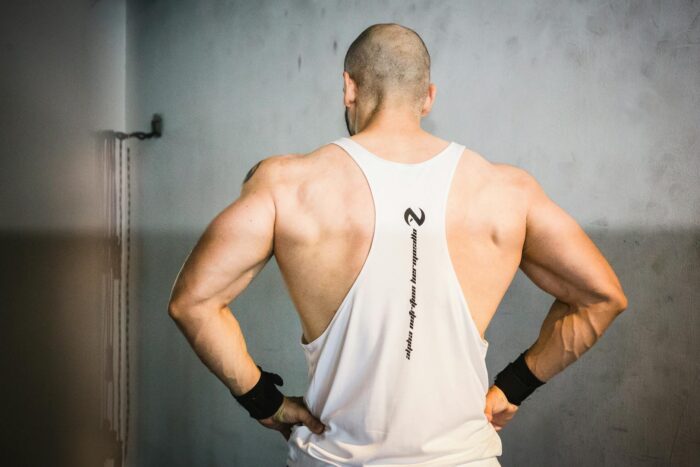
The trapezius is a good example. This large, kite-shaped muscle covers a wide area of the upper back. It can be divided into an upper, a middle and a lower part. Shrugs load mainly the upper trapezius. Rows bring the middle part more into play. Behind-the-neck lat pulldowns on the cable machine affect the lower part more, even though that exercise is often done for the lats.
So what actually happens? The same muscle does the work, but the emphasis of the training load shifts. That’s why, in many cases, one exercise isn’t enough if the goal is to develop a muscle as completely as possible.
Muscle shape and EMG: what do the measurements show?
EMG, or electromyography, measures the electrical activity of a muscle. It can be used both at rest and during exertion. If one exercise produces different activity in different regions of a muscle, that hints that not all parts work in exactly the same way.
The studies cited in the original article contained several interesting observations. In one experiment, participants did only seated leg extensions for six months. The circumference of the upper and lower quadriceps grew by 19%, while the middle of the muscle grew by only 13%. That’s not a small difference.
In another example, triceps training lasted 12 weeks. The result was that mainly the middle part of the triceps developed, while the change in other parts was small. This doesn’t prove that you can grow every millimeter on command. But it supports the idea that exercise selection matters more than many people think.
The abs are an even more classic topic. People have argued for years about whether you can train the upper and lower abs separately. One camp says the rectus abdominis is a single muscle that runs from the pubic bone to the sternum, so every exercise should load it equally.
Practical experience and EMG measurements tell a more nuanced story. A standard crunch activates the upper abs more. Reverse crunches and leg raises shift the emphasis toward the lower segments. Yes, the whole rectus abdominis takes part. But the emphasis can differ.
Dr. Per A. Tesch’s book “Target Bodybuilding” supports the same idea. It describes how MRI imaging was used to look at the effect of different exercises on regions of the muscles. The book’s point is simple: an exercise isn’t just “chest,” “back” or “legs.” The angle, grip and movement path of an exercise change which part does more of the work.
The trapezius in practice: what to do in the gym?
If your goal is a more complete trapezius, don’t stop at shrugs. That exercise is good, but its emphasis is on the upper part. The middle and lower back need different kinds of rows, controlled shoulder blade movement and exercises where the shoulder girdle works in different directions.
The same logic applies to the chest. If the upper chest lags behind, you can put the emphasis on incline presses in one workout. Next time you can go with a more standard angle or a decline. If your development is already symmetrical, you can hit the chest from several angles in every session. Honestly, it depends on your weak spot.
For the quadriceps, stance and movement path also affect how the training load is distributed. Squatting with your feet together and squatting with a wider stance and toes pointed out aren’t exactly the same task for the body. Both are squats, but the emphasis changes. That’s exactly why experienced lifters don’t build an entire leg day around a single movement.
Still, there’s a limit here. You can’t change where a muscle attaches. If your lats insert high, no exercise will give you the look of a low-insertion back. Muscle shape is partly hereditary. Training can emphasize regions, improve balance and build mass, but it can’t rewrite the structure of your body.
Muscle shape in your training plan: practical tactics
If one area lags behind, choose exercises based on what you want to emphasize. Don’t simply add more sets to the same movement. If your lower chest is strong but your upper chest is empty, a tenth set of standard bench press may not solve the problem. You need to change the angle.
Another option is to split the emphasis between workouts. In one session you might do more for the upper part, in the next more for the middle and lower parts. This works especially well if you train a muscle group several times a week. If you train a muscle only once a week, that one workout needs to include more different angles.
The third approach is to use simple tracking. Take notes for a couple of months: which exercises give you a good feel for the muscle, where you see progress and where you don’t. The mirror, a training log and honest feedback work better together than randomly swapping exercises.
Don’t confuse feeling a muscle working with muscle growth. Feeling an exercise in a particular area doesn’t automatically mean more hypertrophy will happen there. But when feel, technique, increases in weight and measurable progress all move in the same direction, you have a better basis for making decisions.
The translator’s note from the original is worth keeping: a large multi-headed muscle is built for multiple functions. The quadriceps consists of four heads, the triceps of three. Since the body has different functions, it makes sense that in the gym you can bring those functions out more or less with different exercises.
Bodybuilders have used this for years. They don’t choose many exercises just for variety. They know that a single exercise doesn’t affect every part of a muscle equally effectively. Science helps explain this, but in practice the idea is quite down-to-earth: if you want more complete development, train the muscle from several angles.
FAQ
Can muscle shape be changed completely?
Not completely. Attachment points, muscle length and overall structure are largely hereditary. Through training you can build muscle and emphasize certain areas, but you can’t turn your anatomy into something entirely different.
Does the trapezius need more than one exercise?
Yes, if the goal is complete development. Shrugs emphasize the upper part, rows the middle part more, and some pulls or scapular control exercises can help get the lower part working better.
Can the upper and lower abs be trained separately?
Not entirely, because the rectus abdominis works as a whole. However, different exercises can emphasize the upper or lower segments more. Crunches and leg raises don’t give the body the same task.
References
1. Antonio, J. Nonuniform response of skeletal muscle to heavy resistance training: can bodybuilders induce regional hypertrophy? J. Strength Cond. Res. 14(1):102-113. 2000.
2. Barnett, C., V. Kippers, and P. Turner. Effects of variations of the bench press exercise on the EMG activity of five shoulder muscles. J. Strength Cond. Res. 9:222-227. 1995.
3. Glass, S.C., and T. Armstrong. Electromyographical activity of the pectoralis muscle during incline and decline bench presses. J. Strength Cond. Res. 11:163-167. 1997.
4. Kawakami, Y., T. Abe, S.-Y. Kuno, and T. Fukunaga. Training-induced changes in muscle architecture and specific tension. Eur. J. Appl. Physiol. 72:37-43 1995.
5. Kraemer, W.J., S.J. Fleck, and W.J. Evans. Strength and power training: Physiological mechanisms of adaptation. Exerc. Sport Sci. Rev. 24:363-398.1996.
6. Lipetz, S., and B. Gutin. An electromyographic study of four abdominal exercises. Med. Sci. Sports 2:35-38. 1970.
7. Nardone, A., C. Romano, and M. Schiepatti. Selective recruitments of high-threshold human motor units during voluntary isotonic-lengthening of active muscles. J. Physiol. 409:451-471. 1989.
8. Narici, M. V., H. Hoppeler, B. Kayser, L. Landoni, H. Claasen, C. Gavardi, M. Conti, and P. Cerretelli. Human quadriceps cross-sectional area, torque, and neural activation during 6 months of strength training. Acta Physiol. Scand. 157:175-186. 1996.
9. Sarti, M.A., M.S. Monfort, M.S. Fuster, and M.D. Villaplana. Muscle activity in the upper and lower rectus abdominus during abdominal exercises. Arch. Phys. Med. Rehab. 77:1293-1297. 1996.
10. Tesch, P.A. Target Bodybuilding. Human Kinetics, Champaign Ill. 1999.
The article is from: http://www.tmuscle.com/free_online_article/sports_body_training_performance/made_to_order_muscle
Translated by Janar Rückenberg
Come and train! ArtGym




