
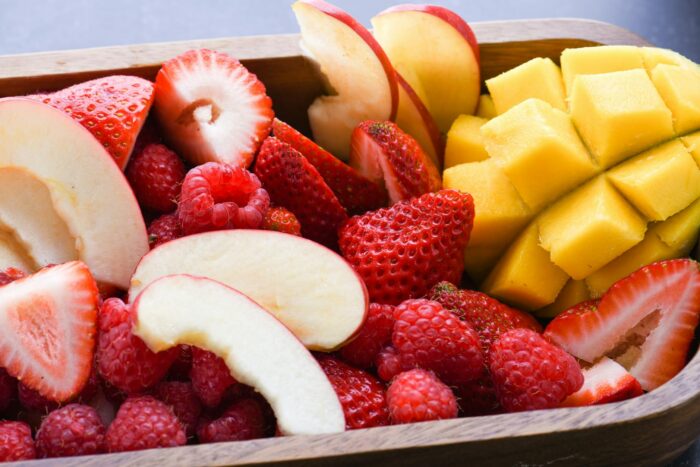
Sliced fruit in your gym bag: does cutting it up destroy the vitamins? The short answer is no. Spanish researchers measured it, and the result surprises many people. In this article we look at why fruit is a good choice before a workout and what to say to those who worry about fructose.
Why bodybuilders once feared fruit
There was a time when most gym-goers steered clear of fruit. The logic went something like this: fructose is a sugar, sugar turns into fat, so a banana will make you flabby. In reality, the story is more nuanced.
Muscles can’t use fructose directly. The liver takes it up, converts it into glycogen and stores it. Only once glycogen stores are full does the excess start to be stored as fat. A moderate amount of fruit a day — two to three pieces — won’t make those stores overflow.
Then there are the antioxidants. Vitamin C, carotenoids, polyphenols — all things you can’t get in an equivalent form from a jar. Training causes oxidative stress, and fruit helps to balance it out.
Why sliced fruit works so well before a workout
The carbohydrates in fruit are absorbed slowly enough that insulin levels don’t swing sharply. That gives you steady energy for the workout, without a slump half an hour later. Toss a large orange or apple in your bag, and it’s ready to eat by the time of your evening group training session.
Sweeter options — pineapple, mango, kiwi, watermelon, strawberries — work too. The only hassle: they have to be washed and cut up. Shops already sell ready-prepared boxes. Convenient, but it raises a question: does sliced fruit lose its nutritional value when it’s cut?
What the Spanish study showed about sliced fruit
That is exactly the question Spanish researchers set out to answer in a study published in the Journal of Agricultural and Food Chemistry. They took five fruits — pineapple, mango, watermelon, strawberries and kiwi — and tracked them in the fridge for 9 days, measuring levels of vitamin C and carotenoids (beta-carotene, lycopene) every day. Half of the fruit was kept whole, half already sliced.
Results after 6 days:
- In sliced strawberries, watermelon and mango, vitamin C levels dropped by just 5% compared with whole fruit.
- In sliced pineapple, vitamin C content dropped by 10%.
- In sliced kiwi, vitamin C dropped by 12%.
- Carotenoid levels dropped by 25% in sliced pineapple, and by 10–15% in chopped strawberries and mango.
- Chopped kiwi and watermelon lost no carotenoids at all during the test period.
In other words, the changes were minimal — especially considering that in real life nobody leaves the fruit meant for their gym bag in the fridge for a whole week. It’s far more likely to get eaten the same day or the next.
Practical tips
A few things worth keeping in mind:
- Eat fruit 30–60 minutes before your workout. Training fasted isn’t the goal, and neither is a heavy stomach.
- Combine it with a shake. A banana with a protein shake gives you both fast and slow carbohydrates in a single serving.
- Whole or sliced — it makes no difference. If you have time, cut it yourself right before eating. If not, pack the already washed and chopped version, guilt-free.
- Store it in the fridge at 0–4 °C. At room temperature, antioxidants break down faster than in the cold.
- Vary your fruit. Eating only apples is monotonous in more than just taste — different fruits provide a different spectrum of antioxidants.
So what actually happens? If you eat a couple of pieces of fruit a day and one of them falls in the pre-workout window, you get both energy and antioxidant protection. The fear of fructose is largely outdated — it applies more if you drink a liter of fruit juice in the evenings while sitting on the couch.
FAQ
Does sliced fruit lose a lot of vitamins from the moment you buy it?
During the first couple of days in the fridge, the loss is too small to measure — in the Spanish study, the difference between whole and chopped fruit after 6 days was only 5–12%, depending on the fruit. For everyday use, no difference is noticeable.
Could the fructose in fruit be enough to make you fat, even if you keep up your training?
Not with two or three pieces of fruit a day. Liver glycogen stores have to fill up before the excess starts to be stored as fat. The problem is more likely to come from sugary drinks and processed food.
Which fruit is best before a workout?
The banana is the classic — easy to carry, and it quickly tops you up with carbohydrates. Apple, orange and mango work just as well. Choose the one you like and will actually eat.
Source: Flex / Tabatha Elliott
Translated by: Aktivist
Source: WHO – physical activity.
Come and train! ArtGym




