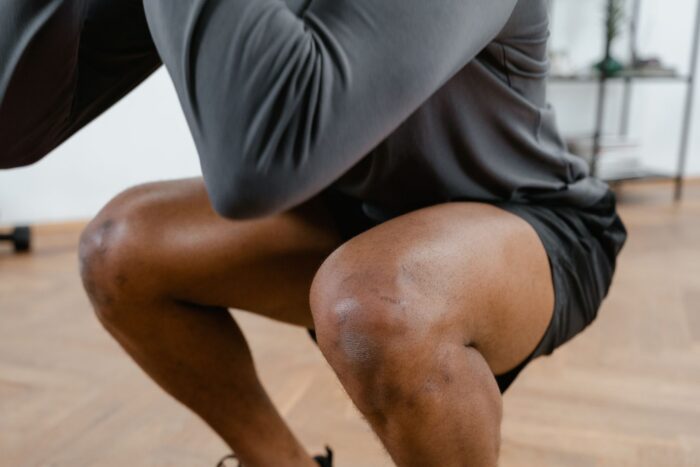
Knee joint biomechanics in training
Knee joint biomechanics explains why the knee has to be both mobile and very stable at the same time. Once you understand that, it’s easier to choose exercises, keep your technique under control and reduce unnecessary training load on the tissues around the knee.
Why knee joint biomechanics matters
The knee joint is formed by the ends of the femur and the tibia. The way these bones fit together is nothing like a deep socket that holds everything in place by itself. The contact surfaces of the tibia and femur are rather shallow, and the rounded ends of the femur glide over them.
The simple truth is that the knee can’t rely on bone shape alone. Stability has to come from the muscles, ligaments, cartilage and all the surrounding connective tissue. That’s exactly why the same knee can feel solid in a squat one day and uncomfortable the next, when you’re tired or your technique slips.
The knee’s role in movement is somewhat contradictory. It has to allow flexion and extension, yet at the same time bear the weight of the body. In strength training, external weight is added on top of that. When you do squats, leg presses or lunges, the knee doesn’t work alone. The hip, the ankle and the trunk muscles also influence how much training load ends up on the knee.
How knee joint biomechanics works
When the knee is fully extended, its main job is to stay stable. The ligaments and connective tissues are taut, and the joint is, in a sense, better locked. That doesn’t mean you should force the knee rigid during training, only that in the extended position the joint’s natural emphasis is on stability.
When the knee flexes, the situation changes. The joint has to allow a greater range of motion. The connective tissues give a little so the knee can move. This is where the work of the muscles comes in. The better the muscles at the front and back of the thigh, the glutes and the lower leg control the load, the less the joint itself has to hold everything together.
It’s also important to know that many of the muscles that influence knee movement cross more than one joint. Most of them work at the knee and the hip at the same time. The calf muscle is more of an exception, since it affects the knee and the ankle. This makes exercise selection interesting, but it also demands attention.
For example, the back of the thigh helps extend the hip and flex the knee. If you try to stretch the muscle hard across both joints at once, passive insufficiency can occur. If you expect the same muscle to produce great force at both joints at once, active insufficiency can occur. These terms sound dry, but in the gym the idea behind them is simple: the body doesn’t always produce strength best when a muscle is very short or very long.
The front and back of the thigh need to work together
The muscles on the front of the thigh play a big role in extending the knee. When the knee flexes, the muscles on the back of the thigh work harder. But in training you can’t look at them as separate islands. The squat, the lunge and the leg press need both sides, plus the hip and the trunk.
The muscles mentioned in the original text, such as gracilis, sartorius, semitendinosus, biceps femoris, semimembranosus and rectus femoris, show that there are different types of muscle around the knee. Some are better suited to creating a large range of motion, others to producing strength. Together they give the knee both movement and control.
Knee joint biomechanics in strength training
In strength training, it’s worth seeing the knee as part of a movement, not as a lone cog in a machine. The squat isn’t just a knee exercise. The knee extension on a machine isn’t just about the front of the thigh. The leg curl isn’t just about the back of the thigh. All of these movements depend on how the body distributes weight.
If the knee collapses inward in a squat, the cause may be the hip, the foot, fatigue or too much weight. If you feel uncomfortable pressure on the knee extension machine, a lower training load, a calmer tempo or a more suitable range of motion may help. Frankly, the knee isn’t always the culprit, even when the sensation shows up in the knee.
A good rule of thumb is to keep the movement controlled. Don’t drop the weight down. Don’t slam the knee into full lockout. Don’t choose an exercise just because of what the person next to you is doing. The knee needs a consistent training load, but not random heroics.
Strengthening the muscles around the knee matters for joint health, performance and injury prevention. That doesn’t mean everyone should follow the same program. For some people the squat suits better, for others the leg press, and for others a calm knee extension and leg curl to start with. What matters is that the training load increases sensibly and your technique doesn’t fall apart.
What to watch for in exercises
When squatting, make sure your foot stays planted on the floor and your knee tracks in the same direction as your toes. This doesn’t have to mean a rigid rule that the knee must never move past the toes. In many people the knee naturally travels forward, especially in a deeper squat. It’s a question of control, not of one magic line.
With the knee extension, start gently. This exercise can be useful for feeling the front of the thigh, but too much weight and an abrupt end position can be hard on the knee. With the leg curl, make sure your hips don’t start popping up on the bench or machine. Then the body shifts the load elsewhere and the goal gets lost.
So what actually helps? A warm-up, a suitable weight, an even tempo and an honest assessment of how you move. If your knee gives you a sharp pain, this is not the time to grit your teeth and push through. If it is simply the feeling of new muscle tension, you can increase the training load sensibly.
FAQ
Is the squat alone enough to strengthen the knee?
The squat is a good exercise, but it is not the only solution. The knee also benefits from strengthening the hamstrings, glutes, calves and core muscles. Sometimes a separate knee extension or leg curl helps as well.
Why does the knee feel less stable in flexion?
In flexion, the knee has to allow more movement. The connective tissues are then not as taut as in the extended position. That is why muscle control becomes especially important.
Should you skip leg training if you have knee pain?
If the pain is sharp or getting worse, it is worth reducing the training load and, if necessary, talking to a specialist. Not all discomfort means an injury, but ignoring pain is not a good training plan.
Source
Source: www.ifbb.com
Professor Mauricio de Arruda Campos
IFBB Educational Commission
Translated by Jupp, Author Professor Mauricio de Arruda Campos
Come and train! ArtGym