
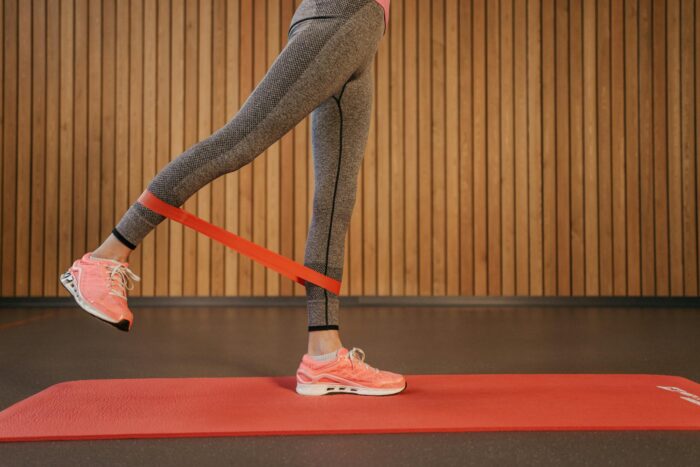
Get your legs in shape: a thigh and glute guide
Your legs get into better shape when your training follows a clear order, starts with a proper warm-up and includes enough recovery. This guide will help you put together a thigh and glute plan so that strength, muscle tone and technique develop together.
Muscle & Fitness Hers once wrote about a very familiar situation: friends head out of town for the weekend, the hotel has a pool, and the conversation quickly turns to bikinis and thighs. One wants slimmer legs, another wants more muscle, and a third hopes to squeeze into her old jeans again. Honestly, that still sounds pretty true to life today.
Why do your legs need their own plan?
Your thighs and glutes aren’t small assistance muscles that you can train in passing. The lower body has many large muscles and joints that work together every time you stand, sit, walk, climb stairs or squat.
That’s exactly why one and the same plan doesn’t suit everyone. Beth Horn, a Chicago-based professional fitness competitor and personal trainer, and Michelle Olson, a professor of exercise science at Auburn University at Montgomery, Alabama, stressed the same idea: your plan has to fit your body, your goal and your level.
If your goal is stronger, better-shaped legs, a random leg press at the end of a workout isn’t enough. You need a warm-up, a main strength exercise, accessory exercises, hamstring work, stretching and rest.
Get your legs working: start with a warm-up
Lower-body training starts with getting the blood flowing. Before lifting, do a calm but noticeable warm-up on a bike, treadmill or elliptical machine. 5-7 minutes at moderate intensity is a good start. Not a stroll. Not a race. Just enough to warm your body up and break a light sweat.
Then do a lighter warm-up with a squat-type movement. You can use just your body weight or very light dumbbells. Do 2 sets of 10-12 repetitions. This signals to your knees, hips and lower back what’s coming.
There’s no point rushing here. A good warm-up makes the main workout better, because your technique stays cleaner and the weights move more confidently.
How do you really make your thighs and glutes grow?
You’re usually at your strongest at the start of a workout, so put the most demanding exercise first. The classic choice is a barbell or dumbbell squat. The squat works the quadriceps, glutes, core and smaller stabilizing muscles.
If free weights feel unsteady at first, you can use a Smith machine. It doesn’t make the exercise magically easy, but it helps you keep your balance until the movement becomes more familiar.
Add a second angle
After the main squat, choose an exercise that loads the same muscles from a slightly different angle. Olson recommended hack squats or sissy squats on a machine. A leg press also works for variety. A simple truth: don’t do the same order every time once your body has already gotten used to it.
The weight should be heavy enough to really tire the large muscle groups. At the same time, your technique must not fall apart. If your knees cave in, your back loses position or the movement becomes half-hearted, the weight is too heavy.
Use single-leg exercises
Lunges and step-ups are good exercises because they force each leg to work separately. Olson noted that unilateral training helps keep strength and growth balanced between your legs. When you train one leg at a time, the stronger side can’t do all the work for the weaker one.
If you’re already tired at this point in your workout, choose a moderate weight. A lunge done under control gives you more than ego-picked dumbbells and sloppy technique.
Your legs also need hamstring work and recovery
The back of the thigh is the weak spot in many people’s plans. Deadlifts and leg curls on a bench or machine suit it well. Horn said she often finishes with seated leg curls, because they hit the hamstrings very directly.
If you’re tired, favor machines or a lighter weight. A machine isn’t cheating. It can help keep the movement clean just when your core and balance no longer work as well.
The number of repetitions and sets depends on your goal. The question “how much should I do?” sounds simple, but the answer depends on your body, your experience and your recovery. Olson and Horn stressed that what works for one person may not suit another as well.
Frequency is easier to pin down. Most women could train their legs with weights two days a week and do cardio intervals on two days. That leaves room for progress without leaving your lower body exhausted every day.
After your workout, do 5-10 minutes of stretching. Cover the glutes, quadriceps, hamstrings and inner thighs. Stretching helps maintain your range of motion and supports hip and knee mobility.
Don’t underestimate rest. Your thighs and hips need 48 hours of recovery between workouts. If your muscles are still sore from the last session, don’t pile another heavy training load on top of them right away.
What to keep an eye on so your legs keep progressing
If you find a plan that works, don’t stay stuck with it forever. Olson recommended reviewing your thigh and glute training every 4-6 weeks. The body adapts quickly, especially when the exercises, weights and repetitions stay the same.
The change doesn’t have to be big. You can switch the order of the exercises, add weight every week, change the rep range, or occasionally use supersets, pyramids and drop sets. The main thing is that your training load keeps moving forward rather than going in circles.
Combine strength training with cardio and keep your nutrition sensible. That way the results won’t stay just numbers in your training log. Within a couple of weeks you may notice that your step is steadier, your squats are deeper, and your thighs and glutes feel the load exactly where they should.
FAQ: legs, thighs and glutes
Can you train your thighs and glutes completely separately?
Not completely. In squats, lunges and step-ups, the thighs, glutes and hips work together. Your choice of exercise lets you shift the emphasis, but the body doesn’t move one muscle at a time.
How often should you train your lower body?
A good starting point is two strength workouts a week and two days of cardio intervals. Leave at least 48 hours between heavy leg days for recovery.
When should you change your plan?
Review your plan every 4-6 weeks. If the weights, repetitions and the feel of your workouts no longer change, your body has probably adapted.
Ask a trainer: https://turg.fitness.ee/en/program-builder-v2
Source: WHO – physical activity.
Come and train! ArtGym




