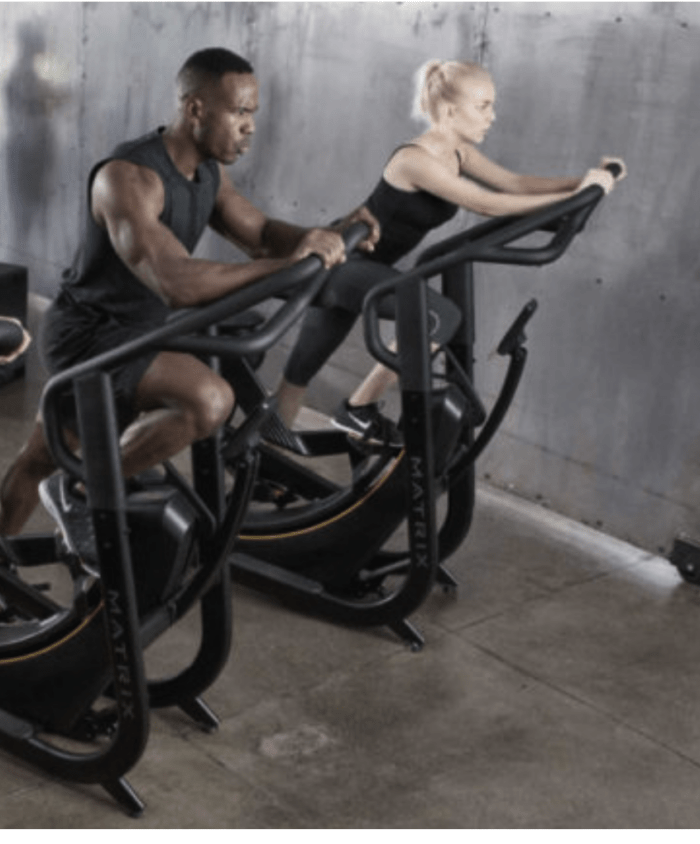
Cardio training isn’t just about raising your heart rate. Pick the right machine, incline, resistance and pace, and your legs get a seriously good workout at the same time.
The simple truth: walking, cycling, sprinting, the stepper and spinning can strengthen your thighs, glutes and calves if you do them deliberately. Below is a practical way to make an ordinary cardio workout more useful for your legs, without having to do a separate leg day every time.
Why does cardio training work for the legs?
Your legs do much of the work in cardio. This is especially clear on the treadmill, the bike and the stepper, where every step or pedal revolution comes from the thigh, calf and glute muscles. If the training load is too light, the session stays more of a way to get moving. Add incline, resistance or short faster bursts, and the picture changes right away.
So what actually happens? The muscles have to work with more strength, not just for longer. The quadriceps help extend the knee, the glutes drive the body forward and the calves keep your stride going. That is why a well-done cardio workout can give your legs better endurance and, in some cases, noticeable tone.
At the same time, it doesn’t replace heavy strength training if your goal is a lot of muscle mass. Squats, deadlifts and lunges keep their place. But if you want cardio to be more than just “burning calories”, you can put it to work for your legs.
Cardio training on the treadmill, bike and stepper
Treadmill
Treadmill: Change the treadmill’s incline and direction. Walking or running on an incline helps strengthen the quadriceps, glutes, hamstrings and calf muscles. When you raise the incline, the pace doesn’t always have to be crazy. Sometimes moderate walking on a steep incline gives your legs a better training load than a too-fast jog on a flat surface.
Walking backwards or sideways adds variety and stimulates the muscles from different angles. Do this only if you feel secure on the machine. Start slowly, keep your hands on the rails if needed, and don’t turn the exercise into a stunt. The goal is control, not a movement that looks impressive on video.
Cycling
Cycling: Increase the resistance when you ride. This puts more work on the thigh and glute muscles. Keep your cadence (revolutions per minute) at about 90 to keep the cardio training effective. If the resistance is too low, your legs just go around in circles. If it’s reasonably strong, you have to genuinely work for every pedal stroke.
On the bike, watch that your knee doesn’t cave inward and your hips don’t start rocking from side to side in the saddle. These are signs that the load or position isn’t right. Good cardio training should be hard, but not sloppy.
Sprints and intervals
Sprints: Add sprints to your training program, whether it’s running, cycling or the elliptical trainer. For example, 1 minute of steady movement followed by a 30-second sprint. Increase the duration of the high-intensity periods as your strength grows.
Intervals work well when time is short. They raise your heart rate quickly and make your legs work harder. Honestly, not every workout has to be a maximal effort. If you sprint too often, your legs get tired before progress has a chance to arrive.
Stepper and spinning
Stepper: Use the stepper to train your legs and glutes. Increase the training load by taking steep steps. Don’t lean your whole body on the handles, because that takes much of the work away from your legs. Keep your torso long, push through the sole of your foot and let your glutes do their part.
Spinning: You can adapt spinning to your goals by increasing the bike’s resistance and adjusting the training load. If you want to load your legs more, use heavier segments and ride standing up, but keep your technique clean. If the goal is recovery movement, keep the resistance lower.
How do you make a cardio workout useful for your legs?
Start by choosing one clear goal for the session. Do you want better endurance, stronger glute work, a faster heart rate, or just some variety between leg days? Once the goal is set, it’s easier to pick the machine and the training load too.
- If you want calm but effective work, choose the treadmill with an incline.
- If you want to involve your thighs and glutes more, raise the resistance on the bike.
- If you need a short, sharp workout, add sprints or intervals.
- If you want a training load based on stepping, use the stepper.
- If the rhythm of a group class suits you, spinning can be a good choice.
A good sign is feeling the work in your legs while your joints stay quiet. A burning sensation in the muscle is normal. A sharp pain in the knee, hip or ankle is not something you should “push through”.
If you want to combine strength training and cardio better, keep your heavier leg workouts and very intense intervals on different days, or leave enough recovery between them. That way one session won’t eat into the quality of the other.
Cardio training and recovery
Cardio that benefits your legs doesn’t mean you have to stagger out of the gym every time. Strong progress comes from alternating training load and recovery. If your legs are still heavy from your last strength workout, choose a lower intensity. If you feel fresh, you can add incline, resistance or short, faster segments.
A warm-up helps too. Before a harder segment, spend a few minutes moving easily so your knees, hips and ankles are ready to work. After your workout, slow the pace down. It doesn’t have to be a long ritual, but your body gets a clearer signal that the training load is over.
If you train several times a week, rotate machines. A treadmill one day, a bike the next, a stepper on the third. That way your legs are loaded from different angles, and boredom doesn’t set in as quickly.
FAQ: cardio training
Does cardio training build leg muscles?
It can improve your leg endurance and muscle tone, especially if you use incline, resistance or intervals. For building a lot of muscle mass, though, strength training is still the better foundation.
Is a cardio workout suitable after leg day?
It is, as long as you keep it light or moderate. Very intense sprints right after a heavy leg day can interfere with recovery.
Which machine is best for your legs?
The best choice depends on your goal. An inclined treadmill, a bike with higher resistance and a stepper are all good, as long as you use them deliberately.
Source: WHO – physical activity.
Come and train! ArtGym