At a glance:
- Your choice of Bulgarian split squat variation depends on your goal: targeting your quadriceps, glutes or hamstrings, training balance or making it easier to increase the training load.
- A forward torso lean is better suited to emphasizing the hip extensors, while a more upright torso keeps the focus more on knee extension.
- Unstable variations and those with suspended supports are not automatically better; they are more suited to training control and core stabilization.
Introduction: Bulgarian split squat variations are a practical way to train your lower body one leg at a time, but a small change in body position, support or load placement changes how the exercise feels and the training stimulus it provides. An evidence-based choice means matching the variation to your goals, mobility, balance and capacity for recovery, rather than declaring one version the best.
How do Bulgarian split squat variations differ?
The Bulgarian split squat is essentially a rear-foot-elevated split squat in which the working leg does most of the work and the rear leg provides support (Mackey, 2021). This makes it a useful exercise when a regular squat on both legs does not suit you, when you want to compare your legs individually or when you need a stronger sense of local muscle fatigue without a very high systemic training load.
The most important variables are the distance between your front foot and the bench, torso angle, rear-foot height, load placement and support. A shorter stance and a more upright torso often shift the emphasis you feel toward your quadriceps. A longer stance and a controlled forward hinge at the hips place more emphasis on hip extension, particularly the combined work of your glutes and hamstrings; in an EMG study, leaning the torso forward increased activation of the gluteus maximus, biceps femoris and rectus femoris (Aygun-Polat, 2025).
If your technique needs work, start with a conventional split squat or a variation with a lower rear-foot support. The same principle applies when learning a regular squat: you need to understand the basic movement before adding complexity. For useful background reading, see Squat, squat, squat, squat, squat, which helps explain why knee, hip and torso position matter so much when squatting.
When should you choose a dumbbell Bulgarian split squat?
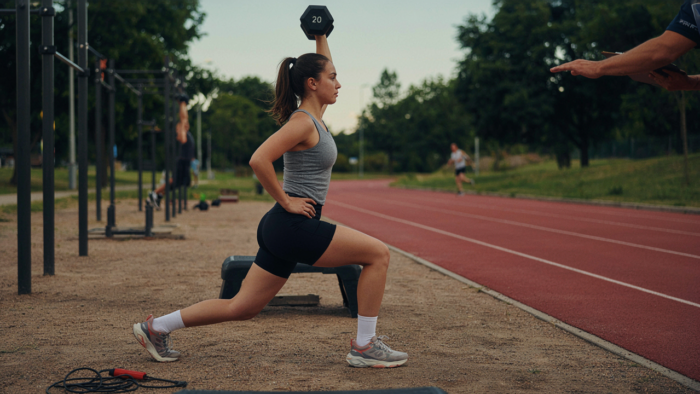
The dumbbell variation is the most practical option for most people. Your arms hang by your sides, your torso can move more freely and it is easier to drop the weights than with a barbell. It works well for building muscle mass and general strength, especially when your goal is to complete your working sets with good form without excessive technical demands.
Dumbbells are also a good option if your lower back fatigues too early during barbell squats. This does not mean the exercise is always easy on your back, as your torso still needs to stabilize, but the load is not on your shoulders or upper back. If grip becomes the limiting factor, you can use lifting straps, a Smith machine or a safe barbell variation. The effects of training still depend on your overall program: if your body weight, recovery and eating habits are inconsistent, Why keep a food diary can help you see whether the exercise or your recovery is holding back your progress.
When should you use a Smith machine or support?
A Smith machine or a variation with hand support is useful when balance gets in the way of training the target muscle. If you lose your position before your quadriceps or glutes really get to work, instability is a limitation, not a training advantage. In this situation, support can make the movement more repeatable and help you reach depth with greater control.
Research shows that the biomechanics of the rear-foot-elevated split squat differ from those of a squat performed on both legs and may produce a different loading profile at the hip (Mackey, 2021). There is therefore no need to treat the Smith machine variation as an “easier” exercise. It is a different tool: fewer balance demands give you more scope to keep your tempo, depth and effort consistent.
The supported Bulgarian split squat is particularly useful during a recovery period or when your goal is to reliably feel the target muscle working. However, if your sporting goal requires you to control your position with free weights, keep an unsupported variation in your program too. In the context of general movement and health, it is useful to remember that regular physical activity has wide-ranging health benefits; WHO physical activity recommendations provides an overview.
When should you choose a Bulgarian split squat with a forward torso lean?
A variation with a forward torso lean is useful when you want to emphasize the hip joint and posterior chain. Hinging forward at the hips does not mean collapsing with a rounded back. With good technique, your spine stays neutral, your core maintains pressure and the movement comes from your hips in a controlled way.
EMG data suggest that leaning the torso forward may increase gluteus maximus and hamstring activation (Aygun-Polat, 2025). In a study by Mausehund and colleagues, the rear-foot-elevated split squat produced greater biceps femoris activation than the conventional split squat when the exercises were performed at comparable relative effort (Mausehund, 2019). This does not make the Bulgarian split squat a hamstring isolation exercise, but it does provide a reason to use it for additional hip extensor work.
If your goal is hip-dominant work, the Bulgarian split squat can fit into your program alongside other less conventional squat variations. For example, the Jefferson squat teaches you a different body position and control of your center of gravity, although it is a different movement.
When should you use an unstable variation or suspended support?
An unstable surface, a suspended rear-foot support or vibration is not automatically a better choice for muscle building. These variations often increase coordination demands and can make it harder to progress the training load smoothly. In a study by Aguilera-Castells, an unstable surface and vibration increased muscle activation under certain conditions, but a suspended rear-foot support did not automatically produce greater activation in the front leg than a regular Bulgarian split squat (Aguilera-Castells, 2019).
A Bulgarian split squat with suspended support is useful when your goal is core stabilization or sport-specific control rather than maximum muscle loading. In Aygun-Polat’s study, the variation with suspended support increased erector spinae activation (Aygun-Polat, 2025). In practice, this means the exercise can be a useful addition, but a more stable variation is usually easier to control when used as a heavy main exercise.
If you’re looking for a technical challenge, you can also try exercises in which your torso and the weight move in less conventional ways. The upper-body squat is a good example of how torso position can change the feel of the entire squat.
How do you choose the right variation for your program?
Choose a variation based on your goal. If you want a simple, effective lower-body accessory exercise, choose the classic Bulgarian split squat with dumbbells. If balance gets in the way, use a Smith machine or hand support. To place more emphasis on your hips and glutes, use a slightly longer stance and lean your torso forward while keeping your spine neutral. If your goal is coordination, include variations using unstable or suspended support in moderation.
The technique checklist is simple: keep your front foot on the ground, let your knee track in the direction of your toes, keep your pelvis from rotating to the side, control the descent, and avoid pushing mainly through your rear leg as you rise. If you feel pain in your knee, hip, or lower back, reduce the depth, adjust your front foot position, or temporarily switch to a split squat without elevating your rear foot. The exercise should be challenging, but not chaotic.
References
- Mackey ER, Riemann BL (2021). Biomechanical Differences Between the Bulgarian Split-Squat and Back Squat. International Journal of Exercise Science. PMID: 34055144. DOI: 10.70252/CIYT8956
- Mausehund L, Skard AE, Krosshaug T (2019). Muscle Activation in Unilateral Barbell Exercises: Implications for Strength Training and Rehabilitation. Journal of Strength and Conditioning Research. PMID: 29870422. DOI: 10.1519/JSC.0000000000002617
- Aguilera-Castells J, Buscà B, Morales J, Solana-Tramunt M, Fort-Vanmeerhaeghe A, Rey-Abella F, Bantulà J, Peña J (2019). Muscle activity of Bulgarian squat. Effects of additional vibration, suspension and unstable surface. PLOS ONE. PMID: 31449568. DOI: 10.1371/journal.pone.0221710
- Aygun-Polat E, Guzel NA, Guruhan S, Polat Y, Karatas N (2025). Targeted muscle activation in Bulgarian split squat variations: effects of trunk position and suspension-based execution. BMC Sports Science, Medicine and Rehabilitation. PMID: 40867012. DOI: 10.1186/s13102-025-01306-z
Frequently asked questions
Can the Bulgarian split squat replace the regular squat?
It can in some programs, but it is not the same movement. The Bulgarian split squat provides a strong stimulus to one leg at a time, while squatting on two legs usually allows for a different overall training load and involves different skills.
Is the Bulgarian split squat better for your glutes or thighs?
It depends on your technique. A more upright torso and a shorter stance tend to emphasize the quadriceps, while a forward torso lean with a neutral spine and a longer stance may increase the work done by the hip extensors (Aygun-Polat, 2025).
Is an unstable Bulgarian split squat better for muscle growth?
Not necessarily. Instability can increase coordination demands, but muscle growth generally depends more on consistent, progressive training load with sufficient stability (Aguilera-Castells, 2019).
What should you do if you lose your balance before your muscles fatigue?
Use hand support, a Smith machine, or a lower support for your rear foot. If the target muscle isn’t doing the work, simplifying the technique is a better choice than putting up with instability.
Come work out! ArtGym