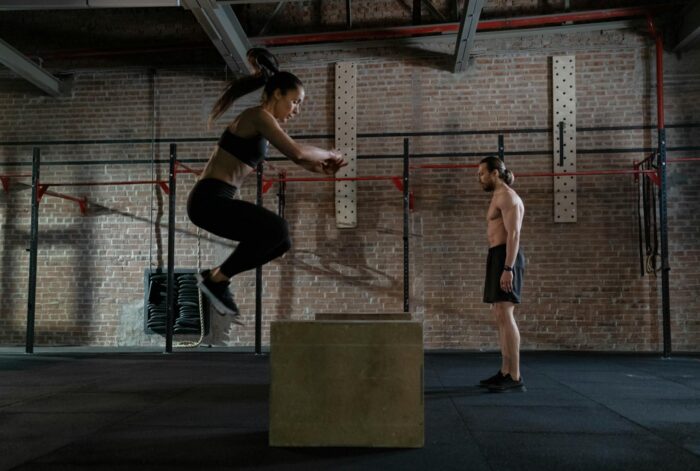
Plyometric training: the complete guide
Plyometric training is a system of jumping exercises designed to make muscles produce maximum strength in a very short time. Put simply: the muscle first lengthens rapidly (the eccentric phase) and then contracts powerfully (the concentric phase). This cycle develops explosive strength, jumping ability and sprint speed.
What is plyometric training and how does it work?
A muscle that has been stretched beforehand contracts far more forcefully and quickly (4, 5). The classic example is the vertical jump: when you drop your body quickly by bending your knees, the muscles involved in the jump are stretched and produce a more powerful movement in the contraction that follows. Why is that? Researchers explain it through two models.
The mechanical model
According to this model, abruptly stretching muscles and tendons generates elastic energy (6, 7, 8). If the stretch is followed immediately by a powerful concentric contraction, that energy is released and adds to the contraction. Hill (9) compared this to stretching a spring — a stretched spring wants to return to its original length.
The neurophysical model
When a muscle senses a rapid, abrupt maximal stretch, receptors respond. Tension rises in the muscle fibers, and the Golgi tendon organ, located at the junction where muscle becomes tendon, sends a signal. We perceive this as soreness or a feeling of discomfort — a warning against overstretching that helps prevent injury. At the same time, the stretch reflex activates the muscle even further, allowing the concentric contraction that follows to be considerably more powerful (10, 11, 12).
The practical takeaway is clear: if the contraction does not follow immediately after the stretch, the potential extra energy is wasted. Take a jump as an example — if there is too long a pause before you rise out of the squat, the bonus disappears. Plyometrics works through both mechanisms together when we use them deliberately.
The muscle stretch-shortening cycle
Every plyometric movement consists of three phases:
- Eccentric phase — the preceding stretch, during which elastic energy is stored.
- Amortization phase — the brief time between the end of the stretch and the start of the concentric contraction. The shorter this phase, the more powerful the contraction that follows.
- Concentric phase — the actual muscle contraction, for example the much-desired high vertical jump.
This three-component cycle is exactly what is called the stretch-shortening cycle, and it is the foundation of plyometric exercises (1).
Plyometric training and jumping ability
The easiest way to feel the effect of the stretch-shortening cycle for yourself is to do two vertical jumps in a row. On the first jump, lower into a half-squat position and hold it for 3–5 seconds before exploding straight up. On the second, do everything exactly the same way, but jump immediately after reaching maximum depth, with no pause. The second jump will be noticeably higher — you made use of the stored elastic energy.
Plyometric exercises are various jumps and combinations of jumps, performed continuously, that stimulate the elastic components of the muscle. Because plyometrics is used in many sports, the exercises you choose should closely resemble the movements of your own sport.
What does the science say?
Studies confirm that plyometrics improves performance in the long jump, sprinting, cycling sprints and various ball sports. You don’t need to train with enormous volumes to see results. Even 1–2 different plyometric exercises 1–3 times per week for 6–12 weeks improve motor performance (13, 14, 15, 16, 17, 18, 19). Typical volumes in the studies were 2–4 sets of ten repetitions (14, 16) or 4 sets of eight (15).
Upper-body plyometrics gets talked about less, but just three sessions of plyometric push-ups improved upper-body power, as measured by medicine ball throws (20). Depth jumps, bounces and other classic exercises undoubtedly add to motor performance (13, 22, 23, 24, 25, 26, 27, 28). Basketball and soccer players use plyometrics regularly in their training practice (16, 23, 28).
Plyometric training combined with strength training
If you include both plyometrics and strength training in your plan, you gain a lot of power. Jumping ability increases and sprint speed improves (13, 14, 29, 30, 31, 32, 33). Studies show that plyometrics and strength training together improve power more than either one alone (13, 29, 30, 33). However, a complete program has to be well thought out — doing both on the same day for the same muscle group is not recommended (3).
One way to structure the week:
| Day | Strength training | Plyometric training |
|---|---|---|
| Monday | Upper body (high intensity) | Lower body (low intensity) |
| Tuesday | Lower body (low intensity) | Upper body (high intensity) |
| Wednesday | Rest | Rest |
| Thursday | Upper body (low intensity) | Lower body (high intensity) |
| Friday | Lower body (high intensity) | Upper body (low intensity) |
Avoiding injury: plyometric training done safely
Coaches tend to believe that plyometrics carries a risk of serious injury. There is no confirmed evidence for this. Several researchers have explicitly noted that no injuries occurred among their subjects during the experiments (13, 33, 34). Some studies simply don’t report on injuries at all.
A common criterion is that an athlete should build a solid strength base before moving on to serious plyometrics — being able to squat 1.5–2 times their body weight (2, 3, 35). For upper-body plyometrics, the benchmark is a bench press of at least their body weight (3, 35).
It’s worth starting depth jumps low. Studies have shown that depth jumps from 50 cm improved jumping power to the same extent as jumps from 80 cm (13). The same result emerged from a comparison of 75 cm and 110 cm (31) and of 50 and 100 cm (16). There is no reason to jump from higher than 50 cm.
The landing surface matters a great deal in plyometrics. Ordinary grass, a rubber-coated floor or rubber mats are all suitable. Concrete, stone and hard wooden floors are definitely not suitable (35). Injuries occur mainly because of incorrect landing, an unsuitable landing surface or depth jumps performed from too great a height (1).
FAQ
How often should I do plyometric exercises?
1–3 times per week, with 1–2 different exercises per session. Give your muscles at least 48 hours of recovery before the next plyometric workout for the same muscle group.
Is plyometric training suitable for beginners?
Before high-intensity plyometrics, you should have a solid strength base — ideally a squat of 1.5–2 times your body weight. You can start earlier with low-intensity variations (jump rope, small bounces).
What surface should I do depth jumps on?
Use grass, rubber mats or a rubber-coated floor. Concrete, stone and hard wood increase the risk of knee and ankle injuries.
References
- Fleck SJ and Kraemer WJ. (2004) Designing Resistance Training Programs, 3rd Edition. Champaign, IL: Human Kinetics.
- Bompa TO. 1999 Periodization Training for Sports. Champaign, IL: Human Kinetics.
- Baechle TR and Earle RW. 2000 Essentials of Strength Training and Conditioning: 2nd Edition. Champaign, IL: Human Kinetics.
- Bosco C and Komi PV. (1980) Influence of countermovement amplitude in potentiation of muscular performance. Biomechanics VII proceeding (pp 129–135). Baltimore: University Park Press.
- Schmidtbleicher D. Training for power events. In Komi PV (ed) Strength and Power in Sport (pp 381–395). Oxford, UK: Blackwell Scientific.
- Asmussen E, Bonde-Petersen F. Storage of elastic energy in skeletal muscles in man. Acta Physiol Scand. 1974 Jul;91(3):385–92.
- Bosco C, Ito A, Komi PV, Luhtanen P, Rahkila P, Rusko H, Viitasalo JT. Neuromuscular function and mechanical efficiency of human leg extensor muscles during jumping exercises. Acta Physiol Scand. 1982 Apr;114(4):543–50.
- Hill AV. (1970) First and last experiments in muscle mechanics. Cambridge: University Press.
- Hill AV. (1970) First and last experiments in muscle mechanics. Cambridge: University Press.
- Guyton AC and Hall JE. (1995) Textbook of medical physiology, 9th ed. Philadelphia: Saunders.
- Bosco C, Viitasalo JT, Komi PV, Luhtanen P. Combined effect of elastic energy and myoelectrical potentiation during stretch-shortening cycle exercise. Acta Physiol Scand. 1982 Apr;114(4):557–65.
- Bosco C, Komi PV, Ito A. Prestretch potentiation of human skeletal muscle during ballistic movement. Acta Physiol Scand. 1981 Feb;111(2):135–40.
- Bartholomeu SA. Plyometrics and vertical jump training. University of North Carolina, Chapel Hill.
- Blackey JB, Southard D. The combined effects of weight training and plyometrics on dynamic leg strength and power. J Appl Sport Sci Res. 1987 1:14–16.
- Gehri DJ, Richard MD, Kleiner DM and Kirkendall DT. A comparison of plyometric training techniques for improving vertical jump ability and energy production. J Strength Cond Res. 1998 12:85–89.
- Matavulj D, Kukolj M, Ugarkovic D, Tihanyi J, Jaric S. Effects of plyometric training on jumping performance in junior basketball players. J Sports Med Phys Fitness. 2001 Jun;41(2):159–64.
- The effects of plyometric training on the vertical jump performance of adult female subjects. British J Sports Med. 1982 16:113–15.
- Scoles G. Depth Jumping! Does it really work? Athletic J. 1978 58:48–75.
- Steben RE, Steben AH. The validity of the stretch shortening cycle in selected jumping events. 1981 Mar;21(1):28–37.
- Comparison of dynamic push-up training and plyometric push-up training on upper-body power and strength. J Strength Cond Res. 14:248–53.
- Adams K, O’Shea JP, O’Shea KL and Climstein M. The effects of six weeks of squat, plyometric and squat-plyometric training on power production. J Appl Sport Sci Res. 1992 6:36–41.
- Bosco C and Pittera C. Zur trainings wirkung neuentwicker sprungubungen auf die explosivkraft. Leistungssport 12:36–39.
- Diallo O, Dore E, Duche P, Van Praagh E. Effects of plyometric training followed by a reduced training programme on physical performance in prepubescent soccer players. J Sports Med Phys Fitness. 2001 Sep;41(3):342–8.
- Fatouros IG, Jamurtas AZ, Leontsini D, Taxildaris K, Kostopoulos N and Buckenmyer P. Evaluation of plyometric exercise training, weight training and their combination on vertical jump performance and leg strength. J Strength Cond Res 14:470–476.
- Ford HT Jr, Puckett JR, Drummond JP, Sawyer K, Gantt K, Fussell C. Effects of three combinations of plyometric and weight training programs on selected physical fitness test items. Percept Mot Skills. 1983 Jun;56(3):919–22.
- Potteiger JA, Lockwood RH, Haub MD, Dolezal BA, Almuzaini KS, Schroeder JM and Zebras CJ. Muscle power and fiber characteristics following 8 weeks of plyometric training. 1999 13:275–79.
- Rimmer E, Sleivert G. Effects of plyometrics intervention program on sprint performance. J Strength Cond Res. 2000 14:295–301.
- Wagner DR, Kocak MS. A multivariate approach to assessing anaerobic power following a plyometric training program. J Strength Cond Res 11:251–255.
- Adams K, O’Shea JP, O’Shea KL and Climstein M. The effects of six weeks of squat, plyometric and squat-plyometric training on power production. J Appl Sport Sci Res. 1992 6:36–41.
- Bauer T, Thayer RE and Baras G. Comparison of training modalities for power development in the lower extremity. J Appl Sport Sci Res. 1990 4:115–121.
- Clutch D, Wilson C, McGown C, Bryce GR. The effect of depth jumps and weight training on leg strength and vertical jump. Research Quarterly. 1983 54:5–10.
- Hunter JP, Marshall RN. Effects of power and flexibility training on vertical jump technique. Med Sci Sports Exerc. 2002 Mar;34(3):478–86.
- Olhemus R, Burkhart E, Osina M, Patterson M. The effects of plyometric training with ankle and vest weights on conventional weight training programs for men and women. National Strength Coaches Association J 2:13–15.
- Blattner SE, Noble L. Relative effects of isokinetic and plyometric training on vertical jumping performance. Research Quarterly. 1979.
- National Strength and Conditioning Association. Position statement: Explosive/plyometric exercise. NSCA J. 1993 15(3):16.
Source: http://www.sport-fitness-advisor.com/plyometrics.html
Translated by: Janar Rückenberg
Come and train! ArtGym