
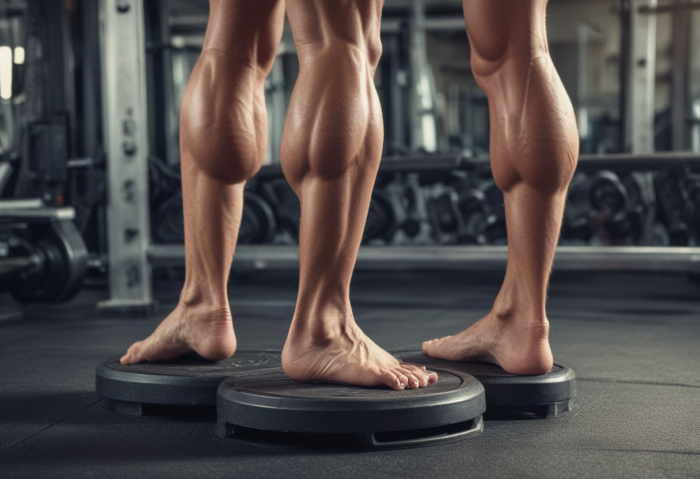
Calves not growing: 5 leg day mistakes
Calves can be the most stubborn muscle group of all: you train, you sweat, but nothing changes in the mirror. Most of the time the cause isn’t “bad genetics” but how you train them.
The good news is simple. Once you fix the order, rep range, weight and technique, your calves will start doing real work again.
Why do calves grow so stubbornly?
Your calf muscles get a lot of training load in everyday life. You walk, stand, climb stairs, rush to catch the bus and carry shopping bags. Your calves work in the background all the time. That’s why the usual “couple of sets at the end of a workout” may no longer give them much reason to get bigger and stronger.
The second problem is ego. On the calf machine it’s easy to load a heavy weight and bounce it up and down with a short movement. From the outside it looks like hard work. In reality, the Achilles tendon, momentum and a partial range of motion do much of the work. The muscle itself gets little tension.
Honestly, calf training is uncomfortable. It burns quickly, the reps feel long and your legs start to shake. That’s exactly why it’s often left to the end of leg day, when the squat, leg press and lunges have already drained your energy. Then you do something just to ease your conscience.
Calves at the start of your workout: order matters
1. You train calves at the end of your workout. Calves are usually done at the end of a leg workout. No other workout taxes you the way a leg workout does. Once you’re already tired, technique gets lazy and sets are left unfinished.
If you want to bring your calves up or prioritize them, start leg day with calf training. Do it when your nervous system is fresh and your focus is still there. That doesn’t mean your whole leg workout has to be turned upside down, but for at least a few weeks it’s worth putting the calf muscles first.
2. You train in the traditional rep range. Calves may not respond only to the same old 8–12 rep logic. The original recommendation was clear: try all rep ranges and shock your calves with sets of 25-30 reps.
That doesn’t mean every set has to be endless suffering. Some days, work heavier with a lower rep count. Another day, do longer sets where you feel the burn and keep the movement clean to the end. Variety gives your calves a new stimulus.
How do you actually get your calves working?
3. You use too much weight. In the gym you often see wild bouncing during calf training. If you can’t keep your calves locked in while up on your toes, the weight is too heavy for you. Simple truth: a lighter, controlled weight gives you more than a nice number on the weight stack.
Every rep should be well defined. At the bottom, really let your heel drop to get a stretch. At the top, rise as high as you can and hold briefly. Then lower slowly. If that sounds too easy, try it without bouncing. You’ll feel the difference right away.
4. Play with your foot position. Turn your toes out. Turn your toes in. Keep your toes straight. That way you can be sure you’re hitting every angle of the calf muscle.
Don’t turn it into complicated science. Pick one position and finish the set properly. In the next set, change the direction of your toes. If your knees or ankles signal a problem, go easier and stay in the position that feels natural.
5. You don’t isolate enough. As with any other muscle group, you get the maximum benefit when the execution consists of three phases: maximum stretch, maximum contraction and a slow negative. Pick the right weight and perform the exercise as cleanly as you possibly can.
Calves and practical training tips
Give calf exercises the same attention you give your chest, back or squat. Write down what weight you used, how many reps you did and whether the movement was clean. If you don’t track your progress, it’s very easy to do the same workout month after month and expect a different result.
A good start is to pick two exercises: one with straight legs and one with a bent knee. That way you can put training load on different parts of the calf. Do both unhurriedly. Don’t rush through a set just to move on to the next machine.
So what actually happens? When the tempo slows down, the weight drops and the range of motion improves, your calves start doing the work they used to dodge. The workout gets harder even though there may be less weight on the machine. That’s a good sign.
In the end, consistency is what counts. Calves won’t change in a week, but they do respond to a clear plan. Train them deliberately, change the rep range from time to time and keep your technique honest. When it burns, don’t run away right away. That’s exactly where the work begins.
FAQ: calves and growth
Why aren’t my calves growing even though I train them every week?
Often the cause is a movement that’s too short, a weight that’s too heavy, or training calves while tired at the end of your workout. Try starting leg day with calves and keep every rep under control.
Are 25-30 reps better for calves than heavy sets?
Both have their place. Long sets of 25-30 reps give a different kind of training load, but heavier sets can be useful too. The best approach is to vary the rep ranges.
How often should you train calves?
Start by training them deliberately and with clean technique. If your recovery is in order, you can give your calves more attention, but don’t turn every set into a contest of momentum and bouncing.
Author:Turg.Fitness.ee
Come and work out! ArtGym




