
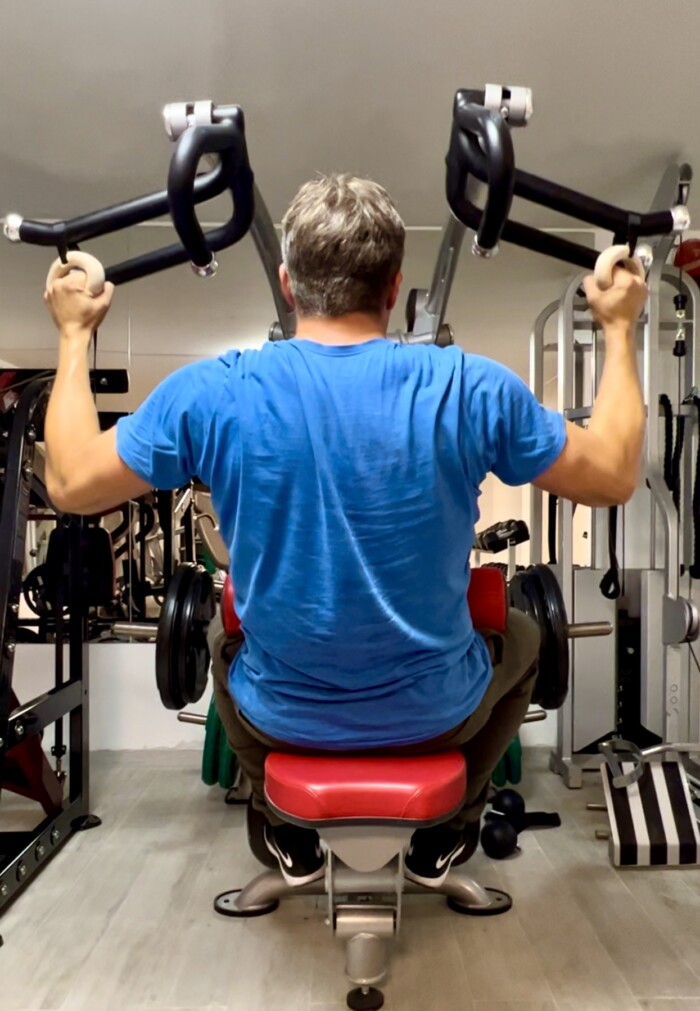
Advanced training methods come into play when the standard 3 x 10 no longer moves either the weight or the reflection in the mirror. Here you’ll get a clear overview of techniques that make your training harder in a smarter way, without turning every set into an ego battle.
Why do advanced training methods matter?
If you’ve been going to the gym for a while, you’ll recognize this moment. At first, you added weight to the barbell almost every week. Then progress stalled. Same plan, same pace, same feeling.
Advanced training methods aren’t a magic trick. They’re ways of changing the training load, the length of the effort or how the muscle does its work. The idea is simple: give your body a new reason to adapt. But it has to be done in moderation. If you put forced reps, negative reps and drop sets into every workout, it’s no longer smart training. It’s just racking up recovery debt.
A good rule: pick one to two methods at a time and use them with a clear goal. For example, heavy and light days suit strength development, isolation exercises suit building a feel for the muscle, and the drop set method suits a short, intense period.
Advanced training methods in practice
Heavy and light days (Heavy and Light Days) mean you don’t train with the same weight and rep count all the time. On a heavy day, you might do 3–5 reps with a heavier weight. On a light day, you choose a lower training load and work up to 12–15 reps. That gives your body a strong stimulus, but your nervous system doesn’t have to run in the red every workout.
Forced reps (Forced Reps) only make sense if you have a reliable training partner. They help you get one or two more reps after your last unassisted rep. Honestly, this method is often overused. If your technique breaks down even before the help arrives, the set is over.
Partial reps (Partial Reps) can help you get past a sticking point in the range of motion. In a press, for example, you work through a shorter range. That doesn’t mean the full range of motion is suddenly bad. On the contrary: the full range stays the foundation, and partial reps are just an extra tool.
Isolation exercises (Isolation Exercises) focus on a single muscle. Calf extensions, dumbbell flyes or biceps work on a Scott bench help you hit a weak spot more precisely. They don’t replace squats, rows and presses, but they help where a big exercise alone doesn’t give you enough feel for the muscle.
Tensing muscles without weights (Isotension) is deliberate tensing and relaxing. In bodybuilding, it’s used to improve stage form and muscle control. For the average lifter, it can be a good way to learn whether your chest, back or glutes are actually working the way you intended.
When should you use advanced techniques?
Negative reps (Negative Reps) put the emphasis on lowering the weight slowly. This is a heavy training load for the muscle, so use it as a short block, not at the end of every exercise. Be especially careful with the bench press, pull-ups and heavy leg movements.
Cheating (Cheating Reps) means using a bit of body momentum to get past a sticking point. In a biceps curl, for example, your hips or upper body come to the rescue. It’s not an excuse for sloppy technique. It’s better thought of as one extra rep at the end of a set, not the style of the whole set.
Heavy Duty is a low-volume, very-high-effort approach. It can work for a short time, especially if you’re honest about your recovery. So what actually happens? Intensity goes up, but the margin for error shrinks. Sleep, food and rest have to keep pace.
Staggered sets (Staggered Sets) suit extra work for a weaker muscle group. If your calves are lagging, you can do one calf set in between other exercises. The same logic works for abs, forearms or rear delts. Don’t turn it into a hidden extra workout that stretches your whole plan to half again its length.
Supersets (Supersets) mean doing two exercises back to back with almost no rest. You can pair exercises for the same muscle group, such as flyes and a press, or opposing muscles, such as pull-ups and the bench press. A superset keeps your heart rate up and makes your workout more time-efficient.
The drop set method (Drop Sets) works well on machines and with dumbbells. You take a set almost all the way, reduce the weight and carry on right away. Two drops are usually enough. More doesn’t always mean better; sometimes it simply means your next workout suffers.
The you-go-I-go method (You Go, I Go) works well with a training partner. One of you does a set and the other goes straight after. Rest stays short and the pace stays high. It’s fun, but choose exercises where your technique doesn’t become dangerous when you’re tired.
Practical options and warning signs
Start with the simplest question: is your basic plan still working? If your weights, reps or form quality are still moving up, there’s no need to overcomplicate things. An advanced trainee doesn’t use a special technique because it sounds cool. They use it when the reason is clear.
In spring and summer motivation tends to rise, because your physique is more on show. In winter, recovery is often harder, especially when sleep and daylight suffer. Take that into account. If your joints ache, your heart rate is higher than usual and your warm-up sets feel heavy, skip the intensity technique for that day.
A simple truth: one well-chosen extra technique gives you more than five at once. Put it at the end of your plan, not in every set. Write down what you did and check after two to three weeks whether it helped.
FAQ: advanced training methods
Can a beginner try these methods?
Yes, but rarely and in a simple form. Your basic technique should be solid first, and you should have followed a regular training plan consistently for at least several months.
How often should you do drop sets?
Usually one exercise per muscle group is enough, and not in every workout. If your recovery gets worse or your strength drops, you’re doing too many.
Are forced reps necessary for muscle growth?
They aren’t necessary, but they can help in some training blocks. They only work when your partner gives minimal assistance and your technique stays under control.
Come and train! ArtGym




