
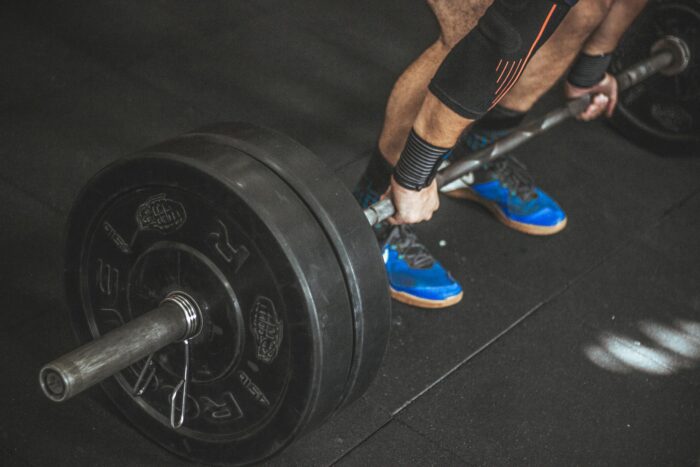
Deadlift: which style suits you?
The deadlift looks simple: lift the barbell off the floor and stand up straight. In reality, much depends on your build, arm length, hip mobility, and whether you choose a conventional or sumo stance.
Why does everyone’s deadlift look different?
One person deadlifts with a narrow stance and their back naturally stays in a strong position. Another tries the same stance and immediately feels uncomfortable tension in their lower back. That doesn’t automatically mean the exercise is bad or that they’re doing everything wrong. Often, the reason is simpler: people have different body proportions.
The conventional deadlift places greater emphasis on the back as a whole, particularly the spinal erectors. If you have a strong lower back, good hip mobility, and relatively long arms, this style may feel natural. The sumo deadlift shifts more of the training load onto the glutes, biceps femoris, quadriceps, hips, and upper traps. If your lower back is easily aggravated, a sumo stance may be worth trying.
The simple truth is that the best style isn’t the one that gets the most praise online. It’s the one that lets you move the barbell powerfully, with control and without pain.
Conventional or sumo deadlift?
For a conventional deadlift, you stand in front of the barbell with a narrower stance. Your feet usually point fairly straight ahead or turn slightly outward. The barbell travels farther from start to finish than in a sumo deadlift. This means a greater range of motion and often more work for your back.
The sumo deadlift starts with a wider stance. The barbell has a shorter distance to travel because your hips are closer to it and your torso is more upright. In theory, a wider stance may allow you to lift a heavier personal best, but only if your hips and knees can accommodate that position. An excessively wide stance can be uncomfortable for your hips, and getting used to it takes time.
In a sumo stance, your feet should generally point along an imaginary straight line running through the middle of each thigh. If your feet are awkwardly positioned and your knees move in a different direction, unwanted stress on your knees increases and your pulling strength decreases.
When should you switch styles?
Switching styles doesn’t always mean an immediate improvement. Even if the new variation suits your body type better, weaknesses may show up first. Experienced deadlifters who have trained exclusively in one style for years may temporarily see a drop in their maximum lift when they switch.
If you’ve always used one style and want to try the other, don’t abandon your existing style straight away. Train both at least until the new stance feels familiar. Trying both is especially sensible if you’re a beginner, as your body will tell you over time which style feels more natural.
How do you choose a deadlift style based on torso length?
Dr. Michael Hales wrote in “Strength and Conditioning Journal” about how the lengths of different body segments affect which deadlift style suits you. This isn’t a complicated laboratory test. All you need is a tape measure and a training partner to help you take accurate measurements.
- Step 1 – measure your torso length from the upper, outer part of the femoral neck, called the Greater Trochanter in English, to the top of your head. Measure vertically to the top of your head, not at an angle.
- Step 2 – measure your arm length from the bony prominence on your shoulder to the tip of your middle finger. Keep your arm straight while measuring.
- Step 3 – measure your full height. Don’t estimate it, as a small error will change the ratios.
To assess your torso length, divide your torso length in inches by your total height in inches. If the resulting ratio is less than 47%, you have a short torso. If the resulting ratio is greater than 47%, you have a long torso.
To assess your arm length, divide your arm length in inches by your total height in inches. If the resulting ratio is less than 38%, you have short arms. If the resulting ratio is greater than 38%, you have long arms.
A practical guide to choosing your deadlift style
Once you have your measurements, you can make an initial, practical choice. This isn’t a final verdict, but it gives you a useful starting point.
- Short arms and a short torso – both conventional and sumo styles may suit you.
- Short arms and an average-length torso – try sumo first.
- Short arms and a long torso – sumo is usually a better starting point.
- Average-length arms and a short torso – conventional may feel more natural.
- Average-length arms and an average-length torso – both conventional and sumo styles may suit you.
- Average-length arms and a long torso – sumo is worth trying.
- Long arms and a short torso – conventional is often a strong choice.
- Long arms and an average-length torso – conventional is usually a good fit.
- Long arms and a long torso – both conventional and sumo styles may suit you.
When a beginner’s conventional deadlift technique starts to break down, the movement sometimes turns into a Romanian deadlift without them noticing. In that case, practicing sumo deadlifts for a while can help you better understand how your hips and back should work together.
It is worth using a range of stance widths in your accessory work. If the sumo deadlift is your main style, good mornings, box squats and Romanian deadlifts with different stance widths can be useful. The aim is not just to yank the barbell off the floor, but to develop a deadlift technique that holds up even at the end of a heavier set.
FAQ: deadlifts and choosing your technique
Is the sumo deadlift easier than the conventional deadlift?
Not necessarily. The barbell travels a shorter distance, but the stance places different strength demands on your hips and thighs and takes some getting used to. Some people take to it straight away; others find it does not suit them at all.
Should beginners train both styles?
Yes, as long as you can maintain control of your technique. Trying both helps you work out whether your body prefers a narrower or wider stance.
Do you have to give up deadlifts if you have a bad lower back?
Not automatically, but you should not stubbornly push through pain. The sumo style may suit some people’s lower backs better, but your technique and training load need to be sensible.
This article is based on the source available HERE.
Author: Janar Rückenberg (translation)
Come and train! ArtGym




