Cable crossovers and three ideas from gym veterans
The cable crossover is an exercise you often see in the gym too early and with too much expected of it. Here are three old-school ideas on chest training, grip and feeling the muscle work, built around Lee Priest, Markus Rühl and Faramarz Aghazadeh.
Why cable crossovers often don’t suit beginners
Lee Priest noticed something simple: personal trainers would sometimes recommend that a complete beginner do cable crossovers between the pulleys. On paper it seems logical. The exercise looks good, the chest moves, the cables give even tension, and in the mirror it feels like something is happening.
But his point was different. The cable crossover is more of a shaping and feel exercise, not the first tool for building chest muscle. If there isn’t much chest muscle yet, what exactly are you sculpting?
A beginner usually gains more from a simple base: presses, flyes, solid technique and consistent progressive overload. These build the foundation. Only later, once the chest has some mass, does the cable crossover become a better helper for detail, stretch and pump.
Priest himself used cable crossovers mainly before a competition. Outside competition prep, they suited him more as a warm-up, to stretch the chest and fill the muscle with blood. That’s a useful distinction: one kind of exercise does the heavy lifting of the build, while another helps you feel what’s already there better.
How to make cable crossovers work in chest training
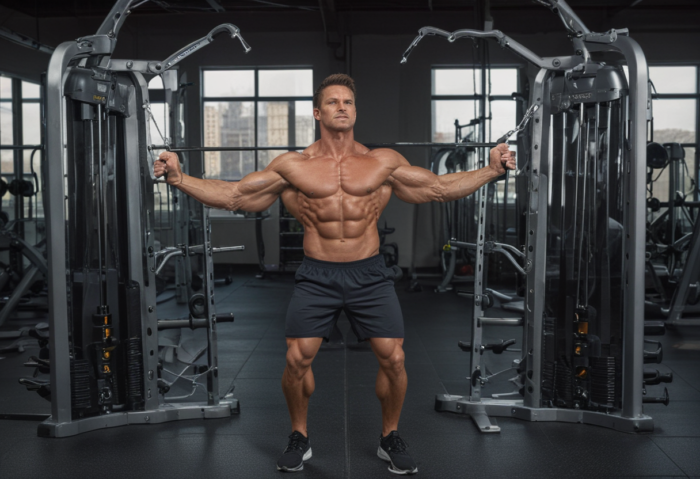
If you do cable crossovers, do them with purpose. Don’t just pull the handles together and hope your chest gets the message. Priest suggested picturing a most muscular pose, specifically the front-facing traps pose. That image helps you bring the chest together at the end of the movement instead of just pushing your arms forward.
A simple truth: the cable crossover is not an ego exercise. If the weight is too heavy, your shoulders roll forward, your elbows move the wrong way and the chest drops out of the work. It may feel like the training load is heavy, but the target muscle may not get the work you came for.
It’s better to keep the movement under control. Open your chest, let your arms travel back a moderate distance, feel the stretch and bring your arms forward with your focus staying on the pecs. If your training day is built around heavy presses, the cable crossover can go at the end of the session. If the goal is to feel your chest before the main work, you can use it as a calm warm-up movement.
Wide grip and the bench press
Markus Rühl talked about a very wide grip on the bench press. He gripped the bar as wide as he could, so that his little finger touched the plates. For him, this put more load on the chest and less on the shoulders and triceps.
Keep a cool head here. Rühl himself said it isn’t the best solution for everyone. He had very wide shoulders, and his build allowed him to use that grip. If an average lifter copies it blindly, the result may be an uncomfortable shoulder or lost pressing strength.
Your grip should suit your shoulders, wrists and chest. If a wide grip gets your chest working better and the movement stays under control, it can be a useful option. But if your shoulder complains or the bar path feels unstable, there’s no point in stubbornly carrying on. In the gym, the winner isn’t the one who copies the most famous name, but the one who finds what works for their own body.
Cable crossovers, feel and training with intent
Faramarz Aghazadeh brought in a completely different angle: lots of repetitions and feeling the muscle. He didn’t believe in heavy weights if they take away contact with the muscle. For him, every exercise was like meditation.
That doesn’t mean weights are bad. Weight is necessary if you want to get stronger and build muscle. The question is whether the weight serves the goal or runs the whole training session. If you feel only the bar, the cables or the stack, but not the chest, something is off.
Honestly, this is the biggest stumbling block for many recreational lifters. You finish the exercise, log the set, but the muscle doesn’t really get worked. The connection between mind and muscle doesn’t have to be mystical. It means a calmer tempo, a better position and attention to where the tension actually is.
In chest training, these three ideas fit together well. Build the foundation with basic exercises. Choose a grip that suits your body. Add cable crossovers when they genuinely add something: a better stretch, a stronger feel or a final muscle pump at the end of the workout.
FAQ
Do cable crossovers build chest muscle?
Yes, they can help, but for a beginner they usually aren’t the main exercise. A more reliable foundation for building chest muscle is presses, flyes and consistent technique.
When should I do cable crossovers in a workout?
Usually they fit at the end of the workout, once the main work is done. In some cases you can also use them as a warm-up, to get the chest working better before presses.
Does a very wide grip suit everyone?
Not necessarily. Markus Rühl used a very wide grip because it suited his body. Your grip should feel secure for your shoulders and let your chest do the work.
Author: joker
Source: WHO – physical activity.
Come and train! ArtGym